
 Worksheets
Economics - Chapter 5 - Quiz
Total questions: 25
Worksheet time: 45mins
Amount that producers bring to the market at any given time
quantity supplied
supply curve
quantity demanded
production
Which of these best describes the influence of high prices on the behavior of producers?
They have no significant overall effect on producer behavior.
They are an incentive for producers to produce more.
They are an incentive for producers to buy less.
They encourage producers to modify their supply schedules.
Tendency of suppliers to offer more of a good at a higher price
Law of Demand
Law of Supply
Market Supply Curve
Supply Schedule
A chart that lists how much of a good all suppliers will offer at different prices
Law of Supply
Market Supply Curve
Market Demand Schedule
Market Supply Schedule
A chart that lists how much of a good a supplier will offer at different prices
Supply
Market Supply Curve
Supply Curve
Supply Schedule

According to this supply curve, how many units will be produced at $20 per unit?
10
110
20
180

How many hours of babysitting is Jane willing to provide at $10/hour?
28
35
38
39.25
Cost of producing one more unit
total cost (TC)
marginal cost (mc)
fixed cost
variable cost
Which of the following is an example of a fixed cost?
Raw materials
Electricity
Rent
workers that get paid by the hour
The amount of money a business earns from selling one more unit:
Marginal cost
Marginal revenue
Marginal product
Total output
Occurs when you continue to add one factor of production and you get a lower and lower ratio of additional output. (Example, as you hire additional workers, each additional worker produces less output that the previously hired one.)
Marginal returns
Diminishing returns
Negative returns
Positive returns
What type of business owner typcially gets a subsidy from the government?
Bankers
Tech giants
Farmers
Private schools

A tax included in the price.
Property tax
income tax
excise tax
sales tax
____ is the main source of revenue for the Government.
Salary
Tax
Loans
Grants
According to the Law of Demand, when prices drop...
demand will also drop
demand will increase
quantity demanded is unchanged
supply increases

When the price of a product increases, a consumer is able to buy less of it. Which effect does this describe?
Cost Effect
Inflationary Effect
Income Effect
Substitution Effect
Economy where the government own some of the factors of production

What does the GDP measure in terms of production?
Only the services produced within a country
Only the goods produced within a country
All of the "stuff" produced within a country
The total number of companies within a country
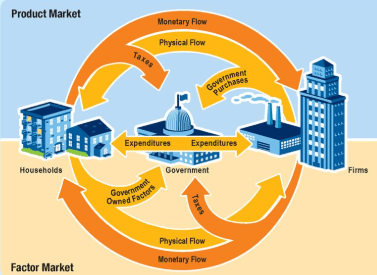
This circular flow model would be for a __________ economy
Traditional
Planned/Command
Free Market
Mixed Economy

This guy is called the father of economics and he literally wrote the book on capitalism
Karl Marx
Tom Brady
Kanye West
Adam Smith
Which animal is the symbol of the Democrats?


Who are the 2 candidates running for the 2024 election?


The ___ says that the price of a product is determined by the relationship of the supply of a product and the demand for the product.
standard of living
trade-off
systematic decision-making process
law of supply & demand

