
 Worksheets
Colonies/French and Indian War Review for Test
Total questions: 15
Worksheet time: 8mins
Name
Class
Date
1.

According to the theory of mercantilism, colonies were important to a nation's economy because:
a)
Colonies provided natural resources that benefited the mother country.
b)
Colonies were used as places to send prisoners.
c)
Colonies were encouraged to import more goods than they exported.
d)
Colonies were independent with little influence from the mother country.
2.
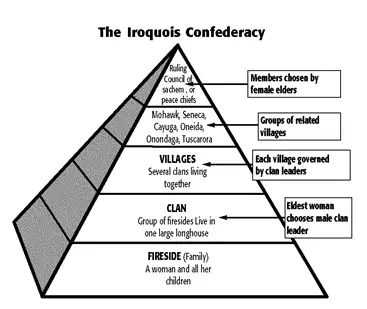
The Iroquois Confederacy can be described as all of the following except:
a)
A system that contains elements of matriarchal authority
b)
A confederacy where all tribes have equal representation
c)
A highly sophisticated and organized system of government
d)
A government ruled entirely by male leaders without input from others
3.
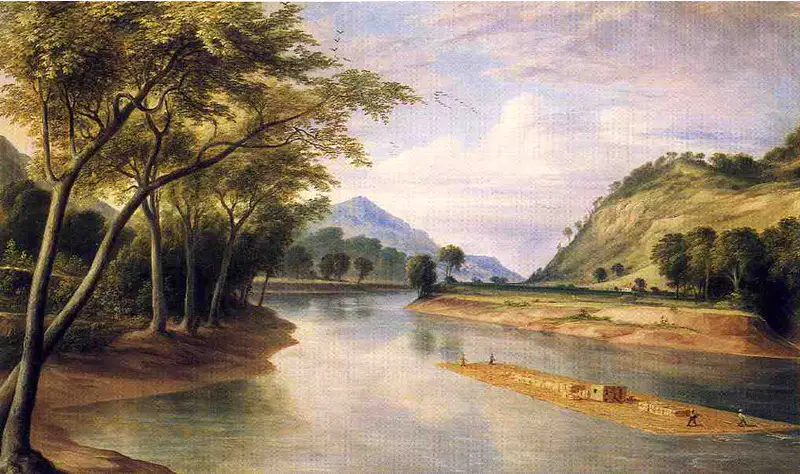
This image shows a scene from the Ohio River Valley, a region that became a point of conflict between the French and British during the 18th century. Why was the Ohio River Valley so important to both the French and British?
a)
It had rich deposits of gold and silver.
b)
It was home to fertile soil and valuable natural resources for farming and trade.
c)
It was home to large cities vital to both empires' control over North America.
d)
It was the site of many major fortifications used during the American Revolution.
4.

Which of the following best compares French and British relations with Native Americans?
a)
The French had conflicts with Native Americans over land, while the British avoided interacting with them entirely.
b)
The French formed alliances and often married Native American women, whereas the British had frequent conflicts over land and were more confrontational.
c)
The French forced Native Americans to convert to Protestantism, while the British formed alliances and cooperated with them.
d)
The French and British both avoided interacting with Native Americans, focusing instead on their own economic pursuits.
5.

How did the colonists change the meaning of "Yankee Doodle" during the French and Indian War?
a)
They transformed it from a song meant to ridicule them into a patriotic anthem celebrating their resilience and identity.
b)
They used it purely as a marching song to boost troop morale without altering its original intent.
c)
They adapted the lyrics to mock British troops instead of celebrating American pride.
d)
They focused on using the song solely for entertainment purposes during military events.
6.
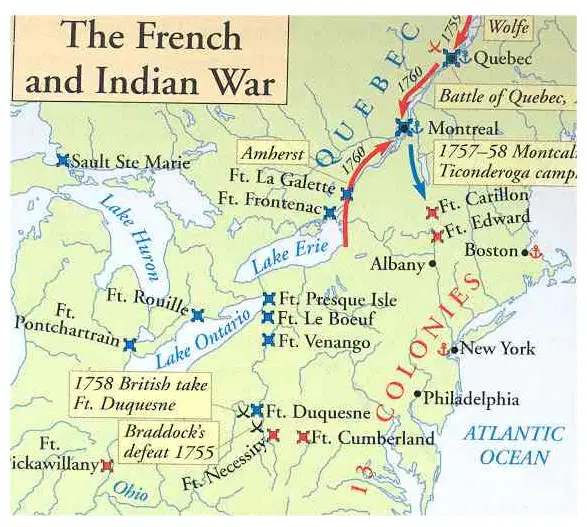
Why were forts and battles during the French and Indian War commonly located along major rivers and lakes?
a)
Major rivers and lakes provided essential transportation routes and supplies, making them strategic for controlling territory and facilitating movement.
b)
Rivers and lakes were primarily chosen for their scenic beauty, which was believed to boost morale among troops.
c)
The locations were selected to avoid engagement with enemy forces, as rivers and lakes were considered natural barriers.
d)
Forts and battles were concentrated in these areas to avoid the harsh terrain of mountainous and forested regions.
7.

According to the passage, what was one result of the French and Indian War?
a)
It decreased the importance of North America to European politics.
b)
It showed that North America was becoming more important to European politics
c)
It remained confined to North America without spreading to other regions.
d)
It caused France to gain control of Pennsylvania.
8.

What failed plan was Franklin referencing in this quote?
a)
Albany Plan of Union
b)
US Constitution
c)
Declaration of Independence
d)
Treaty of Paris
9.
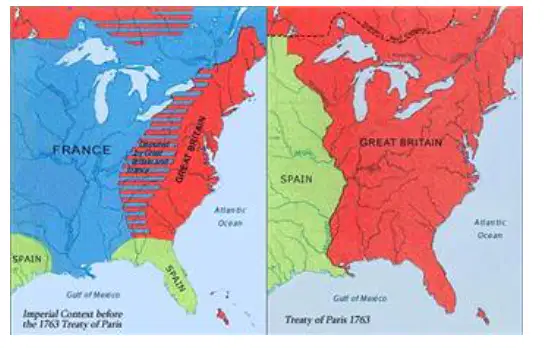
What was a major result of the 1763 Treaty of Paris, as shown in the maps?
a)
France gained control over most of North America.
b)
Spain lost all of its North American territories
c)
Great Britain expanded its control over much of North America
d)
France retained its territory east of the Mississippi River
10.

According to Chief Pontiac, who gave his ancestors their inheritances from the lakes, woods, and mountains?
a)
the French
b)
the Great Spirit
c)
the Iroquois Confederacy
d)
the Treaty of Paris
11.

What is the main complaint of the Massachusetts soldier in his diary entry about the French and Indian War?
a)
He was upset about being treated like a slave under martial law
b)
He was frustrated by a lack of food
c)
He was unhappy about the cold weather
d)
He was dissatisfied with the organization of his regiment
12.
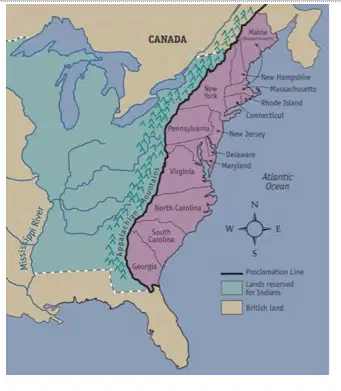
Which of the following natural features formed the western boundary for the colonies under the Proclamation of 1763?
a)
Appalachian mountains
b)
Mississippi River
c)
Gulf of Mexico
d)
Atlantic Ocean
13.

What is the main message of Rev. Thomas Barnard’s sermon in 1763?
a)
Britain should continue its fight against France and other enemies
b)
The end of the war marks the beginning of peace and liberty for the colonies
c)
New England has suffered greatly and must seek independence from Britain
d)
The colonies are destined to become independent from Britain
14.

The hit-and-run fighting tactics used by the combined French and Native forces is known as:
a)
scorched earth
b)
blitzkrieg
c)
line formation
d)
guerrilla warfare
15.
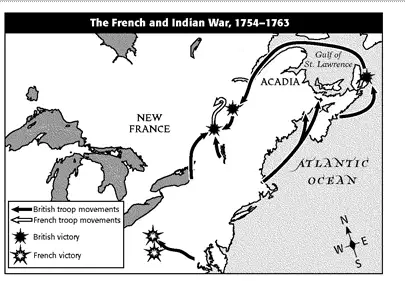
Based on the map of the French and Indian War, which of the following statements is true?
a)
The British won battles in the North
b)
The British never lost a battle
c)
The French won every battle
d)
The French won battles in the East
100 %

