
 Worksheets
A&P Review: Cellular Metabolism
Total questions: 67
Worksheet time: 39mins
The overall function of metabolism is to:
Break down nutrients to release energy
Store energy in the form of fat
Convert energy into nutrients
Eliminate waste products from the body
Anabolism and catabolism are two types of metabolic processes. Which of the following statements correctly describes their relationship?
Anabolism builds up molecules, while catabolism breaks down molecules.
Anabolism and catabolism both build up molecules.
Anabolism breaks down molecules, while catabolism builds up molecules.
Anabolism and catabolism both break down molecules.
Enzymes control metabolic reactions by:
Increasing the temperature of the reaction
Lowering the activation energy required
Changing the pH of the environment
Providing energy for the reaction
A metabolic pathway is best described as:
A series of chemical reactions in a cell
A single chemical reaction in a cell
A type of cell organelle
A genetic sequence
Identify the source of biological energy.
Glucose
Oxygen
Carbon Dioxide
Water
Energy in the form of ATP becomes available for cellular activities through which process?
Photosynthesis
Cellular respiration
Fermentation
Glycolysis
Cellular respiration releases chemical energy by:
Breaking down glucose in the presence of oxygen
Converting sunlight into chemical energy
Absorbing nutrients from the soil
Utilizing carbon dioxide and water
DNA molecules store genetic information by:
Encoding it in the sequence of nucleotides
Storing it in the cell membrane
Using proteins to carry information
Embedding it in the cytoplasm
DNA molecules are replicated through which process?
Transcription
Translation
Replication
Mutation
Which of the following describes the steps of protein synthesis?
Transcription and translation
Replication and transcription
Translation and replication
Mitosis and meiosis
The proteins that control the reactions of metabolism are
amino acids.
catalysts.
enzymes.
substrates.
The metabolic process that synthesizes materials needed for cellular growth and requires energy is called _______________.
anabolism
catabolism
metabolism
glycolysis
The metabolic process that breaks down complex molecules into simpler ones and releases energy is called _______________.
catabolism
anabolism
photosynthesis
glycolysis
Glycerol and fatty acids become bonded to form water and
cholesterol.
lard.
fat molecules.
wax.
Amino acid molecules are joined by peptide bonds to form water and _______________.
the resulting protein strand.
a carbohydrate molecule.
a lipid molecule.
a nucleic acid strand.
A substance that decreases the amount of energy necessary to begin a chemical reaction is a(n) _______________.
inhibitor
reactant
catalyst
product
Enzymes are composed of
lipids.
carbohydrates.
proteins.
inorganic salts.
An enzyme acts only on a particular substance that is called a
binding site.
substrate.
complement.
histologue.
An enzyme's ability to recognize the substance upon which it will act seems to be based on
atomic weight.
molecular shape.
structural formula.
number of hydrogens.
The suffix that identifies a substance as an enzyme is _______________.
ase
ose
ine
ate
The ability of an enzyme to recognize its specific substrate is dependent upon its _______________ or _______________.
structure; shape
color; size
temperature; pH
location; concentration
The speed of an enzyme-controlled reaction depends upon the number of _______________ and _______________ molecules present.
substrate and enzyme
water and oxygen
glucose and ATP
carbon dioxide and nitrogen
A substance needed to convert an inactive form of an enzyme to an active form is called a(n) _______________.
cofactor or coenzyme
substrate
inhibitor
catalyst
The form of energy utilized by most cellular processes is
chemical.
electrical.
thermal.
mechanical.
The process by which energy is released in the cell is called _______________.
photosynthesis
fermentation
cellular respiration
glycolysis
The initial phase of respiration that occurs in the cytosol and produces two 3-carbon pyruvic acid molecules plus energy is called _______________ or _______________.
glycolysis, anaerobic respiration
anaerobic respiration, citric acid cycle
photosynthesis, aerobic respiration
fermentation, condensation
The second phase of respiration that occurs in the mitochondria and produces carbon dioxide, water, and energy is called _______________.
Glycolysis
Electron Transport Chain
Krebs cycle
Fermentation
What element is needed for this second phase of respiration to take place?
Carbon
Oxygen
Hydrogen
Nitrogen
Name the molecule synthesized by the energy released during cellular respiration.
Glucose
ATP
NADH
Oxygen
A molecule consisting of a double spiral with sugar and phosphates forming the outer strands and organic bases joining the two strands is _______________.
DNA
RNA
Protein
Lipid
List the four organic bases of DNA nucleotides.
Adenine, Thymine, Cytosine, Guanine
Adenine, Uracil, Cytosine, Guanine
Adenine, Thymine, Cytosine, Uracil
Adenine, Guanine, Cytosine, Uracil
DNA molecules are located in the _______________. Protein synthesis takes place in the _______________.
nucleus; cytoplasm
cytoplasm; mitochondria
ribosomes; nucleus
mitochondria; cytoplasm
Two types of RNA are _______________ RNA and _______________ RNA.
mRNA and tRNA
rRNA and sRNA
cRNA and dRNA
xRNA and yRNA
In a molecule of RNA, the thymine nucleotide of DNA is replaced by _________________.
uracil
adenine
cytosine
guanine
The function of RNA is to:
form lipids, such as cholesterol.
guide the breakdown of polysaccharides.
control the bonding of amino acids.
provide energy for the cell.
When the genetic material of a cell is altered, the result may be a(n) _________________?
mutation
replication
transcription
translation
Translation involves
DNA
messenger RNA
ribosomes
transfer RNA
The process of forming a messenger RNA from a DNA strand is called _________________.
transcription
translation
replication
mutation
When a gene has been transcribed and translated into a protein, it is said to be _________________.
expressed
mutated
replicated
silenced
Define the following word part: an-
Without
With
Above
Below
Define the following word part: ana-
Up, back, again
Down, away, from
Around, about
Within, inside
Define the following word part: cata-
Down, against
Above, over
Between, among
Around, about
Define the following word part: mut-
Change
Same
Move
Stop
Define the following word part: -zym
A type of enzyme
A type of cell
A type of protein
A type of carbohydrate
Life is maintained by a series of ________________ reactions. ________________ is required to “fuel” all of this activity.
biochemical; energy
chemical; oxygen
physical; water
mechanical; heat
Enzymes promote chemical reactions in cells by ____________________ the amount of ____________________ needed to initiate a reaction.
decreasing; energy
increasing; time
decreasing; temperature
altering; pressure
What is the relationship between an enzyme and a substrate?
An enzyme is a type of substrate.
An enzyme binds to a substrate to catalyze a reaction.
A substrate inhibits the function of an enzyme.
A substrate is a type of enzyme.
Select the agents that can denature enzymes.
Heat
Cold
extreme pH changes
Light
Energy is the ability to do what?
Perform work
Create matter
Generate time
Produce space
What are the 6 common forms of energy?
The form of energy used by cell processes is (a) .
The energy for metabolic reactions is used to synthesize ____________ and some of the energy is lost as __________.
ATP; heat
glucose; light
proteins; sound
lipids; motion
What is a gene?
A specific segment of DNA w/ instructions to make a particular protein
A type of cell
A kind of protein
A form of energy
Genes are necessary to cell metabolism because they:
Provide the instructions for protein synthesis
Store energy for cellular processes
Transport nutrients across the cell membrane
Regulate the cell's water balance
What is the genome?
The genome is the complete set of DNA, including all of its genes
The genome is the part of the DNA that consists of exons
The genome is the part of the DNA that makes a protein
The genome is the part of the DNA that consists of introns
The structure of DNA is best described as:
A double helix
A single strand
A triple helix
A quadruple strand
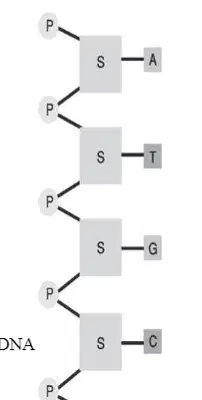
Utilizing what you know about complementary base pairing, select the matching strand of DNA for the strand illustrated here.
A-T-C-G
T-A-C-G
G-C-T-A
C-G-A-T
The genetic code is:
A set of rules by which information encoded in genetic material is translated into proteins.
A sequence of DNA that codes for a specific trait.
The process by which cells divide and replicate.
A type of genetic mutation.
Which is true about how RNA differs from DNA?
RNA contains ribose sugar, while DNA contains deoxyribose sugar.
RNA is double-stranded, while DNA is single-stranded.
RNA contains thymine, while DNA contains uracil.
RNA is more stable than DNA.
What happens in transcription?
DNA is replicated.
RNA is synthesized from a DNA template.
Proteins are synthesized from RNA.
RNA is converted into DNA.
What molecules are required for transcription?
DNA and RNA polymerase
Ribosomes and tRNA
mRNA and ribosomes
DNA ligase and helicase
Codons are sequences of how many nucleotides?
Two
Three
Four
Five
What molecules are required for translation?
DNA, RNA, and ribosomes
mRNA, tRNA, and ribosomes
Proteins, lipids, and carbohydrates
Nucleotides, enzymes, and vitamins
Where does translation occur?
In the nucleus
In the ribosome
In the mitochondria
In the Golgi apparatus
What is the role of the proteasome?
To synthesize proteins
To degrade unneeded or damaged proteins
To transport proteins across membranes
To modify proteins post-translationally
It can be said that many, if not all, diseases are problems with gene expression or have some genetic basis. Why is this true?
Because gene expression regulates all cellular functions.
Because genetic mutations can lead to diseases.
Because environmental factors have no impact on diseases.
Because all diseases are hereditary.
Organize these options into the right categories
Takes place in the cytoplasm
Does not require oxygen
Produces 2 ATP
By products are lactic acid or ethanol
Takes place in mitochondria
Requires oxygen
Produces 36-38 ATP
By products are carbon dioxide and water

