
 Worksheets
Population Growth Quiz
Total questions: 15
Worksheet time: 8mins
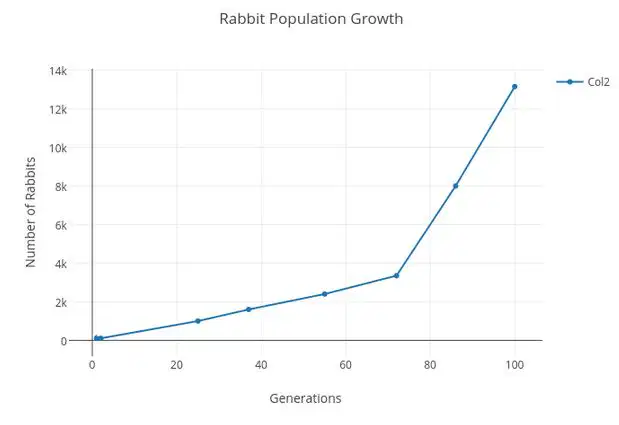
What kind of growth does the rabbit population in Australia exhibit? Why does that present a problem?
Exponential growth; it leads to overpopulation and ecological imbalance.
Linear growth; it is easily manageable.
Declining growth; it poses no threat.
Stable growth; it maintains ecological balance.
Which of the following factors affect population growth?
Birth rate
Death rate
Immigration
All of the above
On your travels through eastern Canada and the United States, you notice gray squirrels everywhere. What can you infer about the squirrels’ geographic range?
Gray squirrels have a limited geographic range.
Gray squirrels are native only to eastern Canada.
Gray squirrels have a wide geographic range.
Gray squirrels are found only in urban areas.
Populations grow exponentially when:
Resources are unlimited and environmental conditions are ideal.
There is a high level of predation.
The birth rate is lower than the death rate.
There is a significant increase in disease.
Exponential growth shows a characteristic J-shaped curve because:
It represents a constant rate of growth over time.
It indicates a rapid increase followed by a plateau.
It shows a slow start followed by a rapid increase.
It demonstrates a decrease in growth rate over time.
Logistic growth occurs when:
The population grows exponentially without any limits.
The growth rate decreases as the population reaches carrying capacity.
Resources are unlimited and the environment is constant.
The population size remains constant over time.
What factors might cause the carrying capacity of a population to change?
Availability of resources
Predation pressure
Climate changes
All of the above
Suppose that a pair of rabbits produces six offspring: three males and three females. Assume that no offspring die. Calculate if each pair of rabbits breeds only once, how many offspring would be produced each year for five generations?
18
36
90
150
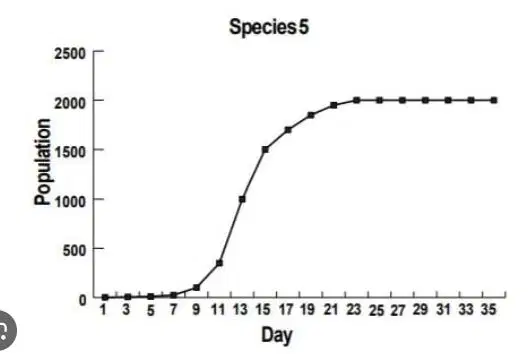
At which day does carrying capacity starts?
35
1
25
15
Which of the following factors determine carrying capacity?
Availability of resources
Predation pressure
Climate conditions
All of the above
Which of the following is an R-Selected Species
mosquitos
polar bears
giraffes
humans
What limiting factors do not typically depend on population density?
Natural disasters
Predation
Disease
Competition
What is the relationship between competition and population size?
Competition increases with population size.
Competition decreases with population size.
Competition is unaffected by population size.
Competition and population size are unrelated.
What is a density-independent limiting factor?
A factor that affects population size regardless of the population's density
A factor that only affects populations when they reach a certain density
A factor that is influenced by the population's density
A factor that increases in effect as the population density increases
Which of the following are examples of density-independent factors that could severely limit the growth of a population of bats living in a cave?
Predation
Disease
Flooding
Temperature extremes

