
 Worksheets
AP CHEMISTRY UNIT 2 REVIEW PACKET
Total questions: 100
Worksheet time: 3hrs 41mins
Why does an atom tend to chemically bond with another atom?
To become more stable
To remain on its present state
To maintain its energy
To decrease its stability
Which of the following describes covalent bonds?
Bonds form because of opposite charges
electrons are shared to fill outer electron shells
Electrons are transferred between atoms
Covalent bonds are magical
Which of the following best describes ionic bonds?
transfer of electrons between a metal and a metal; resulting in no charges (+/-)
sharing of electrons between a metal and a nonmetal
transfer of electrons between a metal and a nonmetal; resulting in ions (charges +/-)
sharing of electrons between nonmetals
Which of the following is the correct example of a CATION?
Na+
Cl-
Na-
Cl+
Which of atom is the correct ANION?
Cl+
Cl-
Na-
Na+
Which substance would have the weakest intermolecular forces of attraction?
CH4
NaCl
H2O
MgF2

Intermolecular forces for: NH3
London dispersion Forces
Dipole dipole
Hydrogen bonding
Which molecule: Br2, HCl, H2S, or NH3, will most likely have London dispersion forces as the MOST important IMF considered when determining melting/boiling points?
Br2, it only has dispersion forces when interacting
HCl, it can participate in dipole-dipole interactions and also dispersion forces
H2S, it can participate in dipole-dipole interactions and also dispersion forces
NH3, it can participate in hydrogen bonding and also dispersion forces
Which noble gas should have the highest boiling point? (Hint: Think about how size affects IMFs)
He
Ne
Kr
Xe
Which of the following will NOT have hydrogen bonding?


Which substance has the weakest intermolecular forces?
Substance A, boiling point of 75 °C
Substance B, boiling point of 105 °C
Substance C, boiling point of 25 °C
Substance d, boiling point of 45 °C

Which type of IMF is responsible for the attraction pictured above?
Dipole-Dipole Interaction
Ion-Dipole Interaction
Hydrogen Bonds
Covalent Bond
Ionic Bond

Which type of IMF is responsible for the attraction pictured above?
Dipole-Dipole Interaction
Ion-Dipole Interaction
Hydrogen Bonds
Covalent Bond
Ionic Bond
Carbon Monoxide containing an electronegativity difference of 1 would contain what type of intermolecular forces if any?
Hydrogen Bonding
Dipole-Dipole
London Dispersion
None
What dispersion forces cause ice to have an open hexagonal structure in the solid state and float?
H-bonding
dispersion forces
D-D interactions
Ion - D interactions
Which substance would have the weakest intermolecular forces of attraction?
CH4
NaCl
H2O
MgF2

Which type of IMF is pictured above?
Dipole-Dipole Interaction
Ion-Dipole Interaction
Hydrogen Bonds
Covalent Bond
Ionic Bond
Rank these in order of strength:
covalent bond
dispersion force
hydrogen bond
dipole-dipole attraction
dipole-dipole > covalent bond > hydrogen bond > dispersion
dispersion > dipole-dipole > hydrogen bond > covalent bond
covalent bond > hydrogen bond > dipole-dipole > dispersion
hydrogen bond > dipole-dipole > dispersion > covalent bond

Which molecule will have hydrogen bonds with other molecules in the sample?
a) CO2
b) HCN
c) C2H2
none of the above
Crystalline solids _____
have their particles arranged randomly
have highly ordered structures
are usually very soft
exist only at high temperatures
The shape of a liquid's meniscus is determined by ____.
the viscosity of the liquid
the type of material the container is made of
the relative magnitudes of cohesive forces in the liquid and adhesive forces between the liquid and its container
the amount of hydrogen bonding in the liquid
Which type of solid has mobile electrons in the crystal (sea of electrons)?
Ionic
Molecular
Metallic
Covalent Network
Which type of solid typically has the lowest melting point of the four types of crystals?
Ionic
Molecular
Metallic
Covalent Network
Which is an example of an ionic crystal?
SiO2
NaCl
SO3
Li
Which is an example of a molecular crystal?
SiO2
NaCl
NH3
Mg
What is the name of the three-dimensional pattern that forms when ions bond?
a crystal lattice
a chemical compound
an ionic bond
an ionic chalice

This is an example of a(n) __________.
Hydrogen Bonding
Dipole
Nonpolar Molecule
Intermolecular Force
Which of the following is an intramolecular force?
hydrogen bonding
polar covalent bonding
London dispersion forces
dipole-dipole interaction

What kind of force is the arrow pointing to?
Intramolecular Force
Intermolecular Force

What kind of force is the arrow pointing to?
Intramolecular force
Intermolecular force
The weaker the intermolecular forces of a substance the _____________ the boiling point
higher
lower
Which types of elements become cations?
non-metals
metals
metalloids
Ionic bonds could be best described as:
A bond formed when 2 atoms share electrons
A firm handshake
An electrostatic attraction between oppositely charged ions
An electrostatic attraction between anions
Molten or dissolved compound conducts electricity.
ionic compound
covalent compound

Diagram above shows the arrangement of atoms in brass. Which of the following could be atoms X and Y?
X : Copper Y: Tin
X: Zinc Y: Copper
X: Iron Y: Carbon
X: Copper Y: Zinc
As the number of covalent bonds between two atoms increases, the distance between the atoms ______ and the strength of the bond between them ______.
increases, increases
decreases, decreases
increases, decreases
decreases, increases
is unpredictable
How many sigma and pi bonds are there in C2H2? (the structure will be ordered HCCH)
1 sigma and 1 pi
3 sigma and 1 pi
3 sigma and 2 pi
2 sigma and 3 pi

Which of these pictures shows the particles in a solid, pure metal?


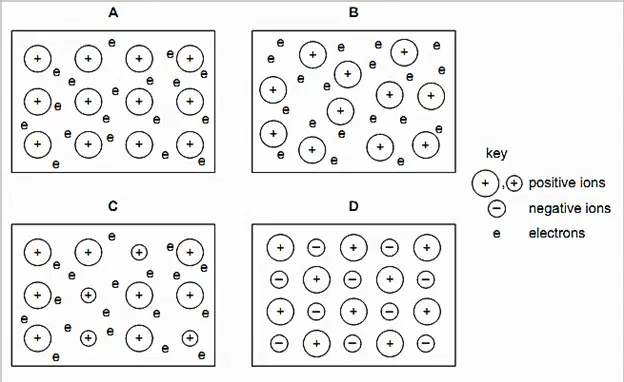
Which structure represents that of an alloy?
A
B
C
D
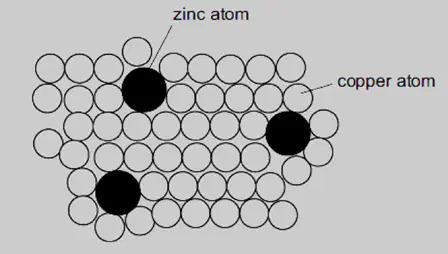
The diagram shows the structure of brass. Why is brass harder than pure copper?
The zinc atoms form strong covalent bonds with copper atoms.
The zinc atoms prevent layers of copper atoms from slipping over each other easily.
The zinc atoms prevent the ‘sea of electrons’ from moving freely in the solid.
Zinc atoms have more electrons than copper atoms.
The Lewis structure of N2H2 shows __________.
a nitrogen-nitrogen triple bond
a nitrogen-nitrogen single bond
each nitrogen has one lone pair
each nitrogen has two lone pairs
each hydrogen has one lone pair
In the nitrite ion (NO2-), __________.
both bonds are single bonds
both bonds are double bonds
both bonds are the same because of resonance
there are 20 valence electrons
there is one single and one double bond
The ability of an atom in a molecule to attract electrons is best quantified by the ______.
electronegativity
paramagnetism
diamagnetism
electron change-to-mass ratio
first ionization energy
A valid Lewis structure of _______ cannot be drawn without violating the octet rule.
NF3
IF3
PF3
SbF3
SO42-
Which atom can accommodate an octet of electrons, but doesn't necessarily have to accommodate an octet?
N
C
H
O
B

In the resonance form of ozone shown, the formal charge on the central oxygen atom is _______.
0
+1
-1
+2
-2
Bond enthalpy is __________.
always negative
always positive
sometimes positive and sometimes negative
always zero
unpredictable
The Lewis structure of the CO32- ion is


Which of these bonds takes the most energy to break?
single
double
triple
quadruple
The ion NO- has _____ valence electrons.
10
12
14
15
16

The formal charge on carbon in the molecule shown is _______.
0
+1
+2
+3
-1
Choose the correct shape for H2S
Tetrahedral
Trigonal pyramidal
Bent
Trigonal planar

How many sigma and pi bonds are there in C2H2? (the structure will be ordered HCCH)
1 sigma and 1 pi
3 sigma and 1 pi
3 sigma and 2 pi
2 sigma and 3 pi
Which of the following does not describe any of the molecules above?

Arrange these elements in order of increasing electronegativity: antimony, fluorine, indium, selenium
antimony, fluorine, indium, selenium
indium, selenium, antimony, fluorine,
indium, fluorine, selenium antimony
indium, antimony, selenium, fluorine

Calculate ΔEN for Pb-S
1.1
-0.1
0.6
3.7

Calculate ΔEN for Na-Br
1.9
0.9
2.8
1.0

Which type of bond is created between Na-I?
Polar Covalent
Non-polar Covalent
Ionic
Metallic
In the resonance form of ozone shown, the formal charge on the central oxygen atom is _______.
0
+1
-1
+2
-2
The formal charge on carbon in the molecule shown is _______.
0
+1
+2
+3
-1
Choose the correct shape for H2S
Tetrahedral
Trigonal pyramidal
Bent
Trigonal planar

The molecular geometry of this molecular compound is ...
Trigonal planar
Tetrahedral bent
Linear
Tetrahedral tetrahedral
The bond angle of the central atom in this molecular compound is ...
109.5
90
90, 120
180

What is the molecular geometry of this molecular compound?
Trigonal bypyramidal
Tetrahedral
Trigonal planar
linear
What is the hybridization of the central atom in this molecular compound?
sp2
sp3d5
s
sp3
Ionic substances typically have high conductivities in which of the following state(s) of matter?
Solids
Molten liquids
Aqueous liquids
Which property of metals means that metal atoms can easily be drawn into a wire without breaking?
Alloy
Conductive
Ductile
Malleable

Which of these alloys is a substitutional alloy?
Bronze
Steel

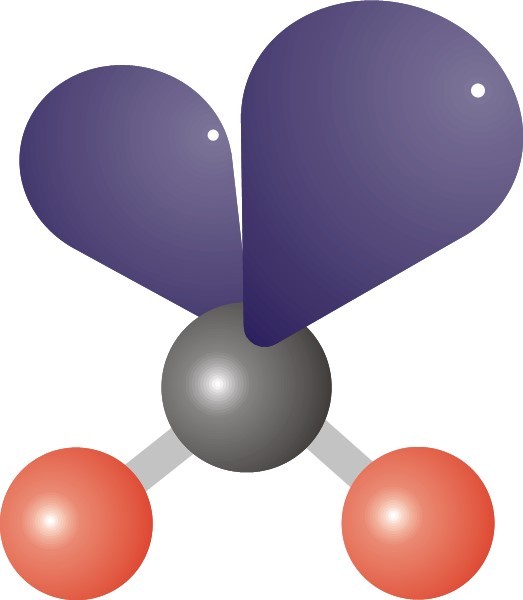
Draw the Lewis Dot structure for ICl2- and determine its predicted molecular geometry.
see-saw
trigonal bipyramidal
linear
bent
Draw the Lewis Dot structure for PCl5 and determine the predicted molecular geometry
octahedral
trigonal pyramidal
seesaw
trigonal bipyramidal


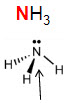

sp3d hybridization
In the nitrite ion (NO2-), __________.
both bonds are single bonds
both bonds are double bonds
both bonds are the same because of resonance
there are 20 valence electrons
there is one single and one double bond

