
 Worksheets
Unit 2 Natural Texas and Its People
Total questions: 54
Worksheet time: 1hrs 18mins
Match the culture to the correct description.
Caddo (Southeastern Culture)
Piney Woods, advanced tribe,
named Texas
Plains Culture
Very hostile & fought with enemies
Puebloan Culture
Used Rio Grande to irrigate their farms
The Gulf Culture cut down trees to make dugout canoes. This is an example of a modification or an adaptation?
Modification
Adaptation
Pottery buried in the Coastal Plains of Texas. This source is considered a...
Primary Source
Secondary Source
Match the following descriptions with the correct culture.
Southeastern
The houses are all round, built with forked poles... and on the outside covered to the ground with dry grass. Most of them were large enough to hold eight or ten persons.
Plains
Known for their nomadic lifestyle, living in tepees made of buffalo hides.
Puebloan
Famous for their adobe structures and cliff dwellings.
"The land is sacred. These words are at the core of your being. The land is our mother, the rivers our blood. Take our land away and we die. That is, the Indian in us dies." The description that represents the quote is (a)
"During the warmer months, we journeyed with them across the land, seeking sustenance as they have no permanent homes or cultivated lands. The men hunt game, while the women gather roots and berries." The quote above most likely describes...
a tribe with permanent settlements
a tribe that moves frequently
a tribe known for its agriculture
The Plains culture utilized buffalo for various needs, ensuring no part was wasted. Is this approach considered beneficial due to their sustainable practices?
True
False
Which activity is least associated with the Comanche and Apache lifestyle?
nomadic lifestyle
fishing
hunting buffalo
living in tepees
Which culture is known for its intricate religious ceremonies such as burial mounds and this represented by (a) Culture?
Gulf
Plains
Puebloan
What was a common characteristic of the Southeastern natives and those in the Mountains and Basins Region?
They both practiced hunting and gathering.
They both constructed large earthen mounds.
They relied heavily on fishing for sustenance.
They were both sedentary agricultural societies.
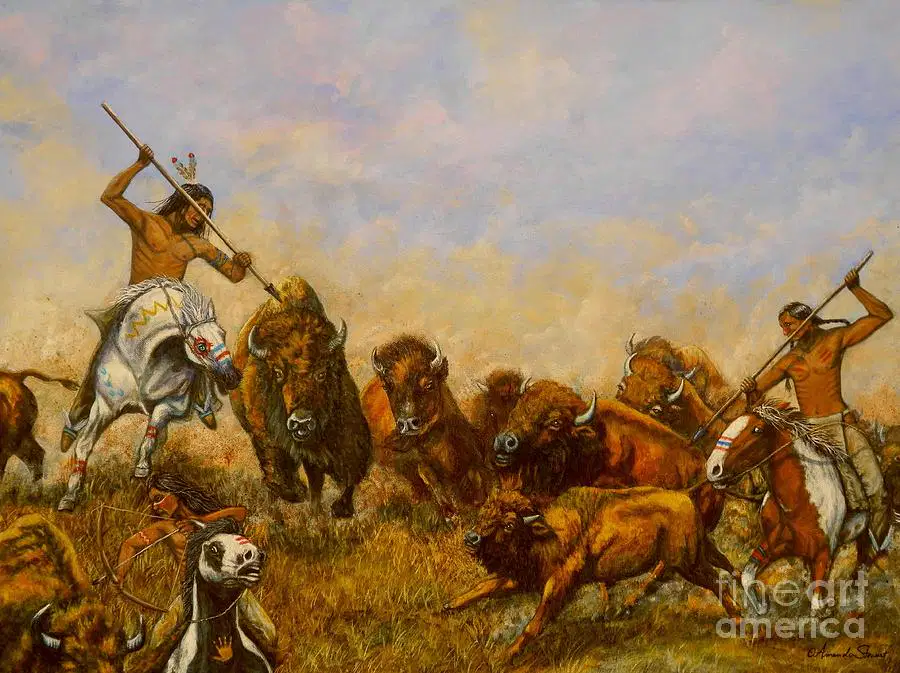
Which TWO Native American Groups are known for their nomadic lifestyle?
Apache
Comanche
Caddo
Witchita
What is a key difference between the food sources of the Gulf Culture and the Puebloans?
The Gulf Culture primarily consumed seafood, while the Puebloans depended on agriculture.
Both cultures were heavily reliant on hunting buffalo.
The Gulf Culture and the Puebloans both focused on fishing.
Both groups were known for their extensive farming practices.
The method shown is an example of how the ________ Culture adapts their environment by _______ to construct dwellings that stay cool in the summer
Southeastern
Puebloan
Gulf
using natural ventilation
Plains
Which Native American culture was renowned for their nomadic lifestyle and reliance on buffalo hunting?
Puebloan
Southeastern
Gulf
Plains
Which type of source is a student's model of an ancient Egyptian pyramid?
Primary
Secondary
The Caddo tribe ensured that their leader did not have absolute power by involving a council in decision-making. What governmental principle does this reflect?
Checks and Balances
Limited Government
Separation of Powers
Popular Sovereignty
Which region was primarily inhabited by nomadic Native American tribes?
the Sierra Nevada Mountains
Southwest
Great Plains

Which region of Texas is number 3 on the map?
North Central Plains
Mountains and Basins
Coastal Plains
Great Plains
Which region of Texas is number 4 on the map?
North Central Plains
Mountains and Basins
Coastal Plains
Great Plains
Which region of Texas is number 1 on the map?
North Central Plains
Mountains and Basins
Coastal Plains
Great Plains

Which number represents the Red River?
1
2
3
4
5
Which number represents the Rio Grande?
1
2
3
4
5
Which tribes were known for their nomadic lifestyle, hunting buffalo, and living in tipis on the Great Plains?
Cheyenne and Arapaho
Comanche, Apache, Kiowa, Tonkawa
Hopi and Zuni
Navajo and Pueblo
How did the Jumano modify their environment?
By using alligator grease as bug repellant
By building irrigation systems for crops
By using dugout canoes for fishing
By hunting buffalo on horseback
Determine whether each characteristic describes the culture of the Gulf or Plains Natives or of both groups.
Were skilled horseman and buffalo hunters
Plains Natives
Built portable housing structures
Both
Used dugout canoes for fishing and transportation
Gulf Natives
Which statement describes a defining characteristic of the Natural Texas and Its People era?
Oil fields were discovered in both south and west Texas.
Native Americans lived in different regions of Texas.
Land in Texas was divided to build towns and railroads.
The Spanish converted Native Americans to Christianity.
The Jumano's were part of the Puebloan Culture. They lived in the Mountains and Basins and
fished in the Gulf of Mexico
were nomadic
were strong swimmers
lived in permanent adobe villages
How did the Karankawa differ from other Native tribes in Texas?
They hunted buffalo in the Mountains and Basins region.
They made dugout canoes for fishing in the Gulf of Mexico.
They developed irrigation systems for farming in the Great Plains.
They farmed using crop rotation in far east Texas.
Match the descriptions of the Coastal Plains, Great Plains, and Mountains and Basins.
Major Landforms: plains, beaches, wetlands
plentiful rain
Coastal Plains
Driest region that gets the least amount of rain
Mountains and Basins
Major Landforms: flat prairies and grasslands
Great Plains
How did the Comanche differ from other Native tribes in Texas?
They built mounds to perform religious ceremonies.
They developed irrigation systems for farming.
They mainly hunted buffalo in the Great Plains.
They were a matrilineal society along the Gulf of Mexico.
To help us study history, we divide it up into time periods called
eras
past
chronological
sections

The native tribes in the Gulf Coast can be described as _________________ and _______________/________________
Sedentary and farmers
Sedentary and hunters/gatherers
Nomadic and farmers
Nomadic and hunters/gatherers

The ELEVATION of TEXAS...
Decreases South to North
Decreases East to West
Decreases West to East
Decreases North to South
An area that is known by similar features:
border
boundary
region
urban
California has passed a law in 2022 to protect Native American lands. State agencies must talk to Native American tribes before building on their land.
What principle of government does this represent?
Federalism
Individual Rights
Popular Sovereignty
Separation of Powers
When Spain takes over Texas, they take away rights from Native Americans including freedom of religion and freedom of expression.
Which principle of government does this GO AGAINST?
Popular Sovereignty
Individual Rights
Checks and Balances
Federalism
The name Texas comes from the Caddo word taysha, which means "_____" or "_____."
Friend, Ally
Enemy, Warrior
Friend, Best Friend
Cattle, Tejano
Which of these is a secondary source?
A text book describing the civil rights movement
The United States Constitution
A Vietnam veteran talking about the war in Vietnam.
A journal by a cowboy about the cattle drives from Texas to Kansas

What Texas River makes up the international boundary between Mexico and the United States?
Red River
Rio Grande River
Sabine River
Sabine River
How did the Jumano modify their environment?
By using alligator grease as bug repellant
By building irrigation systems for crops
By using dugout canoes for fishing
By hunting buffalo on horseback
Match the descriptions of the Coastal Plains, Great Plains, and Mountains and Basins.
Major Landforms: plains, beaches, wetlands
plentiful rain
Coastal Plains
Driest region that gets the least amount of rain
Mountains and Basins
Major Landforms: flat prairies and grasslands
Great Plains
An area that is known by similar features:
border
boundary
region
urban
an artifact or piece of evidence that was found from the scene of history
Nomadic
Sedentary
primary source
secondary source
hunter-gatherer
a secondhand account of an event or a retelling of another person's observations from an event in history
Nomadic
Sedentary
primary source
secondary source
hunter-gatherer

Is terraced farming an adaptation or modification to the environment?
Adaptation
Neither
Modification
Deforestation
Humans change the environment around them to meet their needs
Human adaptation
Human modification
Adjusting the way we live in or around landforms to meet our needs.
human adaptation
human modification

The Pueblo people made their houses out of adobe. There was very few trees in the desert to build shelter out of wood.
Modification
Adaptation
Putting on sunscreen.
Adaptation
Modification
People adapt to cold weather by putting on warmer clothes.
Adaptation
Modification

The Commanche use the buffalo fo food, shelter and clothing.
Modification
Adaptation

When the Colorado River was dammed by the Hoover Dam it created Lake Meade.
Modification
Adaptation

