
 Worksheets
11 PLC Analogue Outputs Quiz
Total questions: 12
Worksheet time: 12mins
What type of signals are digital outputs?
Analog signals
Binary signals
Continuous signals
Variable signals
Which of the following is a common type of digital output?
Analog output
Relay output
Variable output
Continuous output

Which of the following actuators would not be connected to a PLC’s analogue output?
Variable speed motor
Meter display
Dimmable light bulb
Door lock solenoid
What capability might a PLC have built-in as standard?
Digital input
Analogue output
Wireless communication
Battery backup
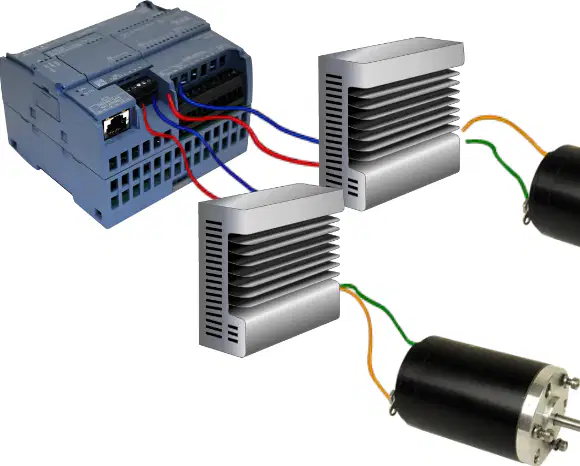
What can industrial PLCs have multiple of?
Digital inputs
Analogue outputs
Wireless connections
Power supplies

What is the process of creating an analogue output signal from a numeric value that a PLC understands called?
Analogue to Digital Conversion
Digital to Analogue Conversion
Signal Processing
Numeric Conversion
What does the converter’s resolution refer to in the context of a D-A converter?
The number of colors displayed
The number of bits used
The size of the converter
The speed of the motor
How many discrete output values does an 8-bit converter produce?
128
256
512
1024
What is the output signal when the minimum converter input value is set?
Maximum
Minimum
Average
Random
What is an analogue output voltage set to achieve in a control program?
A specific motor speed
A specific temperature
A specific light intensity
A specific sound level
What does an analogue sensor monitor in a control program?
Motor temperature
Motor speed
Motor voltage
Motor current
What does the PLC program do to the output value?
Increases it continuously
Decreases it continuously
Adapts it until the required speed is reached
Keeps it constant

