

wayground logo

Free Printable Worksheets

Font size

S
M
L
XL
Worksheets

Lesson 1 Adobe Certification

Total questions: 57

Worksheet time: 1hrs 8mins

Name
Class
Date
1.

What are the seven elements of art?

a)
Line, shape, form, space, color, value, texture
b)
Hue, saturation, brightness, rhythm, balance, contrast, movement
c)
Circle, triangle, square, light, shadow, pattern, depth
d)
Outline, dimension, perspective, gradient, highlight, shadow, composition
2.

What are primitives?

a)
Primitives are complex data structures that can be broken down.
b)
Primitives are advanced programming concepts used in object-oriented languages.
c)
Primitives are basic data types that cannot be subdivided.
d)
Primitives are user-defined types that require extensive definitions.
3.
  1. From which colors are all colors on the color wheel created?

a)
Cyan, Magenta, Brown
b)
Black, White, Gray
c)
Red, Blue, Yellow
d)
Green, Orange, Purple
4.

What is the difference between a complementary and an analogous color?

a)
Complementary colors are next to each other on the color wheel, while analogous colors are opposite each other.
b)
Complementary colors are created by mixing primary colors, while analogous colors are made from secondary colors.
c)
Complementary colors are opposite each other on the color wheel, while analogous colors are next to each other.
d)
Complementary colors are shades of the same hue, while analogous colors are different hues.
5.

What is the difference between positive space and negative space?

a)
Positive space refers to the background of an image.
b)
Negative space is the main subject of a composition.
c)
Positive space is always larger than negative space.
d)
Positive space is the area taken up by objects, while negative space is the area around and between those objects.
6.

What is a vanishing point?

a)
A vanishing point is a type of vanishing cream.
b)
A vanishing point is a point in perspective where parallel lines seem to converge.
c)
A vanishing point is where objects disappear in a painting.
d)
A vanishing point is a point in time when something ceases to exist.
7.

What are the principles of design for most design projects?

a)
Symmetry, simplicity, color, texture
b)
Innovation, creativity, technology, feedback
c)
Balance, contrast, emphasis, movement, pattern, rhythm, unity
d)
Functionality, usability, accessibility, aesthetics
8.

Which principles of design involve applied action for an object?

a)
Contrast, emphasis, unity
b)
Proximity, alignment, variety
c)
Texture, shape, color
d)
Movement, rhythm, balance
9.

​ (a)   is the principle of design involves drawing attention to an object by making it brighter, larger, or moving?
Choose from the below words
Emphasis
Balance
Contrast
Repetition
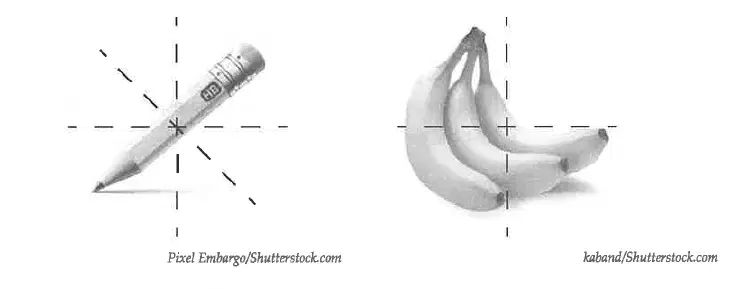
10.

Which principle of design is demonstrated in the pictures?

a)
Balance
b)
Contrast
c)
Emphasis
d)
Repetition
11.

How does the rule of thirds help alignment of elements in a scene or image?

a)
The rule of thirds is used to create symmetry in an image.
b)
It helps to blur the background elements for focus.
c)
The rule of thirds dictates the color palette of the scene.
d)
The rule of thirds helps align elements by positioning them along grid lines or intersections for better visual balance.
12.

​ (a)   is the principle of design describes why a blue object is hard to see on a blue background?

Choose from the below words
Contrast
Harmony
Symmetry
Balance
13.

​ (a)   is the principle of design involves making all the parts of a scene work together?

Choose from the below words
Unity
Contrast
Balance
Emphasis
14.

Why would a designer copy and paste the same button design on all web pages on a website?

a)
To ensure consistency and improve user experience.
b)
To save time by not creating new designs for each page.
c)
To confuse the users with different designs.
d)
To make the website look more colorful.
15.

What are the three benefits of maintaining unity of design?

a)
Increased project costs
b)
Reduced collaboration among team members
c)
Limited design flexibility
d)

Consistency across the project, Enhanced user experience, Strengthened brand identity

16.

What is Traditional Artwork?

a)
Any form of art that uses modern techniques.
b)
Art created solely with digital tools.
c)

Art created without the use of computer technology.

d)
Artwork that has no cultural significance.
17.

What is Digital Artwork?

a)
Digital artwork is only created with traditional paint.
b)
Digital artwork cannot be shared online.
c)
Digital artwork is exclusively for video games.
d)

Digital artwork is art created using a computer.

18.

Definition: The individual features needed to compose artwork.

(a)  

19.

Definition: To effectively combine the elements of art to compose a pleasing work of art.

(a)  

20.

What are Geometric Shapes?

a)
Geometric shapes are exclusively used in art and design.
b)
Geometric shapes are random patterns without defined boundaries.
c)

Geometric shapes are cubes, pyramids, or spheres.

d)

Geometric shapes are regular figures, like a square, circle, triangle octagon, or trapezoid.

21.

​ (a)   are regular shapes and objects that are used to assemble more complex shapes or objects.

Choose from the below words
Primitives
Complexes
Figures
Assemblies
22.

What are Organic Shapes?

a)

Organic shapes are irregular; cloud, tree, blowing steam, or even an ergonomic computer mouse.

b)
Organic shapes are only found in mathematical equations.
c)
Organic shapes are strictly man-made and uniform.
d)
Geometric shapes are always symmetrical and angular.
23.

​ (a)   ​is the assembly of 2D shapes to represent a third dimension.

Choose from the below words
Form
Collage
Flat Design
Sketching
24.

What is an Implied Line?

a)

An implied line is the path the viewer’s eye takes to connect the two endpoints of the line when it is not continuous.

b)
An implied line is a line that is always visible in a composition.
c)
An implied line is a type of solid line used in technical drawings.
d)
An implied line is a physical line drawn on a surface.
25.

​ (a)   is a hue with both black and white, or gray added.

Choose from the below words
Tone
Saturation
Brightness
Chroma
26.

​ (a)   is a hue with black added.

Choose from the below words
Shade
Tint
Tone
Brightness
27.


(a)   is the pure color.

Choose from the below words
Hue
Saturation
Brightness
Shade
28.

​ (a)   is a hue with white added.

Choose from the below words
Tint
Shade
Tone
Saturation
29.

What are the Primary Colors?

a)
Cyan, Magenta, Yellow
b)
Black, White, Gray
c)
Red, Blue, Yellow
d)
Green, Orange, Purple
30.

How are Secondary Colors created?

a)
Secondary colors are created by using only one primary color.
b)
Secondary colors are created by mixing two primary colors.
c)
Secondary colors are created by adding white to primary colors.
d)
Secondary colors are created by mixing three primary colors.
31.

How are Tertiary Colors created?

a)

Tertiary colors are created by mixing a primary color with a secondary color or two secondary colors.

b)
Tertiary colors are created by mixing two primary colors.
c)
Tertiary colors are created by mixing a secondary color with another secondary color.
32.

​ (a)   colors appear adjacent to each other in the color wheel.

Choose from the below words
Analogous
Complementary
Primary
Secondary
33.

​ (a)   colors are opposite each other on the color wheel.

Choose from the below words
Complementary
Analogous
Primary
Secondary
34.

What is Pixel Shading?

a)
Pixel shading refers to the process of creating 3D models.
b)
Pixel shading is a method for compressing image files.
c)
Pixel shading is a technique for enhancing audio quality.
d)

Pixel shading is the use of lighter and darker colors, or changed in value, to create light and shadow.

35.

Applied action is​ (a)  

Choose from the below words
Movement
Jumping
Sitting
Crawling
36.

​ (a)   is using similar elements in a design.

Choose from the below words
Harmony
Chaos
Disarray
Inconsistency
37.
  1. ​ (a)   is when objects arranged such that no one section overpowers any other part.

Choose from the below words
Balance
Chaos
Disorder
Asymmetry
38.

​ (a)   is Purposeful absence of harmony to create visual or contextual interest.

Choose from the below words
Variety
Monotony
Uniformity
Simplicity
39.

​ (a)   appears as a single piece and not an assembly of different parts.

Choose from the below words
Unity
Diversity
Fragmentation
Separation
40.

​ (a)   is the use of light and dark to add highlight, shading, or shadows.

Choose from the below words
Value
Texture
Pattern
Contrast
41.

​ (a)   The area or volume occupied by the primary objects.

Choose from the below words
Positive Space
Negative Space
Empty Space
Void Space
42.
  1. ​ (a)   is the area or volume around or between the primary objects.

Choose from the below words
Negative Space
Positive Space
Foreground
Background
43.

What is Vertex Shading?

a)

Vertex shading is moving the points on an object to resize it such that the object appears smaller in the distance.

b)
Vertex shading refers to the lighting calculations for pixel colors.
c)
Vertex shading is the technique used for creating 2D graphics effects.
d)
Vertex shading is the process of rendering textures on surfaces.
44.

What is Visual Perspective?

a)
Visual perspective refers to the color palette used in painting.
b)

Visual perspective is the proportion scaling of objects as they move toward a vanishing point.

c)
Visual perspective is a type of camera lens used in photography.
d)
Visual perspective is a method for creating 3D animations.
45.

What is Vanishing Point?

a)

A point where receding parallel lines appear to meet.

b)
A method for blending colors in art.
c)
A technique used in painting to create depth.
d)
A type of camera lens that focuses light.
46.

What is Tactile Texture?

a)

Tactile texture is an irregular surface that can be physically felt, like sandpaper.

b)
Tactile texture refers to the visual appearance of an object.
c)
Tactile texture is the emotional response to an object's design.
d)
Tactile texture is the temperature of an object when touched.
47.

What is Optical Texture?

a)
Optical texture is the sound quality of a surface when touched.
b)
Optical texture refers to the physical roughness of a surface.
c)

Optical texture is creating variation in what you see.

d)
Optical texture describes the temperature of a surface when exposed to light.
48.

​ (a)   is when a designer draws attention to an object.

Choose from the below words
Emphasis
Distraction
Obscurity
Neglect
49.

What is Symmetrical Balance?

a)
Symmetrical balance is a design principle that focuses on color harmony.
b)
Symmetrical balance is achieved by using only one type of shape in a design.
c)
Symmetrical balance involves random placement of elements without a central axis.
d)

Symmetrical balance is when the right and left sides, top and bottom, or all equal sides or formal balance.

50.

What is Asymmetrical Balance?

a)

Asymmetrical balance is informal balance, is the use of similar objects to create balance, or the use of color and light balance instead of objects.

b)
Asymmetrical balance is a technique used to create a chaotic and unbalanced design.
c)
Asymmetrical balance refers to a symmetrical arrangement of elements in design.
d)
Asymmetrical balance is a design principle that requires equal distribution of elements.
51.

​ (a)   is when the work is not all balanced.

Choose from the below words
Asymmetry
Symmetry
Equilibrium
Harmony
52.

​ (a)   is how closely objects are arranged.

Choose from the below words
Proximity
Distance
Alignment
Spacing
53.

What is the Rule of Thirds?

a)

The Rule of Thirds is a rule for determining the best time to take photographs.

b)

The Rule of Thirds is a method for selecting color palettes in design.

c)

The Rule of Thirds is a technique for adjusting camera exposure settings.

d)

The Rule of Thirds is a guideline that states an image should be divided into three sections horizontally and three sections vertically to create nine areas.

54.

​ (a)   is the variation of color and brightness to make object stand out from each other.

Choose from the below words
Contrast
Hue
Saturation
Shade
55.

​ (a)   is the size of an object in relation to the other objects around it.

Choose from the below words
Proportion
Volume
Weight
Color
56.

What does Trompe L’oeil translate to?

a)
fool the eye
b)
enhance the vision
c)
paint the scene
d)
deceive the eye
57.

​ (a)   is an element that is repeated.

Choose from the below words
Pattern
Shape
Color
Texture
