
 Worksheets
Benchmark
Total questions: 54
Worksheet time: 2hrs 41mins
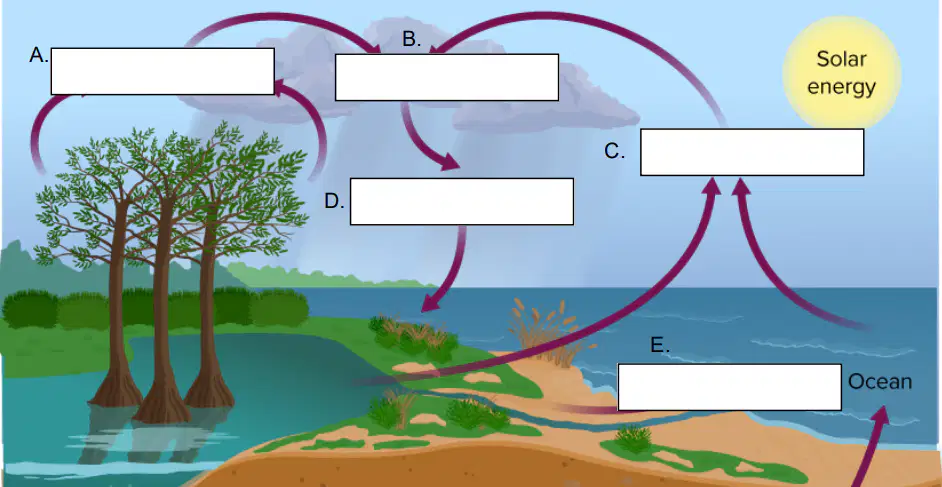
Label the diagram by matching the vocabulary words with the letters they represent
A
transpiration
B
condensation
C
evaporation
D
percipitation
E
run off
Match the descriptions with the type of organism it represents.
autotroph
organism that produces its own food
heterotroph
organism that consumes other organisms
herbivore
organism that eats autotrophs
detritivore
organism that feeds on dead organic matter
omnivore
organism that eats both plants and animals
Which of the following is true of a population with a growth rate of zero with no emigration and no immigration?
The birth rate exceeds the death rate.
The birth rate equals the death rate.
The birth rate is less than the death rate.
I don't know yet.
Match the term with its definition.
The geographical area in which a species can be found
range
the pattern of spacing of a population within an area
dispersion
the number of organisms per unit area
density
A biotic or abiotic factor that restricts the numbers of organisms in an ecosystem is called a (an)
primary succession
tolerating factor
end point
limiting factor
I don't know yet.
Sort the density-dependent factors from the density-independent factors
predation relationships
symbiotic relationships
disease
competition
drought
flooding
hurricane
termperature
Match the description to the vocabulary word.
a large school of barracuda
population
a barracuda
individual
all the conifer forests growing in Canada
biome
all the groups of organisms that interact with each other in the same region.
community
What is a climax community?
community left behind immediately after a forest fire
community consisting of pioneer organisms
community with no biotic factors
stable community with little change in species numbers
I don't know yet.
The exchange of matter through the _________________ is called the bioecochemical cycle.
atmosphere
biosphere
community
popularion
I don't know yet.
Place the steps of mitosis in the correct order.
prophase
metaphase
anaphase
telophase
I don't know yet.
Meiosis produces genetic variation in
gametes
haploids
diploids
genes
Match the descriptions and the correct term.
substances move from high to low area of concentration
diffusion
water from high area to low area of concentration
osmosis
ions from low to high area of concentration
active transport
large particles entering the cell
endocytosis
What is homeostasis?
a membrane which allows some substances to pass through wile keeping others out
the ability to arrange phospholipids in a way that allows the plasma membrane to tolerate the watery environment
the ability to move needed substances or waste materials through the plasma membrane
the process of maintaining balance in an organism's internal environment
I don't know yet.
DNA is shaped in a (a) . It consists of 4 different (b) . They pair a specific way. Guanine will always pair with (c) . Adenine will always pair with (d) . There is a 5th nucleoitides, (e) that will only be found in RNA.
Which sets of structures are homologous?
a butterfly's wing and a bat's wing
a moth's eyes and a cow's eyes
a whale's pectoral fin and a bird's wing
a beetle's leg and a horse's leg
I don't know yet.

Which statement about the tortoise shells would be part of an explanation for tortoise evolution based on natural selection?
the tortoise shell does not look like the shell of either parent
Tortoises with domed shells have more young than tortoises with flat shell.
All tortoises look like the tortoise shown.
All tortoises born on an island survive.
I don't know yet.
Why is seed dispersal an important adaption?
allows close proximity to parent plants
limits competition with parent plants
allows offpsring to grow next to each other
decrease the diversity of plant seeds.
I don't know yet.
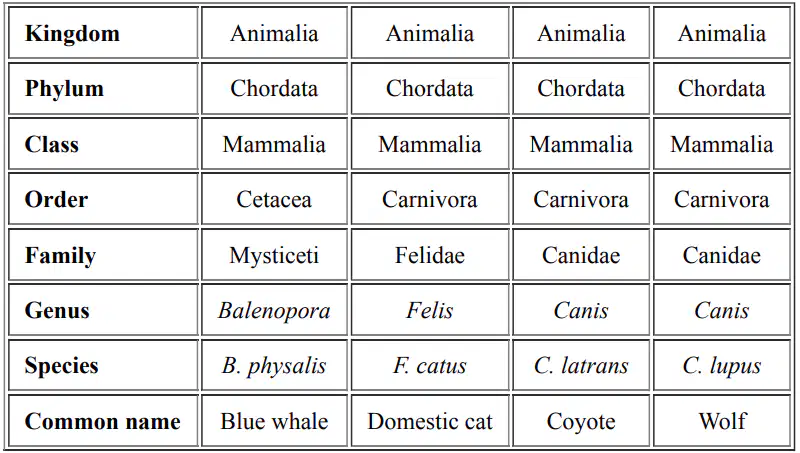
Which animal is the most distant relative to the others?
blue whale
wolf
domestic cat
coyote
I don't know yet.
What type of organism converts light energy from the sun into chemical energy?
detritivore
autotroph
chemotroph
heterotroph
I don't know yet.
What do muscles require for maximum ATP production?
I don't know yet.
What is the purpose of photosynthesis?
I don't know yet.
Which line represents the carrying capacity of this population?
Predators can affect the (a) of a prey population. An increase in predators leads to a increase in the prey population's (b) , causing the growth rate of the prey population to (c) .
The insecticide-resistant bugs will (a)
causing their offspring to be (b)
.
This means the insecticide will (c) .

What type of growth is this graph representing?
Logistical Growth
Exponential Growth
I don't know yet.
What will happen if all of the frogs in a population die?
The frogs' predators will decrease and the frogs' prey will increase
The frogs' predators will increase and the frogs' prey will decrease
the numbers of other populations wouldn't be affected
I don't know yet.
I don't know yet.
I don't know yet.
A man, who has red-green colorblindness, and his wife, who is a carrier for colorblindness, have a colorblind son. What is the probability that their next son will also be colorblind?
Hint: Color blindness IS X-linked.
0%
0/4
25%
1/4
50%
2/4
100%
4/4
I don't know yet.
0%
0/4
25%
1/4
50%
2/4
100%
4/4
I don't know yet.
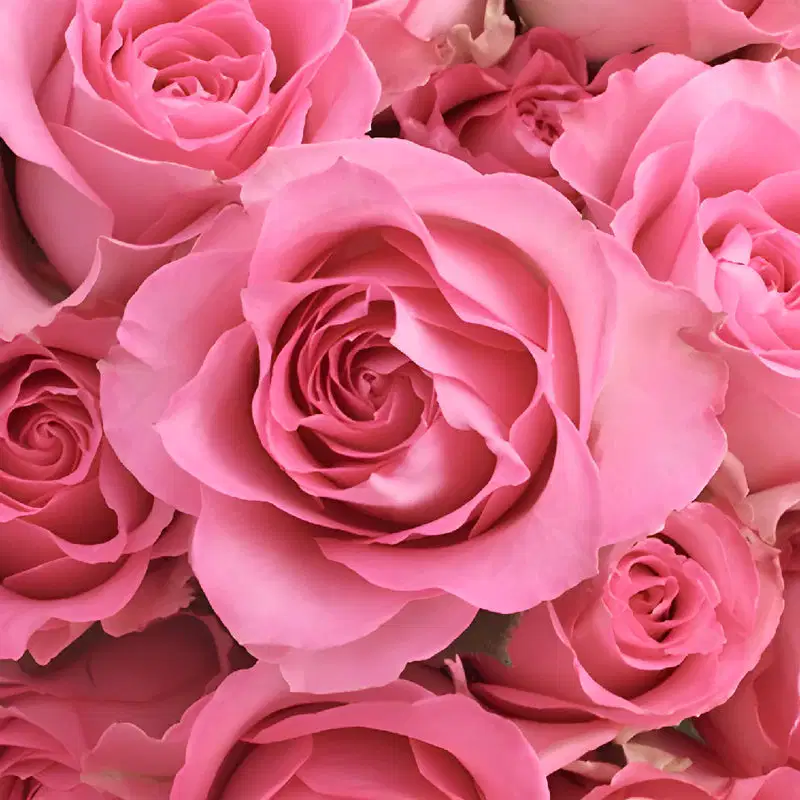
Scott was looking at the results of a cross between red and white roses. What pattern of dominance is shown when he ends up with pink roses?
incomplete dominance
recessive dominance
codominance
mendelian dominance
I don't know yet.
The physical appearance of a trait is known as its (a) .
transcription
translation
I don't know yet.
A key purpose of meiosis to to produce genetically ___________ cells.
there is no way to tell
opposite
I don't know yet.
I don't know yet.
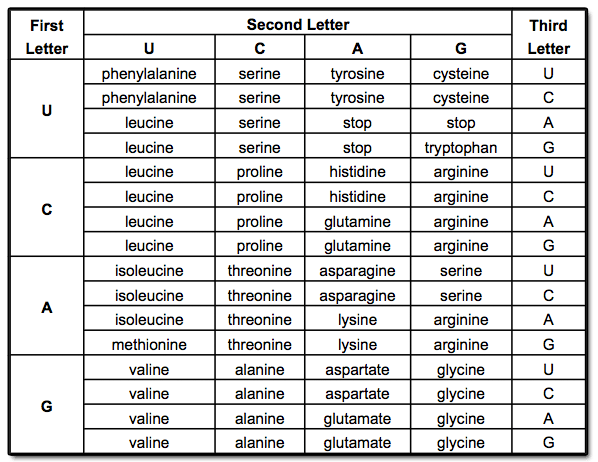
I don't know yet.
What is the order for protein synthesis?
Transcription -> Translation -> Protein
Translation - > Transcription -> Protein
Protein -> Transcription -> Translation
Translation -> Protein -> Transcription
I don't know yet.
Where does TRANSCRIPTION occur?
Nucleus
Ribosome
Cytoplasm
Mitochondria
I don't know yet.
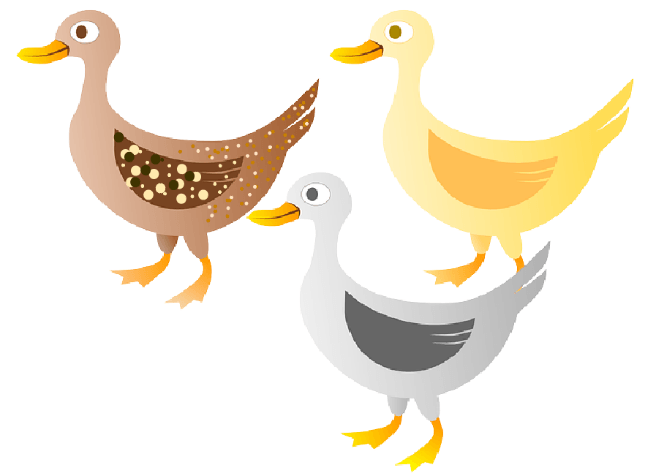
Genetic diversity in a species makes long term survival of some members
impossible
improvable
more likely
less likely
I don't know yet.

Label the natural selection graphs correctly...
1 Stabilizing, 2 Directional, 3 Disruptive
1 Disruptive, 2 Stabilizing, 3 Directional
1 Directional, 2 Stabilizing, 3 Disruptive
1 Directional, 2 Disruptive, 3 Directional
I don't know yet.

Seed cracker birds have either large beaks or small beaks. They do not have medium sized beaks because medium sized beaks do not allow for adequate cracking of seeds. What type of selection does this represent?
Stabilizing
Directional
Disruptive
Not enough information to tell
I don't know yet.
All the possible gene combinations in a population.
allele
gene pool
genome
mitosis
I don't know yet.
Some insects are resistant to certain pesticides, chemicals that are sprayed on crops to keep the insects from eating them. The insects that have the resistant trait are not affected by the pesticides. This resistance trait can be passed to their offspring. The resistance to pesticides that some individual insects have is a result of-
the behavior of those insects
the genetic makeup of those insects
transfer of resistance from one individual insect to another
individual insects becoming resistant over time
I don't know yet.
What does aerobic mean?
without ATP
without oxygen
with ATP
with oxygen
I don't know yet.
Where does photosynthesis occur in the cell?
chloroplast
cytoplasm
mitochondria
nucleus
I don't know yet.
What are the products in the photosynthesis equation?
carbon dioxide and water
adenosine triphosphate and carbon dioxide
glucose and water
glucose and oxygen
I don't know yet.
Which of the following are some of the major carbon reservoirs on Earth?
metals
inorganic matter
living things
salt
I don't know yet.
Identify organisms roles in a food web.

In this energy pyramid, which organisms have the most energy available?
Producers
Carnivores
Herbivores
Top Predator
I don't know yet.
Match the following
emmigration
moving out of a population
immigration
moving into a population
migration
moving based on season
Match the following
one organism benefits and the other is unaffected
commensalism
both organisms benefit
mutalism
one organism benefits and the other is harmed
parasitism
Put the following in order from most specific to broadest
cell
tissue
organ
organ system
organism
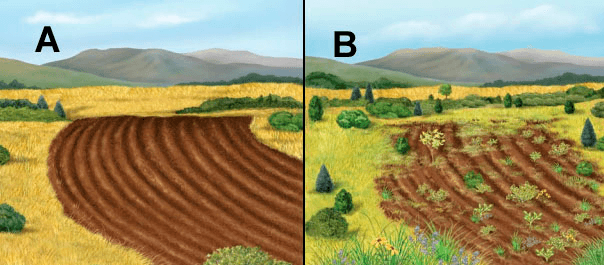
What is the main difference between primary and secondary ecological succession?
Primary begins WITHOUT soil; Secondary begins WITH soil
Primary is the first state and secondary is the second stage
Primary builds plant community; secondary builds animal community.
Primary begins WITH soil; Secondary begins WITHOUT soil
I don't know yet.
I don't know yet.

