wayground logo

Free Printable Worksheets

Font size

S
M
L
XL
Worksheets

Ecological Pyramids

Total questions: 31

Worksheet time: 3hrs 12mins

Name
Class
Date
1.

Use the pyramid of biomass below to decide which of the following tables is correct.

a)
b)
c)
d)
2.

All food webs and food chains begin with _________________.

a)

primary consumer

b)

producers

c)

secondary consumers

d)

tertiary consumers

3.
In this energy pyramid, which organisms have the most energy available?
a)
Producers
b)
Carnivores
c)
Herbivores
d)
Top Predator
4.
How many carnivores are shown in this food web?
a)
6
b)
4
c)
5
d)
3
5.

If there are 100 Kcal of energy available in the producers, how much energy would be available in the primary consumers?

a)

10 Kcal

b)

1 Kcal

c)

100 Kcal

d)

1000 Kcal

6.
What percentage of energy is passed on to each tropic level?
a)
10%
b)
50%
c)
90%
d)
100%
7.

Which organism do the owl and the weasel compete for in the food web?

a)

Hawk

b)

Spider

c)

Grasshopper

d)

Shrew

8.
Organisms which carry out the process of decomposition by breaking down dead or decaying organisms.
a)
Consumer
b)
Producer
c)
Decomposer
d)
Herbivore
9.
An organism that eats the secondary consumer.
a)
Primary Consumer
b)
Secondary Consumer
c)
Tertiary Consumer
d)
Consumer
10.
Who does the grasshopper get energy from? 
a)
Grass
b)
Grasshopper
c)
Mouse
d)

Owl

11.

How are primary consumers different from secondary consumers?

a)

Primary consumers eat only plants; secondary consumers eat other consumers.

b)

Primary consumers eat other consumers; secondary consumers eat only plants.

c)

Primary consumers eat plants and other consumers; secondary consumers eat plants and decompose matter.

d)

Primary consumers eat plants and decompose matter; secondary consumers eat plants and other consumers.

12.

The most Biomass is found?

a)

Top Predator

b)

Carnivore

c)

Herbivore

d)

Producers

13.

Autotrophs are also know as __________ because they make their own food.

a)

Consumer

b)

Herbivore

c)

Producer

d)

Omnivore

14.
Which of the following is NOT a heterotroph?
a)
grass
b)
fungus
c)
shark
d)
sea urchin
15.
The arrows in a food chain or web represent ...
a)
They point to the organism that is being eaten.
b)
It shows how sunlight flows within an ecosystem.
c)
They show the direction the energy is flowing between organisms. 
d)
They represent how water is transferred within a habitat.
16.
What are the Abiotic factors in this image? 
a)
water, sunlight, dirt, air
b)
birds and plants
c)
birds, water, dirt
d)
plants, water
17.

The only difference between an ecosystem and a community is that the community includes the abiotic environment but the ecosystem does not.

Answer true or false.

a)

true

b)

false

18.

What is another name for a primary producer that means self-feeder?

a)

Heterotrophs

b)

Autotroph

c)

Detritivores

d)

Consumers

19.
A __________ includes all living and non-living things in an environment. 
a)
population
b)
niche
c)
abitotic
d)
ecosystem
20.
Which is a difference between abiotic and biotic factors?
a)
abiotic factors are plants and biotic factors are animals
b)
biotic factors are plants and abiotic factors are animals
c)
abiotic factors are all living things and biotic factors are all nonliving things
d)
abiotic factors are all nonliving things and biotic factors are all living things
21.
The original sources of energy for all living things come from
a)
decomposers, which provide energy for consumers
b)
Consumers, which provide energy for consumers
c)
Producers, which provide energy for consumers
d)
The sun, which provides energy for producers.
22.
What term can be used to describe clams that eat decaying plant matter?
a)
A. Detritivores
b)
B. Tertiary consumers
c)
C. Saprotrophs
d)
D. Decomposers 
23.

Which term best describes the image below?

a)

An individual

b)

A population

c)

A community

24.

Which of the following are considered abiotic (never living)?

a)

Fallen leaves

b)

Nail trimmings

c)

Rocks

d)

Deceased organisms

e)

pH

25.

Which term(s) best describe(s) the picture below? (Select all that apply)

a)

Autotroph

b)

Heterotroph

c)

Consumer (w/in heterotroph)

d)

Detritivore

e)

Saprotroph

26.

Choose the correct levels of Organization from lowest to highest...

a)

population, community, ecosystem, organism

b)

species, population, community, ecosystem

c)

organism, population, ecosystem, community

d)

population, species, community, ecosystem

27.
The diagram represents a pyramid of energy in an ecosystem.  Which level would most likely contain organisms that do photosynthesis?
a)
A
b)
B
c)
C
d)
D
28.
Which of the following is a herbivore?
a)
cricket
b)
frog
c)
hawk
d)
shrew
29.
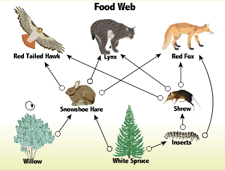
What may happen if the snowshoe hare was removed from the food web pictured?
a)

The insects in the habitat would increase.

b)

The shrew population would decrease due to the shrew now being the only food source for the hawk.

c)

The willow tree population would decrease.

d)

The fox would become extinct due to a lack of a food source. 

30.
The fox in this food web would be considered a:
a)

Secondary and Tertiary Consumer

b)

Producer

c)

Primary Consumer

d)

None of the above

31.
The fox in this food web would be considered a:
a)
Tertiary Consumer
b)
Producer
c)
Secondary Consumer
d)
Primary Consumer