
NEW
Font size
 Worksheets
Nine Weeks Chemistry Review
Total questions: 64
Worksheet time: 2hrs 8mins
Do molecules generally move faster at 45 C or 106 C?
45 C because molecules have more energy than in 106C
106 C because molecules have more energy than in 45C
106 C because molecules have less energy than in 45C
45C because molecules have less energy than in 106 C
When you place the metal in boiling water, heat flows from the _________ to the _______.
metal to the boiling water
bottom of the metal to the top half of the metal
bottom of the water to the top of the water
boiling water to the metal
DON'T RUSH, YOU HAVE TIME.
Frying an egg on a skillet. Referring to the egg, would the Enthalpy change be positive or negative?
Skillet is absorbing heat energy from the egg. Absorbing energy is Endothermic. Endothermic has a positive Enthalpy
Egg absorbing heat energy from the skillet. Absorbing energy is Endothermic. Endothermic has a positive Enthalpy
Egg absorbing heat energy from the skillet. Releasing energy is Exothermic. Exothermic has a positive Enthalpy
Egg absorbing heat energy from the skillet. Releasing energy is Exothermic. Exothermic has a negative Enthalpy
Define Exothermic
Energy is released; ΔH is negative; Going from Gas to Liquid, Liquid to Solid
Energy is absorbed; ΔH is positive; Going from Gas to Liquid, Liquid to Solid
Energy is released; ΔH is positive; Going from Solid to Liquid, Liquid to Gas
Energy is absorbed; ΔH is negative; Going from Gas to Liquid, Liquid to Solid
Define Endothermic
Energy is absorbed; ΔH is negative; Going from Liquid to Gas, and Gas to Liquid
Energy is released; ΔH is negative; Going from Solid to Liquid, and Liquid to Gas
Energy is released; ΔH is positive; Going from Solid to Liquid, and Liquid to Gas
Energy is absorbed; ΔH is positive; Going from Solid to Liquid, and Liquid to Gas
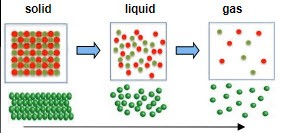
Is this phase change representing an exothermic or endothermic reaction?
GAS to LIQUID
Exothermic
Endothermic
What does the Zeroeth Law of Thermodynamics state?
If two bodies are in thermal equilibrium with a third body, they are not in equilibrium with each other.
If two bodies are in thermal equilibrium with a third body, they are also in equilibrium with each other.
If two bodies are in thermal equilibrium, they must be at the same temperature.
If two bodies are not in thermal equilibrium, they cannot exchange heat.
What is the Second Law of Thermodynamics primarily concerned with?
The unrestricted creation and destruction of heat energy.
The transfer of heat energy from a body at a lower temperature to a body at a higher temperature without the addition of outside energy.
The prediction of energy costs for heating and cooling systems.
The concept of entropy and the direction of heat transfer.
What is "absolute zero" according to the Third Law of Thermodynamics?
The temperature at which matter contains a maximum amount of energy.
The temperature at which matter is at its most disordered state.
The temperature at which matter has absolutely no energy at all.
The temperature at which matter changes from one state to another.
Which process involves the transfer of heat between objects by direct contact?
Radiation
Convection
Conduction
Entropy
Which phrase describes the motion and attractive forces of ideal gas particles?
random curved-line motion and no attractive forces
random straight-line motion and strong attractive forces
random straight-line motion and no attractive forces
random curved-line motion and strong attractive forces
The concept of an ideal gas is used to explain
the behavior of a gas sample
why some gases are monatomic
why some gases are diatomic
the mass of a gas sample
At 25ºC, gas in a rigid cylinder with a movable piston has a volume of 145 mL and a pressure of 125 kPa. Then the gas is compressed to a volume of 80. mL. What is the new pressure of the gas if the temperature is held at 25ºC?
69 kPa
93 kPa
160 kPa
230 kPa
Which graph best represents the pressure-volume relationship for an ideal gas at constant temperature?


As the temperature of a gas increases with the volume remaining constant, the pressure of the gas
decreases
increases
remains the same
Which scientist discovered the electrons?
Dalton
Thomson
Atristotle
Bohr
Bohr discovered that electrons are located in
the nucleus
inside protons
electron cloud
circular orbits around the nucleus
The smallest particle of an element that still represents that element.
Nucleus
electron
proton
atom
What is a particle with one negative charge called?
electron
proton
quark
neutron
What is the center of an atom called?
nucleus
electron cloud
proton center
photon center
What is a particle with one positive charge called?
proton
electron
neutron
quark
Who was the Greek philosopher who called the smallest particle of matter an "atom"?
Democritus
Aristotle
J.J Thompson
Einstein
The majority of an atom's mass exists where?
In the nucleus
In the electron cloud
In the space between the nucleus and the electrons
In the neutrons

Which of the following is/are conclusions based on Rutherford’s gold foil experiment?
Atom is mostly empty space
The nucleus is positively charged
The atom has a small dense nucleus
All answers are correct
Identify the coefficients of the following equation?
___PCl5 + ___ H2O → ___ HCl + ___H3PO4
1, 4, 5, 1
1, 1, 6, 1
1, 3, 8, 1
1, 2, 2, 1
Identify the coefficients of the following equation?
___ Al + ___ FeO → ___Al2O2 + ___ Fe
1, 1, 2, 1
2,1,2, 1
2, 2, 1, 2
2, 4, 1, 2
Which number, found on a balanced equation, shows the number of a specific atom within a compound?
Example: H2O
Coefficient
Subscript
Charge
Oxidation Number
Identify the coefficients of the following equation?
___ Al +___ HCl --> ___ H2 +___ AlCl3
2, 6, 3, 2
it is already balanced
4, 12, 3, 4
2, 1, 4, 5
Al + O2 --> Al2O3
2H2 + O2 --> 2H2O
2H2 + O2 --> 2H2O
Balance the following equation:
___ H2+ ___ O2→___ H2O
1, 1, 3
2, 2, 2
1, 2, 1
2,1, 2
Which of the coefficients could be used to balance this equation?
__Ag2O →__ Ag +___O2
2,4,1
1,1,1
2,1,2
2,2,2
Balance the following equation:
___ SeCl6+ ___ O2→___ SeO2+____Cl2
1, 1, 1, 3
2, 1, 2, 1
1, 2, 1, 2
2, 2, 2, 4
A student inflates a balloon with helium then places it in the freezer. The student should expect
the balloon's volume to increase
the balloon's volume to decrease
the balloon's moles to increase
the balloon's moles to decrease
Three gases are mixed together in a container with a total pressure of 4.8 atm. If two of the gases have pressures of 1.2 atm and 1.5 atm, what is the pressure of the third gas?
2.5 atm
1.8 atm
2.1 atm
1.3 atm
Which equation would you use to solve the following problem:
"The volume of of 300 mL of gas at 1 atm is decreased to 100 mL. What is the new pressure?"
P1V1 = P2V2
V1/T1 = V2/T2
(P1V1)/T1 = (P2V2)/T2
None of the above
Which equation would you use to solve the following problem:
"A gas occupies 2 L of space at 0 C. What will its volume be at 100 C?"
P1V1 = P2V2
V1/T1 = V2/T2
(P1V1)/T1 = (P2V2)/T2
None of the above
A tank of helium is full with a pressure of 4.5 atm at 298K. What is the temperature of the tank when the pressure drops to 2 atm?
670.5K
0.007K
132.4K
2682K

