
NEW
Font size
 Worksheets
A level PE - Cardiorespiratory/vascular systems
Total questions: 27
Worksheet time: 14mins
What is the primary function of the ventricles in the heart?
Collecting blood at the top of the heart
Pumping blood throughout the body
Allowing blood to travel in only one direction
Dividing the heart into two pumps
What role do the atria play in the heart?
Pumping blood throughout the body
Collecting vessels at the top of the heart
Allowing blood to travel in only one direction
Dividing the heart into two pumps
What is the function of the valves in the heart?
Pumping blood throughout the body
Collecting vessels at the top of the heart
Allowing blood to travel in only one direction
Dividing the heart into two pumps
What is the role of the superior vena cava?
Transporting oxygen-rich blood from the lungs to the heart
Returning deoxygenated blood to the heart from the head and arms
Carrying oxygen-poor blood from the heart to the lungs
Dividing the heart into two pumps
What is the function of the inferior vena cava?
Transporting oxygen-rich blood from the lungs to the heart
Returning deoxygenated blood to the heart from the head and arms
Transporting almost all venous blood from the abdomen and lower extremities back to the heart
Dividing the heart into two pumps
What do the pulmonary arteries do?
Carry oxygen-rich blood from the lungs to the heart
Carry oxygen-poor blood from the heart to the lungs
Return deoxygenated blood to the heart from the head and arms
Transport venous blood from the abdomen to the heart
What is the function of the pulmonary veins?
Carry oxygen-poor blood from the heart to the lungs
Return deoxygenated blood to the heart from the head and arms
Collect oxygen-rich blood from the lungs and carry it to the heart
Transport venous blood from the abdomen to the heart
Where is oxygenated blood returned to after leaving the lungs?
Right atrium
Left ventricle
Right ventricle
Left atrium
Through which vessel is blood pumped from the left ventricle into the arteries?
Pulmonary trunk
Aorta
Pulmonary veins
Vena cava
What is the definition of heart rate?
The amount of blood pumped out of the heart per minute.
The number of times your heart beats, or contracts, per minute.
A measure of how much blood is squeezed out of the heart into the aorta each time it beats.
The pressure of blood against the walls of the arteries.
What does stroke volume measure?
The number of times your heart beats per minute.
The amount of blood pumped out of the heart per minute.
A measure of how much blood is squeezed out of the heart into the aorta each time it beats.
The pressure of blood against the walls of the arteries.
How is cardiac output (Q) calculated?
Q = Heart rate x Blood pressure
Q = Stroke volume x Blood pressure
Q = Stroke volume x Heart rate
Q = Heart rate x Blood volume
What does the respiratory system comprise of?
Heart, veins, arteries
Mouth, nose, airways, and lungs
Brain, spinal cord, nerves
Stomach, intestines, liver
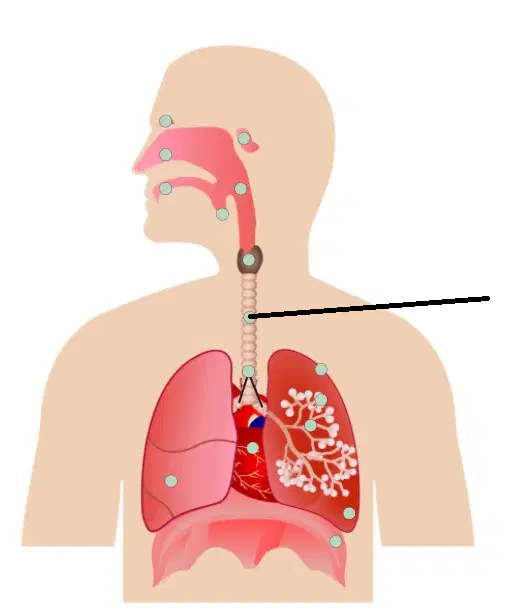
Identify the part of the respiratory system labelled in the diagram.
Nasal cavity
Pharynx
Trachea
Diaphragm
Which part of the respiratory system is responsible for gas exchange?
Alveoli
Larynx
Bronchus
Pleura
What is the function of the diaphragm in the respiratory system?
To filter air
To produce sound
To assist in breathing
To protect the lungs
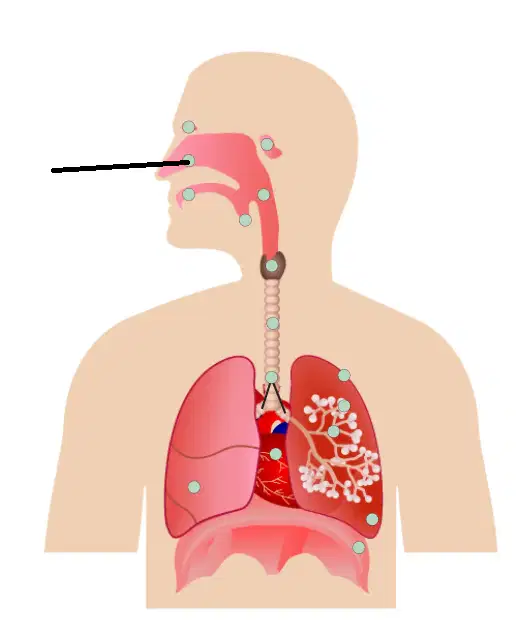
What is the primary function of the nasal cavity in the respiratory system?
To exchange gases
To filter, warm, and moisten air
To produce sound
To protect the lungs
What happens to the intercostal muscles and diaphragm during inspiration?
They contract
They relax
They remain unchanged
They expand
What occurs during expiration?
The intercostal muscles and diaphragm contract
The intercostal muscles and diaphragm relax
The ribs move upwards and outwards
The thoracic cavity increases in size
Energy producing system within the muscles that requires oxygen is called
Aerobic
Anaerobic
Musculoskeletal
Ligamentary
Which energy producing system in the muscles is more powerful for quick, short bursts of energy?
Aerobic
Anaerobic
Which energy producing system is utilized during cardiorespiratory endurance training?
Aerobic
Anaerobic
Which of the following activities would NOT help improve cardiorespiratory endurance?
Static stretching
Jogging
Swimming
Bicycling


The amount of oxygen that is consumed by the body during a specific level of activity.
Oxygen Extraction
Resting Oxygen Consumption
Oxygen Consumption

