
NEW
Font size
 Worksheets
Weather and Climate Part 1
Total questions: 45
Worksheet time: 24mins
What is the main difference between weather and climate in terms of measurement?
Measured over short-term (day-to-day)
Measured as an average over a long period of time
Measured by humidity levels
Measured by wind speed
Which of the following is a characteristic of climate?
Changes of the condition of the atmosphere at a certain place and time
Measured as an average over a long period of time
Reported as a temporary forecast
Local - occurs differently in smaller regions
How is weather typically reported?
As averages over a long period of time
As a temporary forecast
By the amount of sunlight
By the number of storms
Which of the following is NOT a major climate zone?
Polar
Temperate
Arid
Equatorial
How does climate occur in terms of region?
Occurs similarly over a large region
Occurs differently in smaller regions
Changes daily
Is unpredictable
What is the greenhouse effect?
The cooling of Earth's surface and atmosphere
The natural warming of Earth's surface and lower atmosphere
The process of photosynthesis in plants
The reflection of sunlight by clouds
What causes the greenhouse effect?
Ultraviolet radiation from the sun
Infrared radiation (heat) from the sun being absorbed and emitted into the atmosphere
Visible light from the sun
X-rays from the sun
Why are certain gases called greenhouse gases?
They reflect sunlight back into space
They absorb and trap heat from the sun
They cool the Earth's surface
They are only found in greenhouses
What is the primary role of greenhouse gases in Earth's atmosphere?
They absorb solar radiation and release it as light.
They trap infrared energy from the sun and reemit it as heat.
They reflect solar energy back into space.
They convert heat energy into chemical energy.
What happens to solar radiation when it enters Earth's atmosphere?
It is completely absorbed by the oceans.
It is converted into chemical energy.
It enters as heat energy.
It is immediately reflected back into space.
What effect do greenhouse gases have on global temperatures?
They cause global temperatures to decrease.
They have no effect on global temperatures.
They cause global temperatures to rise.
They stabilize global temperatures.
What is the role of greenhouse gases in Earth's atmosphere?
They make Earth too cold for life.
They maintain a comfortable temperature on Earth.
They have no effect on Earth's temperature.
They make Earth too warm for life.
What happens if there are too few greenhouse gases in the atmosphere?
Earth becomes too warm for life.
Earth becomes too cold for life.
Earth remains unaffected.
Earth becomes more humid.
What can a small change in global temperature cause?
No effect on Earth's systems.
Changes to climate that cause challenges for life on Earth.
Immediate extinction of all life.
A permanent ice age.
Which of the following is a source of carbon dioxide (CO₂)?
Fossil fuel production
Fertilizer application
Cement production
Agriculture
What is a major source of methane (CH₄)?
Deforestation
Landfills
Cement production
Industrial processes
Which greenhouse gas is associated with fertilizer application?
Carbon dioxide
Methane
Nitrous oxide
Oxygen

Which human activity involves the burning of fossil fuels and organic matter, releasing large amounts of greenhouse gases?
Photosynthesis
Combustion
Recycling
Irrigation
What is the environmental impact of deforestation?
Increases carbon dioxide absorption
Reduces carbon dioxide in the atmosphere
Causes less carbon dioxide to be taken out of the atmosphere
Enhances oxygen production

Which of the following activities releases methane and other greenhouse gases as organic wastes decompose?
Agriculture
Decomposition
Industrial Products
Transportation
What is a byproduct of digestion in livestock such as cows that contributes to greenhouse gas emissions?
Carbon dioxide
Nitrous oxide
Methane
Oxygen
Which of the following industrial products release powerful greenhouse gases called HFCs?
Fertilizers
Refrigerants
Pesticides
Biofuels
Which of the following is a natural source of greenhouse gas emissions?
Automobile exhaust
Volcanic eruptions
Industrial waste
Deforestation
What role does Earth play in managing greenhouse gases?
It increases the amount of gases.
It has systems to balance gases released naturally.
It eliminates all greenhouse gases.
It only releases gases through human activities.
How does the amount of natural greenhouse gas emissions compare to those produced by human activities?
Natural emissions are much larger.
Natural emissions are slightly larger.
Natural emissions are very small.
Natural emissions are equal.
What is the most abundant greenhouse gas that stays in the atmosphere longer than most others?
Methane
Nitrous Oxide
Carbon Dioxide
Ozone
How do human activities primarily increase atmospheric CO₂ levels?
Planting trees
Using solar panels
Burning fossil fuels for transportation, heating, and electricity
Recycling waste
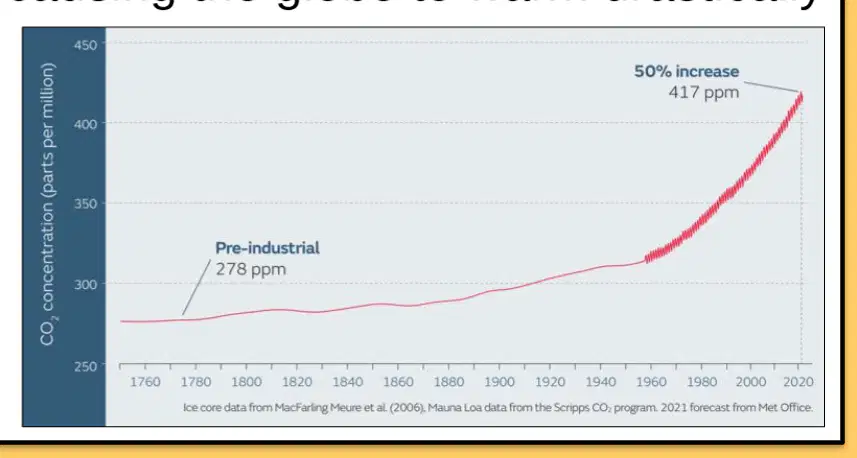
By what percentage are current carbon dioxide levels higher than the pre-industrial era?
20%
30%
50%
70%
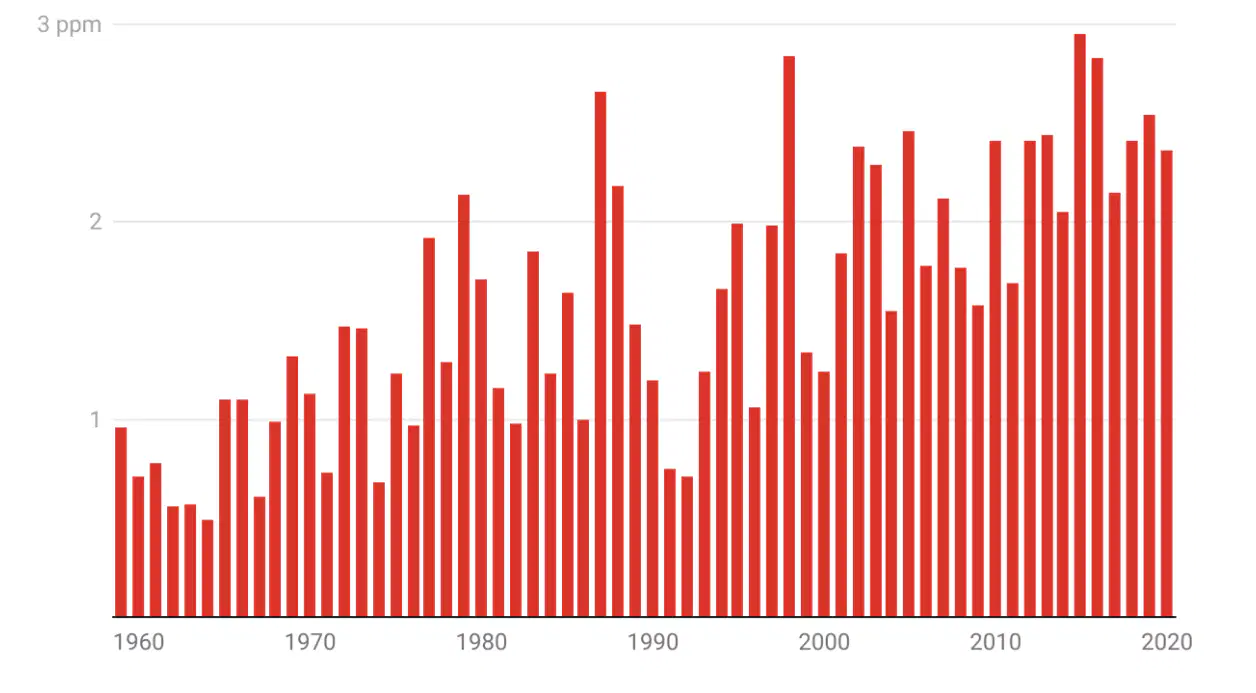
What was the increase in CO2 concentration in 2020 despite lower emissions during the pandemic?
1.5 parts per million
2.4 parts per million
3.0 parts per million
0.5 parts per million
What is the current CO2 concentration compared to before the industrial era?
280 ppm
350 ppm
415 ppm
500 ppm
What is the carbon cycle?
The process of burning fossil fuels
The cycling of carbon molecules between oceans, air, organisms, and rocks
The formation of carbon compounds in plants
The release of carbon dioxide from vehicles
What are carbon sinks?
Sources of carbon emissions
Factors that store or deduct the amount of carbon dioxide in the atmosphere
Machines that capture carbon
Areas with high carbon dioxide levels
Why are carbon sinks important?
They increase carbon dioxide levels
They remove and/or store carbon dioxide
They produce carbon dioxide
They have no effect on carbon dioxide levels
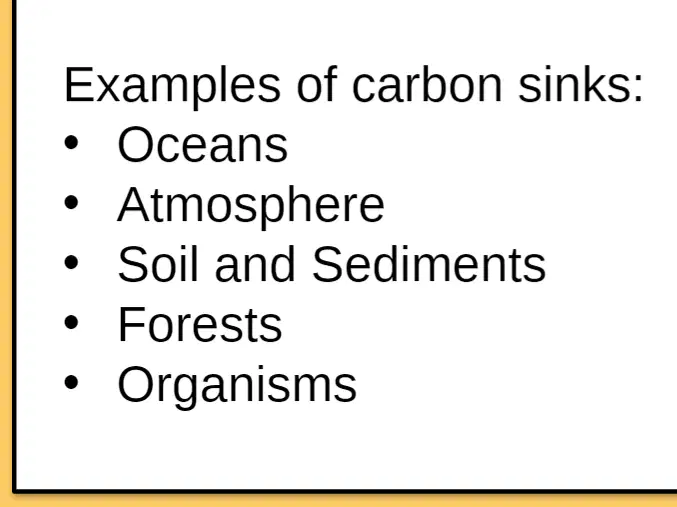
Which of the following is an example of a carbon sink?
Cars
Factories
Oceans
Plastic
What is the largest carbon sink in the world?
Forests
Oceans
Soil
Atmosphere
What happens to the ocean's ability to absorb carbon as atmospheric carbon dioxide increases?
It increases
It remains the same
It decreases
It fluctuates randomly
What is one effect of excessive carbon dioxide in the ocean?
Decreases ocean temperature
Causes ocean acidification
Increases fish population
Reduces coral growth
What is a consequence of ocean acidification?
Enhanced coral growth
Fish population increase
Coral bleaching and fish kills
Improved shell formation
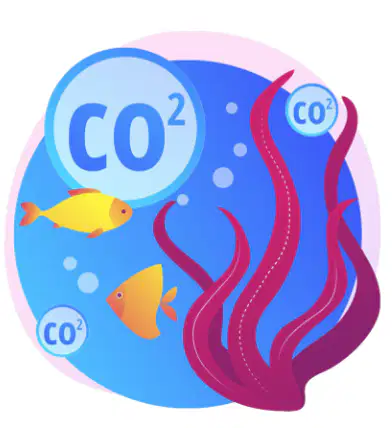
Illustration of carbon dioxide effects in the ocean, showing CO2 bubbles, fish, and coral.
CO2 bubbles increase oxygen levels in the ocean.
CO2 bubbles contribute to ocean acidification.
CO2 bubbles have no effect on marine life.
CO2 bubbles help in coral bleaching.

What does the red line in the graph represent?
Annual mean
Five-year smoothing
Monthly average
Decadal average

Between which years did the global average temperature show a significant increase?
1880 to 1900
1940 to 1960
1980 to 2020
1920 to 1940
What is global warming primarily caused by?
Natural climate cycles
Increased greenhouse gas emissions from human activity
Volcanic eruptions
Solar flares
Since the pre-industrial era, how much has Earth's global average temperature increased per decade?
0.5°C
1°C
2°C
1.5°C
What effect do high greenhouse gas concentrations have on global temperatures?
They decrease global temperatures
They have no effect on global temperatures
They cause global temperatures to increase
They stabilize global temperatures

Is this an example of weather or climate?
We can expect rain on Saturday.

