
NEW
Font size
 Worksheets
Unit 3: Marine Ecology & Energy Flow
Total questions: 25
Worksheet time: 13mins
An organism’s ________ is the full range of physical and biological conditions in which the organism lives and the way in which it uses those conditions- its role in the environment.
Niche
Habitat
Ecology
Biotic Factor
Which of these is correct about a community in the environment?
Each species inhabits its own community
A community inhabits a specific niche
Multiple populations of species make up a community
Multiple communities make up a population
Which of the following statements about competition is true?
Individuals within a population may compete with individuals of different species
Individuals within a population may compete with other individuals of the same species
A population within a community may compete with other populations within the community
All of the choices are correct
Carrying capacity is the result of which of the following:
How much weight a human can carry on their shoulders
Within a community every species has a particular niche
Different populations living in the same place interact with one another
While living organisms have the capacity to produce populations of infinite size, environments and resources are limited
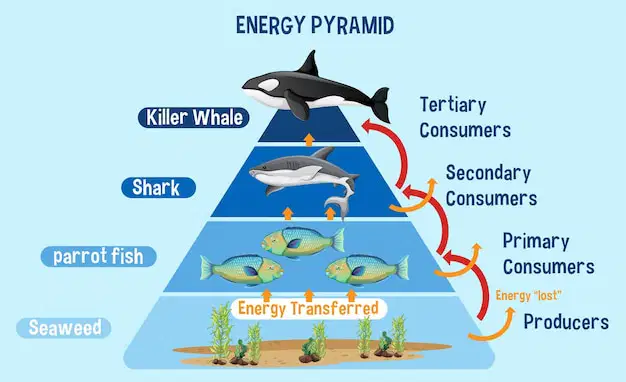
Where in an energy pyramid would we find the killer whale?
Trophic Level 1- producer
Trophic Level 2- primary consumer
Trophic Level 3- secondary consumer
Trophic Level 4- tertiary consumer
Which of the following statements about invasive species is true?
Invasive species are not subject to natural selection
The invasive species may compete with native species for habitat or food
Invasive species play an important role by keeping populations of prey species below their carrying capacity
None of the choices are correct
An organism’s habitat is ________ it lives. An organism’s niche is ________ it lives
How; Where
What; Who
Where; How
When; Why
Why; When
What is a species?
A group of related individuals sharing common characteristics that interbreed and produce fertile offspring having the same common characteristics as the parents.
Animals with a backbone, which are adapted to live in aquatic environments
A group of individuals that live together and need each other to survive
None of the choices are correct
Intensive fishing or overfishing is one factor that contributes to algae overgrowth because it does which of the following?
Reduces the number of organisms/fish that feed on algae
Allows more sunlight to be available to algae
Increases the competition between different algae species
Prevents the spread of bacteria in algae colonies
Which of the following lists the order of biological organization from smallest to largest?
Population, organism, community, ecosystem
Population, organism, ecosystem, community
Organism, community, population, ecosystem
Organism, population, community, ecosystem
The wrasse, a small marine fish, periodically cleans harmful parasites from the mouth and body of the moray eel. The moray, in turn, protects the wrasse from larger predators and provides it with a constant supply of food. This is an example of the type of relationship known as-
Commensalism
Competition
Parasitism
Mutualism
About ______________ of available energy transfers from each level of the trophic pyramid to the next.
10%
50%
20%
5%
30%
About ______________ of available energy is lost from one level to the next. This is lost as heat.
10%
90%
20%
5%
30%
The collective mass of all living things in a particular area or at a specific trophic level of an ecosystem is known as...
Population Size
Biomagnification
Biomass
Apex Tropism
Which of the following is an abiotic factor?
Water
Fish
Algae
Tree
Which of the following is a biotic factor?
Water
Rocks
Seaweed
Temperature
The phenomenon by which toxins concentrate in the organisms at higher trophic levels within an ecosystem is known as...
Biotoxicity
Biomagnification
Eutrophication
Predation
Consider the following food chain: Kelp -> Sea Urchin -> Sea Otter -> White shark. In a polluted ecosystem, which organism would likely have the HIGHEST level of toxic chemicals in its body?
Kelp
Sea Urchin
Sea Otter
White shark
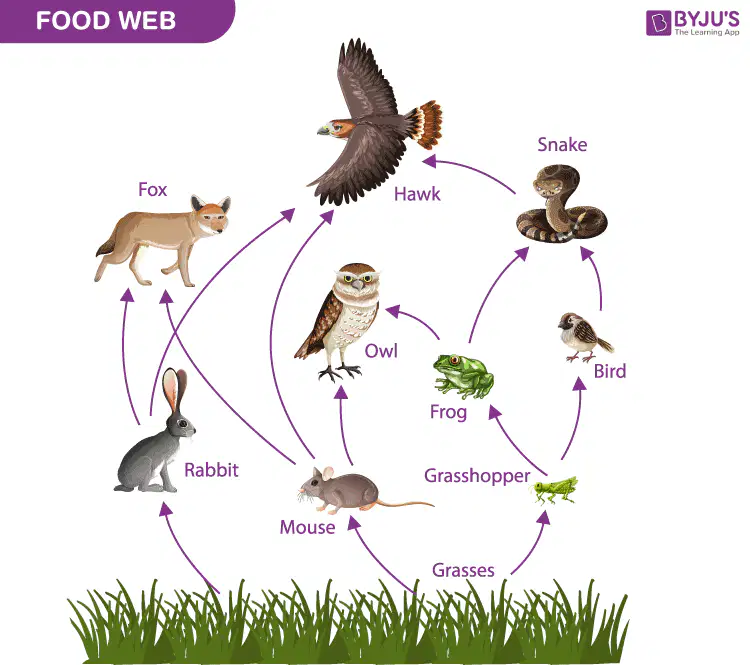
Using the food web to the right, which of the following would be a result of decreasing the grasshopper population?
a decrease in the grass population
an decrease in the hawk
a decrease in the frog & bird population
an decrease in the rabbit population
Water, Fish, Turtles, Oxygen, Rocks and Moss interacting in a river system.
Identify the examples as: a organism, population, community, or ecosystem.
All nurse sharks that live in the Pacific Ocean

