
 Worksheets
Inorganic Chemistry pt.2
Total questions: 93
Worksheet time: 47mins
What is the primary difference between metals and nonmetals in terms of band theory?
Metals have widely separated energy bands.
Nonmetals have overlapping energy bands.
Metals have overlapping energy bands.
Nonmetals allow free movement of electrons.
What is an intrinsic semiconductor?
A material with a large band gap.
A material with a small band gap.
A material with an impurity band.
A material that prevents electron movement.
What is the coordination number in simple cubic packing?
Four
Six
Eight
Twelve
In body-centered cubic packing, how is the second layer arranged?
Over the first layer
Over holes in the first layer
Over the third layer
Over the sides of the first layer
In a hexagonal arrangement, how many neighbors surround each atom in the same plane?
Four
Six
Eight
Ten
What is the packing arrangement called when a third layer is placed over the holes of the second layer in hexagonal packing?
Cubic packing
Tetragonal packing
Hexagonal close-packed (hcp)
Orthorhombic packing
In hexagonal packing, what percentage of the crystal volume is filled with atoms if the occupancy is 60 percent?
40 percent
50 percent
60 percent
70 percent
What does a higher occupancy percentage indicate in crystal structures?
A less dense arrangement of atoms
A denser arrangement of atoms
More empty space
Fewer atoms
What is the coordination number for a body-centered cubic (bcc) structure?
6
8
12
14
In a simple cubic unit cell, how many one-eighth atom segments are there?
4
6
8
10
Which packing type has an occupancy of 74%?
Simple cubic (sc)
Body-centered cubic (bcc)
Hexagonal close packed (hcp)
Cubic close packed (ccp/fcc)
How many atoms are there in a body-centered cubic (bcc) unit cell?
1
2
4
6
What is an alloy?
A single metal element
A combination of two or more solid metals
A mixture of gases
A type of nonmetal
How are atoms in alloys held together?
Ionic bonds
Hydrogen bonds
Metallic bonds
Van der Waals forces
Which of the following is NOT a type of magnetic property in metals?
Ferromagnetic
Antiferromagnetic
Ferrimagnetic
Paramagnetic
What is the characteristic of ferromagnetic materials?
Weak magnetic properties
Strong magnetic properties due to parallel alignment of unpaired electrons
No magnetic properties
Magnetic properties due to random alignment of electrons
What happens in antiferromagnetic materials?
All atomic moments align in the same direction
Adjacent atomic magnetic moments align in opposite directions
There is no alignment of atomic moments
Atomic moments align randomly
What is a characteristic of ionic compounds in their crystal form?
They are soft and malleable.
They have low melting points.
They are characterized by hardness and brittleness.
They are always liquid at room temperature.
What happens to ionic compounds when they are melted?
They become non-conductive.
They can conduct electricity.
They dissolve in non-polar solvents.
They lose their ionic character.
According to the "pure" ionic model, what happens to the outermost electrons?
They are shared equally between atoms.
They remain with the less electronegative element.
They are fully transferred to the more electronegative element.
They are not involved in bonding.
What does Fajans' Rule state about larger anions?
They are less polarizable.
They have a stronger ionic character.
They are more polarizable.
They cannot be distorted by cations.
What effect does a small, highly charged cation have on bond character?
It decreases covalent character.
It increases covalent character.
It has no effect on bond character.
It makes the bond purely ionic.
What is the polarizing power of a cation directly proportional to?
The size of the anion
The charge density of the cation
The number of electrons in the cation
The atomic mass of the cation
Why are small cations more effective at polarizing anions?
They have a lower charge density
They have a higher charge density
They have more electrons
They have a larger atomic radius
What does polarizability of an anion refer to?
The ability to gain electrons
The tendency to undergo distortion in the presence of a cation
The ability to lose electrons
The tendency to remain stable in the presence of a cation
In a simple cubic unit cell, where are anions positioned?
At the center of the cube
At each corner of the cube
Along the edges of the cube
Randomly within the cube
What is the optimal packing arrangement for anions in an ionic lattice?
Hexagonal close packing
Face-centered cubic
Simple cubic array
Body-centered cubic
What is the coordination number an indication of?
The number of neighboring ions of the same charge
The number of neighboring ions of the opposite charge
The number of atoms in a molecule
The number of electrons in an ion
Which coordination number is associated with a cubic geometric arrangement?
4
6
8
10
What is the general formula for perovskite?
ABX
ABX2
ABX3
ABX4
Which of the following is a common example of an A cation in perovskite?
Oxygen
Titanium
Calcium
Chlorine
What do Schottky defects result in within a crystal structure?
Increased density
Charge neutrality
Increased thermal conductivity
Decreased solubility
What is a Frenkel defect?
A type of defect where an atom or ion is displaced to an interstitial position, creating a vacancy.
A defect where an atom is missing from the lattice entirely.
A defect that involves the addition of a foreign atom into the lattice.
A defect that results in a change in the chemical composition of the material.
How do Frenkel defects typically form?
Due to thermal agitation allowing ions to move to interstitial spaces.
Through the introduction of impurities into the lattice.
By the application of external pressure on the crystal.
Through the exposure to high levels of radiation.
What is the impact of Frenkel defects on the density of a material?
They do not significantly change the overall density.
They increase the density of the material.
They decrease the density of the material.
They cause the density to fluctuate.
What does descriptive inorganic chemistry study?
The study of organic compounds and their reactions
The study of chemical elements and the compounds they produce
The study of physical properties of metals
The study of biological processes in organisms
What is required for a chemical reaction to be considered spontaneous?
Positive free energy
External energy input
Negative free energy
High temperature
What is an example of a compound formed through a chemical reaction mentioned in the text?
Water (H2O)
Sodium chloride (NaCl)
Carbon dioxide (CO2)
Ammonia (NH3)
What is the reverse reaction to regenerate sodium metal and chlorine gas?
2NaCl (s) → 2Na (s) + Cl2 (g)
2NaCl (l) → 2Na (l) + Cl2 (g)
NaCl (s) → Na (s) + Cl (g)
NaCl (l) → Na (l) + Cl (g)
Diagram showing the formation of a compound with Cs+, O2-, and Au+ ions.
Cs2O
Au2O
CsAuO2
CsAu
What does enthalpy represent in a chemical system?
The total heat content of a system
The total mass of a system
The total volume of a system
The total pressure of a system
What is the enthalpy change (ΔH) in an exothermic reaction?
Positive
Negative
Zero
Undefined
What is the symbol for the enthalpy of formation under standard conditions?
ΔG°
ΔS°
ΔH°
ΔE°
Which phase has the highest entropy?
Solid phase
Liquid phase
Gas phase
Plasma phase
In the reaction between hydrogen gas and oxygen gas to form water, what type of reaction occurs?
Endothermic
Exothermic
Isothermal
Adiabatic
What is the symbol used to denote the change in entropy?
ΔH
ΔS
ΔG
ΔE
In which state of matter is entropy highest?
Solids
Liquids
Gases
Plasmas
What is the formula for calculating the standard entropy change for a reaction?
ΔH° = ΣΔH°(products) - ΣΔH°(reactants)
ΔG° = ΔH° - TΔS°
ΔS°(reaction) = ΣΔS°(products) - ΣΔS°(reactants)
ΔE° = ΣΔE°(products) - ΣΔE°(reactants)
What does Gibbs Free Energy predict?
The speed of a reaction
The spontaneity of a reaction under constant pressure and temperature
The color change in a reaction
The pH level of a solution
What is the formula for Gibbs Free Energy?
ΔG° = ΔH° + TΔS°
ΔG° = ΔH° - TΔS°
ΔG° = ΔS° - TΔH°
ΔG° = ΔE° - TΔS°
What does enthalpy (ΔH) represent in a reaction?
The disorder in the system
The heat exchanged in a reaction
The temperature of the reaction
The pressure of the system
Which type of reactions are often favorable when ΔH < 0?
Reactions that absorb heat
Reactions that release heat
Reactions that decrease disorder
Reactions that increase pressure
What does entropy (ΔS) measure in a system?
The heat exchanged
The pressure of the system
The disorder or randomness
The volume of the system
What is required for a solute and solvent to mix?
Different intermolecular forces
Compatible intermolecular forces
High temperature
Low pressure
What is a characteristic of polar protic solvents?
They lack a dipole moment
They cannot form hydrogen bonds
They have a dipole moment and can donate a hydrogen bond
They are nonpolar
Calculate the free change for the following reaction at 25°C: CO(g) + 1/2O2(g) → CO2(g)
ΔG° = -283 kJ·mol⁻¹
ΔG° = -257 kJ·mol⁻¹
ΔG° = 0 kJ·mol⁻¹
ΔG° = 100 kJ·mol⁻¹
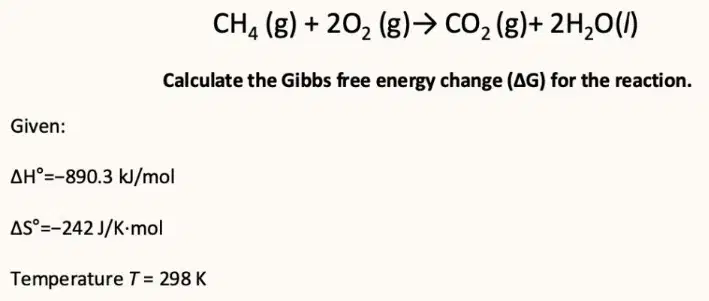
Calculate the Gibbs free energy change (ΔG) for the reaction: CH4(g) + 2O2(g) → CO2(g) + 2H2O(l)
ΔG° = -890.3 kJ/mol
ΔG° = -242 J/K·mol
ΔG° = -1000 kJ/mol
ΔG° = 0 kJ/mol
What is a characteristic of polar aprotic solvents?
They contain hydrogen atoms directly connected to an electronegative atom.
They are capable of hydrogen bonding.
They function by being strong Lewis acids or bases.
They have a high dipole moment.
Which type of solvent does not have a dipole moment?
Polar protic solvents
Dipolar aprotic solvents
Nonpolar solvents
Polar aprotic solvents
What happens during ionization in a liquid solution?
Covalent bonds are formed.
Ionic compounds are dissolved.
Covalent bonds are broken, resulting in ion formation.
Hydrogen bonds are strengthened.
What occurs during autoionization in acid-base behavior?
Solvent molecules react with each other, exchanging hydrogen ions.
Ionic compounds dissociate into ions.
Covalent bonds are formed between solvent molecules.
Hydrogen bonds are broken.
Which of the following is an example of autoionization?
NaOH + HCl → NaCl + H2O
NH3 + HCl → Cl⁻ + NH4⁺
2 H2O ⇌ H3O⁺ + OH⁻
Fe³⁺ + 6H2O → Fe(H2O)6³⁺
According to the Arrhenius classification, what ion do acids produce in aqueous solutions?
OH⁻
Cl⁻
H⁺
NH4⁺
Which classification of acids and bases involves a lone pair donor?
Arrhenius
Brønsted-Lowry
Lewis
Autoionization
What is a limitation of the Arrhenius theory?
Applicable to non-aqueous reactions
Explains neutralization without ions
Only applicable to compounds with HA or BOH
Produces acidic or basic salts
Which of the following is an advantage of the Bronsted-Lowry theory?
It explains the behavior of BF3 and AlCl3.
It explains acid-base behavior in aqueous and non-aqueous mediums.
It predicts the exact acid or base in a reaction.
It explains reactions between acidic and basic oxides.
What is a limitation of the Bronsted-Lowry theory?
It can explain the behavior of BF3 and AlCl3.
It can predict the exact acid or base in a reaction.
It cannot explain reactions between acidic and basic oxides.
It explains the formation of coordination bonds.
According to Lewis theory, what defines an acid?
An acid is a substance that donates protons.
An acid is any ion or molecule that can accept a pair of nonbonding valence electrons.
An acid is a substance that donates electrons.
An acid is a substance that forms covalent bonds.
Which of the following is a characteristic of hard acids and bases?
They have low charge densities.
They are very polarizable.
They have a high charge to ionic radius ratio.
They form covalent coordination bonds easily.
Which of the following ions is considered a hard base?
Cl⁻
H⁺
OH⁻
NH₄⁺
What characteristic do soft acids or bases typically have?
High charge to radius ratio
Low charge to radius ratio
High oxidation states
Small ions that are non-polarizable
Which of the following ions is considered a soft acid?
Fe²⁺
Pb²⁺
Ag⁺
Na⁺
In the periodic table, which type of acids/bases are found in the second and third row with a +1 or +2 charge?
Hard acids
Soft acids
Intermediate acids
Non-metal acids
According to the "Like Likes Like" principle, how do hard acids interact with bases?
More strongly with soft bases
More strongly with hard bases
Equally with hard and soft bases
Do not interact with bases
What is the order of halide binding for hard acids?
I⁻ > Br⁻ > Cl⁻ > F⁻
Cl⁻ > F⁻ > Br⁻ > I⁻
F⁻ > Cl⁻ > Br⁻ > I⁻
Br⁻ > I⁻ > Cl⁻ > F⁻
What is a frustrated Lewis pair?
A compound with a Lewis acid and a Lewis base that cannot form a classical adduct
A compound with a Lewis acid and a Lewis base that easily forms a classical adduct
A compound with only a Lewis acid
A compound with only a Lewis base
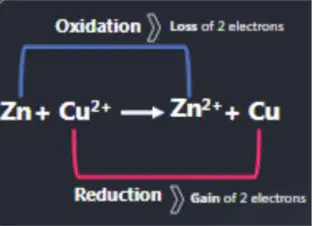
What is oxidation in an oxidation-reduction reaction?
Increase in oxidation number, gain of oxygen atoms, loss of hydrogen atoms, and loss of electrons
Decrease in oxidation number, gain of hydrogen atoms, and gain of electrons
Increase in oxidation number, gain of hydrogen atoms, and gain of electrons
Decrease in oxidation number, loss of oxygen atoms, and loss of electrons
What does the acronym OIL RIG stand for in redox reactions?
Oxidation is loss of electrons, Reduction is gain of electrons
Oxidation is gain of electrons, Reduction is loss of electrons
Oxidation is gain of protons, Reduction is loss of protons
Oxidation is loss of protons, Reduction is gain of protons
What is the oxidation number of an element by itself?
0
+1
-1
+2
What is the usual oxidation number for halogens?
-1, positive with oxygen
+1, negative with oxygen
+2, positive with oxygen
-2, negative with oxygen
What is the sum of oxidation numbers for a neutral compound?
Equals the ion charge
Equals zero
Equals the number of atoms
Equals the atomic mass
In the compound MgO, what is the oxidation state of magnesium (Mg)?
+1
+2
0
-2
What is the oxidation state of oxygen in most compounds?
-1
0
-2
+1
Which element always has an oxidation state of -1 in compounds?
Hydrogen
Oxygen
Fluorine
Nitrogen
What is the first step in balancing redox reactions in basic solutions?
Balance O with H₂O
Split into half-reactions
Balance charge with e⁻
Add hydroxide to both sides
What type of bond is a coordination bond?
Ionic bond
Covalent bond
Dative Lewis acid-base bond
Metallic bond
What is the role of a metal atom in a coordination bond?
Acts as a Lewis base
Acts as a Lewis acid
Acts as a ligand
Acts as a solvent
What are ligands in the context of coordination complexes?
Neutral molecules only
Ions only
Lewis basic molecules or ions
Lewis acidic molecules or ions
What happens to the overall charge in a coordination complex?
It becomes positive
It becomes negative
It remains unchanged
It becomes neutral
What are the two classes into which Werner complexes are separated?
Neutral/charged and monodentate/bidentate/tridentate
Coordination number and spectrochemical series
Oxidation state and electron configuration
Lewis base and Lewis acid
What is the role of a ligand in a metal-ligand interaction?
To donate protons
To act as a Lewis acid
To consist of a central metal ion surrounded by ions or molecules
To increase the oxidation state
What happens when a ligand is removed from a metal?
It leaves behind both electrons
It takes both electrons
It forms a new compound
It changes the oxidation state
What is the general information about oxidation states?
They are related to the number of protons in an atom
They determine the ability of an atom to oxidize or reduce other atoms
They are always positive
They are not observed in transition metals

