
 Worksheets
25-26 CCA1
Total questions: 50
Worksheet time: 45mins
People who wanted to separate themselves from the Church of England were called ______
From 1690 to 1760, Parliament and the king of England allowed colonists in America to exercise a great deal of control over local and regional matters. Historians have described this practice as “salutary neglect.”
Which of the following happened as a direct result of this policy?
The colonies developed a strong tradition of self-government.
Many proprietary colonies were converted to royal colonies.
The colonies refused to participate in a system of common defense.
Many colonies sought economic aid from other countries.
Mercantilism was an economic system that was created for
free Republics to buy and sell goods all over.
Kings and Queens to hide their treasures.
colonies to get rich, rich, rich!
the mother country to get rich from raw materials of a colony.
Spain's reasons for Exploration:
Establish Catholic missions
Establish a successful fur trade
Seek opportunities for religious freedom
Expand religion across their colonies
What was the document signed by the Pilgrims in 1620, which stands as the first example of many colonial plans for self-government?
Fundamental Order of Connecticut
Magna Carta
House of Burgesses
Mayflower Compact
What was the first elected general assembly in the colonies which was established in Virginia?
Mayflower Compact
Fundamental Order of Connecticut
Magna Carta
House of Burgesses
What document was signed by English nobles that limited the power of the monarch (king or queen) by guaranteeing that no one would be above the law, not even a king or queen?
House of Burgesses
Mayflower Compact
Fundamental Order of Connecticut
Magna Carta
Reasons for the growth of representative government:
Distance from England : too far from authority figure (the king)
Salutary Neglect : ignored by the colonists
The Great Awakening : religious revival
Enlightenment Era : people want a voice in their government
The idea that people hold the power of government and consent to being governed comes from --
King George
William Penn
John Locke
James Town
Which colonial region is nicknamed "The Bread Basket"?
Middle
New England
Southern
None
Which colonial region was known for its plantation system and large cash crops?
New England
Middle
Southern
Western

What was stated in the Proclamation of 1763?
Colonists were BANNED from settling west of the Appalachian Mountains.
The Proclamation ended the French and Indian War.
Colonists were ENCOURAGED to begin settling west of the Appalachian Mountains.
The Proclamation proclaimed independence for the American colonists.
According to the British what was the REASON for the Proclamation of 1763?
The Proclamation of 1763 gave all of the land to the American colonists.
The Proclamation was a meeting between Native Americans and the colonists.
It was attempt to end conflicts/war between Native Americans and colonists west of the Appalachian Mountains.
It was a law that allowed colonists the chance to settle west of the Appalachian Mountains.
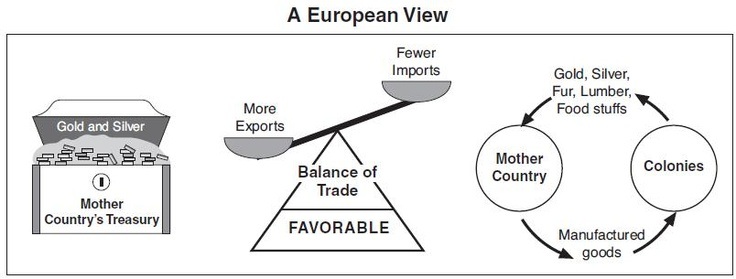
What is mercantilism?
A system where a mother countries gains money and power from natural resources that come from its colonies.
where colonies trade gold and silver with each other.
Wars that start over money.
Plantation colonies trading slaves for money.
How many voyages did Christopher Columbus make?
one
two
three
four
Which of the following BEST describes the idea of "No Taxation without Representation"?
The colonists wanted to pay taxes as along as Britain did the work of creating laws for them.
The colonists did not want to pay taxes to the British government, because that means they needed to do a lot of work making laws.
The colonists did not want to pay taxes to the British government because they felt that they didn't have a say in the laws that were being made for them.
The colonist voted on representatives to speak on their behalf in the British Parliament. In turn, they did not have to pay taxes
What caused the British to impose the Sugar Act on the colonists?
British tea was very bitter and needed a lot of sugar to make it tolerable
The British government needed money to pay for the expensive protection of the American colonies from the French and Indian War.
Sugar was very expensive to ship to the American colonies so the British wanted the colonists to pay the cost
There had been many tropical storms that ruined the sugar plants so the British government needed to collect the tax to pay for new sugar crop to be planted
7. What was the effect of colonists throwing British tea into the Boston Harbor?
It made Britain so angry that it caused the Boston Massacre to happen
It caused Britain to send a new governor over to Boston that put all colonists under house arrest and
It led to sugar being taken away, stamps needed on every paper, and taxes were imposed on tea
It led to more Acts being imposed, more British troops being sent, meetings were not allowed to be held, and ultimately led to the Revolutionary War
Match the following
New England Colonies
used trade, shipbuilding, fishing and fur trapping to make money
Included Pilgrims and Puritans
Southern Colonies
Cash crops
plantations
House of Burgesses
Warm and humid climate
Middle Colonies
agriculture and trade
diverse population
moderate climate
The Tea Act resulted in what act of civil disobedience?
Boston Tea Party
Revolutionary War
Mayflower Compact
Lexington and Concord
When the colonists said "No Taxation without Representation" what did they mean by Representation?
They hated ALL taxes
They did not get any promotional material from the company representative
A colonial form of government

Which of the following best replaces the question mark in the diagram?
created a general council to manage the colonies
experienced strict control by Parliament
established their own representative governments
appointed governors who reported to the King

The factors listed above contributed most to the —
creation of alliances between British settlers and American Indians
election of British colonists to Parliament
growth of representative government in the British colonies
expansion of British trade in the Americas

Which sentence best completes this diagram?
The Puritans allowed women to participate in government.
The Puritans refused to obey the appointed governor.
The Puritans outlawed slavery in Massachusetts.
The Puritans developed a form of representative self-government.

Which statement explains the significance of this colonial institution?
The assembly served as a model for other colonial legislatures.
Colonists used the assembly to overrule decisions of the royal governor.
The assembly sent delegates to Parliament to represent Virginia.
The king revoked Virginia’s charter because the assembly became too powerful.
"With England 3,000 miles away, political and legal matters couldn’t wait for word from England."
Which of the following reasons matches the description?
Distance
Rights and Traditions of Englishmen
Salutary Neglect
Self-Governing Colonies
"British policies were rarely enforced in the colonies, due to the belief that the colonies might flourish without strict supervision."
Which of the following reasons matches the description?
Distance
Rights and Traditions of Englishmen
Salutary Neglect
Self-Governing Colonies
What is the name of the act that the British passed as punishment for the Boston Tea Party, which closed the port of Boston until damages from the Boston Tea Party were paid?
The Quartering Act
The Stamp Act
The Townshend Act
The Intolerable/ Coercive Acts
What was the name of Britain's law-making assembly?
Parliament
Congress
House of Representatives
First Continental Congress
What was the purpose for establishing the Committees of Correspondence?
To maintain communication with one another
To start a war
To communicate with King George III
To invent the telephone


Which of the following was not an item taxed under the townshend act?
Paints
Glass
Lead
Lumber

Which 1765 law placed a direct tax on newspaper, playing cards, shipping papers and other legal documents by requiring stamps on these printed materials?
Sugar Act
Stamp Act
Paper Act
Tea Act
Which of the following was a significant reason for European exploration?
To study and document new plant and animal species
To establish democratic governments in the New World
To search for a direct route to Asia for the spice trade.
To promote cultural exchanges with Native American civilizations
Why did France colonize (claim land) in the New World?
To profit from fur trading with Native Americans
To spread Christianity and Catholicism
To establish colonies for economic reasons
To find new trade routes to Asia
Why did England establish colonies in the New World?
For economic reasons
To spread Christianity and Catholicism
To profit from fur trading with Native Americans
To find new trade routes to Asia

Which pair of actions best completes this graphic?
Enslaved native populations / Organized utopian societies
Established Catholic missions / Focused primarily on fur trading
Promoted political freedom / Participated in the triangular trade
Became commercial shipbuilders / Created an early system of public schools
What were the primary reasons for establishing the Plymouth and Jamestown colonies?
Both colonies aimed for economic prosperity through trade and agriculture.
Plymouth sought religious freedom, while Jamestown pursued economic gains.
The colonies were established to expand the British Empire's territorial claims.
Plymouth and Jamestown were both founded as military outposts.
Label the colonial regions.
New England
Middle
Southern
Virginia
Cash Crops
Long growing seasons/fertile soil
Quakers
William Penn
Diversity
Religious Tolerance
Puritans/Pilgrims
Rocky Soil
Economy based on shipbuilding, fishing, trade
Economy based on agriculture
Economy based on trade and grain crops
Religiously intolerant
New England Colonies
Region most reliant on the Atlantic Ocean for trade, shipping, and fishing
Middle Colonies
Region most characterized by cultural, economic and religious diversity
Southern Colonies
Region most known for plantations reliance on slave labor
Match the region with its description
New England
subsistence farming, shipping, & lumber
Middle
farming (grain)
Southern
cash crops, large # of enslaved people
Match the following
House of Burgesses
1st representative gov't in the colonies
Mayflower Compact
1st self governing document (Pilgrims)
Enslaved Africans
Brought to Americas on Middle Passage
Mercantilism
"mother" country gets wealth from colony
Match the following vocabulary words to their most direct example
English Bill of Rights
Individual rights (Freedom of speech)
Representative Government
Virginia House of Burgesses
Mayflower Compact
Self Government
Fundamental Orders of Connecticut
1st written Constitution in the colonies
Magna Carta
Limit the King's power

