
 Worksheets
Unit 2 (SSUSH 6-10) Review
Total questions: 57
Worksheet time: 33mins
During whose presidency was the Louisiana territory purchased, doubling the size of the United States?
John Adams
George Washington
Thomas Jefferson
James Madison
During his presidency, he wrote a doctrine that told European nations not to interfere in the Western Hemisphere.
James Monroe
James Madison
Thomas Jefferson
George Washington
Which job did Alexander Hamilton hold in Washington's cabinet?
Secretary of State
Secretary of War
Secretary of the Treasury
Attorney General
Postmaster General
What is a loose interpretation of the Constitution?
The belief that the Constitution grants you lots of rights
The belief that the Constitution should limit your rights
The belief that there are implied powers in the Constitution
The belief that the Constitution must be word for word
What is a strict interpretation of the Constitution?
The belief that there are implied powers in the Constitution
The belief that the Constitution grants you lots of rights
The belief that the Constitution should limit your rights
The belief that the Constitution must be taken word for word


In the 1820s, voting rights expanded to include who?
All white men 21 and over.
All white men and women over 21.
All White and Black men 21 and older.
All white and Native Americans 21 or older.

U.S. President who signed the Indian Removal Act of 1830 ordering ALL Native Americans to be relocated west of the Mississippi River.
George Washington
Thomas Jefferson
James Madison
Andrew Jackson

Which state said they wouldn't pay the new tariff and passed the Nullification Act?
North Carolina
South Carolina
Virginia
Georgia

Who was the mastermind behind the American System?
Henry Clay
John C. Calhoun
Thomas Jefferson
Andrew Jackson


Secede means
to win.
to lose.
to change.
to withdraw.
An 1854 law that established the territories of Kansas and Nebraska and gave their residents the right to decide whether to allow slavery.
Compromise of 1850
Kansas-Nebraska Act
Missouri Compromise
Fugitive Slave Law
Who was the president of the Confederacy?
Abraham Lincoln
Ulysses S. Grant
Jefferson Davis
Robert E. Lee

Who was the general that surrendered to General Grant at Appomattox Courthouse in 1865, ending the Civil War?
Stonewall Jackson
Robert E. Lee
Winfield Scott
Abraham Lincoln
At the end of which battle did General Grant and his troops secure control of the Mississippi River?
Antietam
Gettysburg
Vicksburg
Richmond
Which 3-day battle was the turning point of the war for the Union army?
Gettysburg
Antietam
Cold Harbor
Fall of Richmond

Which statement BEST explains President Abraham Lincoln's original reason for fighting the Civil War?
President Lincoln wanted to end all slavery everywhere in the US
President Lincoln wanted to preserve the Union
President Lincoln wanted to punish the South for their rebellion

What was the MOST SIGNIFICANT outcome of the Dred Scott court case?
Slaves were determined to have "no rights which any white man was bound to respect"
The North scored a major victory in abolishing slavery
Congress could not outlaw slavery anywhere in the US
What were the advantages the South had in the war? (Check all that apply).
Military leadership (better generals)
Larger army
Fighting in familiar territory
More money

Based on the pictograph, predict which side would win the war because it had more resources.
Union (North)
Confederates (South)
Western Territories
The main goal of the Ku Klux Klan during the Reconstruction was to
prevent African Americans from exercising their rights.
gain control of state legislatures.
restore the Confederacy.
improve conditions for poor whites.
The Fourteenth Amendment was part of a series of laws that
ensured the civil rights of African Americans.
shifted the balance of power in favor of the Supreme Court.
changed the way a President could hire government officials.
restored the balance of power between the President and Congress.
The Freedmen’s Bureau succeeded in
electing African Americans to southern state governments.
keeping ex-Confederate supporters out of office.
redistributing formerly white-owned land to black southerners.
providing clothing, medical care, food, and education to many freed people.
The goal of the Freedmen’s Bureau was to
prevent African Americans from voting.
force African Americans to move north.
help former slaves adjust to freedom.
abolish slavery.
The Reconstruction Act of 1867
gave voting rights to all Southerners.
closed the South to scalawags.
closed the South to Democrats.
put the South under military rule.
What was the verdict in President Johnson’s impeachment trial?
He escaped conviction by one vote.
He was forced to confess his guilt.
He was removed from office.
He was found guilty.

This system of agriculture developed in the late 19th century, in which a landowner allowed a tenant to use the land in return for a portion of what was produced. It was called:
slash and burn farming
sharecropping
rent farming
farm to fork farming

The period of rebuilding of the South after the Civil War was known as
The Renaissance
Reconstruction
The Gilded Age
The Industrial Revolution

What organization was designed to intimidate former slaves and anyone who supported former slaves?
Ku Klux Klan
Freedmen's Bureau
Black Codes
Lincoln's Lenient Reconstruction Plan.
30% OFF
10% Plan
The Dab
20% Plan
Who was president of the Confederate States during the war?
Jefferson Davis
Thomas Jefferson
John Adams
Alexander Hamilton
The first shots of the Civil War were fired at this fort on April 12, 1861.
Fort Benning
Fort Sumter
Fort Belvoir
Fort Pierce
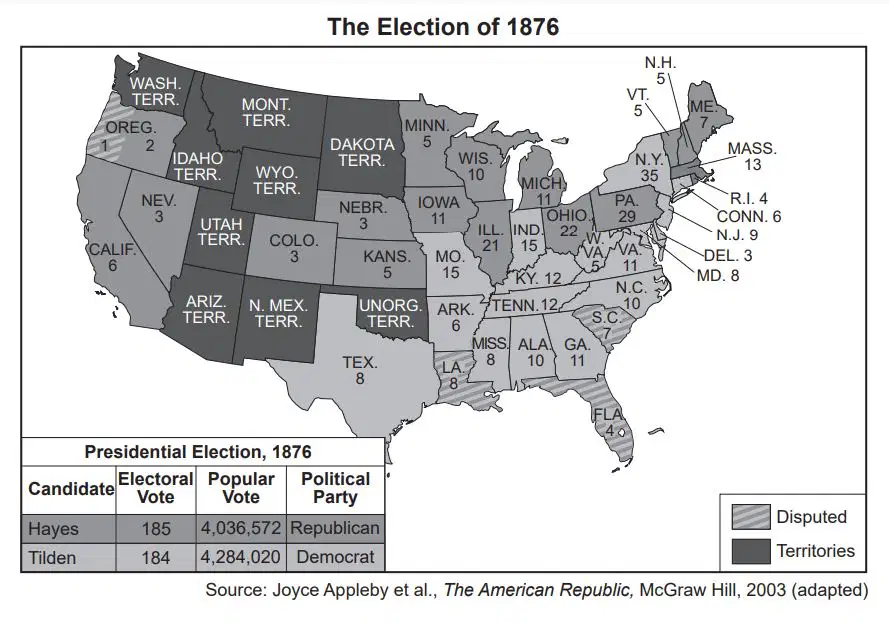
What was one result of the election of 1876?
Fighting in the Civil War continued.
Reconstruction officially ended.
Federal troops remained in the South.
Discrimination ended in the South.

Granted citizenship and guaranteed equal protection under the law
13th Amendment
14th Amendment
15th Amendment
Civil Rights Act of 1866

Gave African American men the right to vote
13th Amendment
14th Amendment
15th Amendment
Civil Rights Act of 1866

Case brought before the Supreme Court involving a slave who wanted his freedom: Court decided African Americans CAN'T be citizens and can't sue in federal court.
Dred Scott Decision
Compromise of 1850
Kansas-Nebraska Act
Fugitive Slave Act
Secede means
to win.
to lose.
to change.
to withdraw.
He led a slave revolt that killed 57 people.
Nat Turner
Harriet Tubman
Frederick Douglass
John Brown

What did the southern states do after Lincoln was elected?
Formed the Confederate States of America
Seceded from the country
Voluntarily freed all the slaves
Wrote letters to thank Lincoln for his service

Law in 1820 that prevented slavery north of the 36 degree, 30'N parallel and allowed Maine to enter as a free state and Missouri as a slave state.
Protective Tariff
Sectionalism
Missouri Compromise
Kansas-Nebraska Act

Belief that it is more important to focus on your area then the nation as a whole.
Protective Tariff
Sectionalism
Missouri Compromise
Kansas-Nebraska Act

