
Font size
 Worksheets
Quarter 1 Science Review
Total questions: 83
Worksheet time: 42mins
Why are experimentation and evidence important in science?
They provide a systematic way to test hypotheses.
They eliminate the need for observation.
They ensure that all scientific theories are correct.
They allow scientists to avoid making mistakes.
Which of the following best describes the role of hypotheses in scientific investigations?
They are final conclusions based on data.
They are untested assumptions.
They are testable explanations for observations.
They are irrelevant to the scientific method.
What does the term “electromagnetic spectrum” refer to?
The range of different sound frequencies.
The range of all types of light radiation.
The range of different types of gases.
The range of temperatures in space.
How has studying old solar system models helped us understand how planets move and are arranged today?
By providing historical context and comparison
By offering precise mathematical models
By predicting future planetary positions
By showing the influence of other galaxies
Which of the following statements is true about the scientific method?
It is a rigid set of steps.
It is based solely on intuition.
It does not require experimentation.
It involves making observations, forming hypotheses, and testing them.
The ozone layer plays a crucial role in protecting life on Earth by:
Blocking harmful ultraviolet radiation from the sun
Increasing the Earth's temperature
Absorbing carbon dioxide
Producing oxygen
Which historical model of the solar system placed Earth at the center?
Heliocentric model
Big Bang model
Geocentric model
Nebular model
Gravity affects the formation of objects in our solar system by influencing the structure and movement of celestial bodies. Which of the following is NOT an example of an object formed by gravity?
Planets
Stars
Moons
Asteroids
The process of testing a scientific hypothesis through experiments and observations is known as ______.
hypothesis
experimentation
control
variable
analysis
Which of the following is a property of stars?
They have no gravitational pull.
They emit light and heat.
They are always cold.
They do not produce energy.
Electromagnetic waves that are also low in energy and used for cell phones and heating food.
Microwaves
Gamma rays
X-rays
Ultraviolet rays
Energy that travels in waves, including light, radio waves, and microwaves.
Electromagnetic energy
Thermal energy
Chemical energy
Nuclear energy
The distance between one wave and the next. Long wavelengths mean the waves are more spread out, and short wavelengths mean they are closer together.
Wavelength
Frequency
Amplitude
Velocity
Waves that are between microwaves and visible light. Felt as heat, like warmth from the sun or a fire.
Infrared waves
Ultraviolet waves
Radio waves
X-rays
Electromagnetic waves with low energy and long wavelengths, used for sending signals like music to radios or helping with GPS navigation.
Radio waves
Gamma rays
X-rays
Ultraviolet rays
The strongest type of electromagnetic waves, which come from changes in atoms. They can be harmful because they have so much energy.
Gamma rays
X-rays
Microwaves
Radio waves
How often a wave moves up and down in a certain amount of time.
Frequency
Amplitude
Wavelength
Velocity
The properties of stars, such as color and temperature, can be used to determine their:
Age and composition
Distance from Earth
Size and mass
Orbital speed
Compare and contrast the properties and behaviors of light when interacting with each different material: 1. Transparent objects 2. Translucent objects 3. Opaque objects
Light passes through transparent objects without scattering.
Light is scattered as it passes through translucent objects.
Light does not pass through opaque objects.
All of the above
Which model, Heliocentric or Geocentric, places the Sun at the center of the solar system?
Heliocentric
Geocentric
The distance between the Earth and the Sun is approximately:
1 million kilometers
200 thousand kilometers
50 million miles
93 million miles
What type of light interaction occurs when light passes through a transparent material and bends?
Reflection
Absorption
Refraction
Diffraction
How has new technology made it easier to watch and study space objects and events?
By providing high-resolution telescopes
By reducing the cost of space missions
By enabling real-time data transmission
By increasing the number of space observatories
How do astronomers determine the distance between celestial objects?
By measuring the angle of parallax
By using the Doppler effect
By calculating the object's brightness
By observing the object's color
Which of the following phrases is most appropriate when discussing scientific findings?
The results prove the hypothesis
The hypothesis is correct
The results support the hypothesis
The data confirms the theory
Which of the following is a characteristic of scientific knowledge?
It is fixed and unchangeable.
It is based on empirical evidence and subject to revision.
It is based on personal beliefs and opinions.
It remains the same across all cultures.
How does light from the Sun reach the Earth?
Through a vacuum in space
By conduction through air
Via sound waves
Through water currents
Sort the electromagnetic waves on the electromagnetic spectrum from lowest frequency (left) to highest frequency (right):
Radio Waves, Microwaves, Infrared Waves, Visible Light, Ultraviolet Waves, X-Rays, Gamma Waves
Gamma Waves, X-Rays, Ultraviolet Waves, Visible Light, Infrared Waves, Microwaves, Radio Waves
Visible Light, Infrared Waves, Microwaves, Radio Waves, Ultraviolet Waves, X-Rays, Gamma Waves
X-Rays, Gamma Waves, Ultraviolet Waves, Visible Light, Infrared Waves, Microwaves, Radio Waves
Which type of electromagnetic radiation is primarily used in medical imaging to view the inside of the body?
Radio Waves
Microwaves
Infrared
X-rays
Which layer of the Earth’s atmosphere contains the ozone layer?
Troposphere
Mesosphere
Thermosphere
Stratosphere
Scientists use models to understand complex systems in space, like the solar system, because they help simplify and explain these systems. Which of the following is an example of a historical model that impacted scientific knowledge?
The Ptolemaic model
The Copernican model
The Tychonic model
The Aristotelian model
Which of the following is an example of refraction in everyday life?
A mirror reflecting light
A straw appearing bent in a glass of water
A black shirt absorbing sunlight
A white wall reflecting sunlight
What type of light interaction causes the colors of a rainbow to appear?
Refraction
Reflection
Absorption
Transmission
How is space organized from galaxies to single stars? Explain how this helps us understand the universe.
Space is organized into galaxies, which contain stars, planets, and other celestial bodies.
Space is a random collection of stars and planets without any organization.
Galaxies are smaller than stars and are part of a larger cosmic structure.
Stars are organized into galaxies, which are isolated and do not interact with each other.
How do light waves travel through different materials?
Light travels through air and water but not solids.
Light travels through solids and water but not air.
Light travels at the same speed through all mediums.
Light travels through all mediums but travels slowest through solids.
How do light waves travel through different materials?
Light travels through air and water but not solids.
Light travels through solids and water but not air.
Light travels at the same speed through all mediums.
Light travels through all mediums but travels slowest through solids.
Why do astronomers use X-ray or radio telescopes to capture images of objects in space?
Telescopes are the only form of technology that can detect images in space
Telescopes can capture images in all forms of the electromagnetic spectrum
Telescopes can capture images at wavelengths of light that are visible to the human eye
Telescopes can capture images at wavelengths of light that are invisible to the human eye
The Sun is classified as this type of star:
Red Giant
Yellow Dwarf
White Dwarf
Main Sequence
The layer of the Sun where Nuclear Fusion occurs:
The Chromosphere
The Core
The Photosphere
The Corona
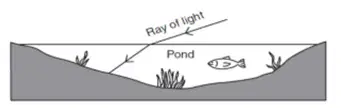
What happens to the light as it enters the pond?
Reflection
Refraction
Absorption
Scattering
An astronomer observes a sunspot. Which of the following describes this feature of the Sun?
Where heat rises to the Sun’s surface
Location that produces most of the Sun’s heat energy
Location that is cooler than other parts of the Sun’s surface
Where energy and matter leave the Sun’s atmosphere
The visible surface of the Sun that we can see from Earth
Photosphere
Chromosphere
Radiative Zone
Atmosphere
Energy from the Sun's core moves through the radiative zone via
Nuclear Fusion
Radiation
Convection
Emanation

How does Star X compare to the Sun?
Star X is brighter and hotter than the Sun.
Star X is dimmer and cooler than the Sun.
Star X is dimmer and hotter than the Sun.
Star X is brighter and cooler than the Sun.
The outermost layer of the Sun's atmosphere
Stratosphere
Photosphere
Chromosphere
Corona
Why an apple is green?
It refracts green light
It absorbs all colors of visible light but reflects green light
It absorbs green and reflects all other colors of visible light.
Green is the only color of visible light that shines on the apple
The Sun rotates every _ days at the Equator
27
25
24
30
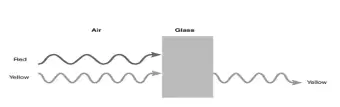
What happened to the red light?
The glass absorbs the red light.
The glass absorbs the yellow light.
The glass refracts the yellow light.
The glass reflects the red light.
What is the most common element found in stars?
Oxygen
Helium
Hydrogen
Carbon
Which property of a star is directly related to its color?
Age
Temperature
Distance
Size
How is visible light from the Sun different from other forms of electromagnetic radiation?
It has different amplitudes.
It travels a different distance through space.
It is a different form of energy.
It has different wavelengths.
How bright a star appears from Earth:
Distance
Luminosity
Absolute Brightness
Apparent Magnitude
How bright a star looks from a standardized distance of 10 parsecs
Absolute Brightness
Apparent Brightness
Luminosity
Radiance
The total energy output of a star
Absolute Brightness
Radiance
Luminosity
Apparent Brightness
Why do we see objects as the color that they are?
The color of the object is the color of light being absorbed, all other colors are reflected.
The color of the object is the color of light being reflected, all other colors are absorbed.
The color of the object is due to all of the colors being absorbed.
The color of the object depends on the transparency of the object.
The hottest stars radiate _ visible light.
Red
Orange
Yellow
Blue
The coolest stars radiate _ visible light.
Blue
White
Orange
Red
Energy that moves through space in waves, like sunlight or heat from a fire
Visible Light
Frequency
Microwaves
Radiation
When a star's size and temperature increases, its absolute brightness _
Increases
Decreases
Why does thunder sound like a loud boom when lightning strikes nearby, but it makes a rumbling sound from far away?
The further away the source of sound, the more the sound gets distorted
Thunder travels slower over longer distances
The sound is absorbed by the Earth's magnetic field
The temperature of the clouds changes the sound of thunder
An effect that occurs when light bends as it passes from one substance into another
Reflection
Absorption
Refraction
Diffraction
An effect where light is taken in by a substance or surface
Absorption
Reflection
Refraction
Diffusion
An effect that occurs when light hits smooth, shiny surfaces and bounces back.
Refraction
Reflection
Absorption
Diffusion
Anything that has mass and takes up space
Matter
Energy
Light
Force
Part of the electromagnetic (EM) spectrum that has the highest frequency
Radio Waves
Gamma Rays
X-Rays
Infrared Waves
The distance between one crest of a wave to the next
Velocity
Amplitude
Frequency
Wavelength
Which of the following types of radiation has the longest wavelength?
Infrared
Ultraviolet (UV)
X-rays
Gamma Rays
All light passes through
Opaque
Translucent
Transparent
Baroque
No light passes through
Opaque
Baroque
Equivoque
Transparent
Some light passes through
Opaque
Translucent
Transparent
Transfixed
An object that _ a certain color of light appears to be that color.
Absorbs
Reflects
Converts
Transfers
Electromagnetic waves that are low in energy and used for cell phones and heating food.
Infrared Waves
Radio Waves
Microwaves
Cellular Data
Invisible waves with more energy than light. These waves might cause skin damage or cancer.
Ultraviolet (UV)
Waves
X-Rays
Gamma Rays
Infrared Waves
What is the first step in the scientific method?
Formulating a hypothesis
Communicating results
Conducting an experiment
Making an observation
What is a hypothesis?
A final conclusion
A scientific tool
A testable possible answer to a question
A detailed experiment
What is the purpose of a control group in an experiment?
To test multiple variables
To provide a baseline for comparison
To change the outcome of the experiment
To ensure the experiment is complex
What is an independent variable?
A variable that is not used
A variable that is kept constant
A variable that is measured
A variable expected to have an effect
What is a null hypothesis?
A hypothesis that states there is no effect
A hypothesis that is proven
A hypothesis that cannot be tested
A hypothesis that is always true
Why do scientists avoid claiming to 'prove' a specific idea?
Because science is mutable and continuously changes
Because experiments are always wrong
Because hypotheses are never testable
Because observations are not important
What should be done if the results of an experiment do not support the hypothesis?
Stop the experiment
Prove the hypothesis
Modify the hypothesis based on new observations
Ignore the results
What is the dependent variable in an experiment?
The variable that is manipulated
The variable that is measured
The variable that is kept constant
The variable that is not used
What is the role of communication in the scientific method?
To keep results secret
To stop further experiments
To change the hypothesis
To share results with other scientists and the public
What is the crux of scientific inquiry?
A stepwise recipe
A continuous refinement and testing of ideas
A final conclusion
A single experiment

