
Font size
 Worksheets
S.S. Quarter 1 Review
Total questions: 161
Worksheet time: 2hrs 49mins
One of the main differences in the reasons for Jamestown and Plymouth was that (a)
Which statement best explains the significance of the Mayflower Compact?
It limited the power of future colonial governments
It weakened the influence of religion in government
It established a form of self-government based on social contract
It guaranteed liberties for colonists through local government
Which is true about social differences in Jamestown and Plymouth
Unlike Plymouth, Jamestown settlers moved as whole families
Unlike Jamestown, Plymouth was settled for commercial reasons
Unlike Jamestown, Plymouth settlers moved as entire families
Unlike Plymouth, Jamestown banned slavery
What caused the Pilgrims to land at Cape Cod instead of Northern Virginia?
A storm
A bad map
They wanted to land at Cape Cod
a attack on the ship by the Spanish
Separatists
A group of settlers that wanted to leave Jamestown
Colonists of the New World that wanted to separate from the Old World
A Protestant group that wanted to separate from the Church of England but were persecuted for their beliefs
A Catholic group that wanted to separate from Spain
Who provided the charter needed to start Jamestown Colony?
John White
King James I
Spaniards
Queen Elizabeth II
What was the main purpose of Jamestown Colony?
Farming
Land ownership
Wealth
Freedom of Religion
What was the Mayflower Compact?
A document that allowed the Native Americans to live on the colony.
A document that allowed women to vote.
A document that listed a set of rules that 41 male passengers agreed to follow in the colony.
A document that allows for colonists to trade amongst each other.
One way in which Jamestown and Plymouth were similar was that -
both established colonies in Massachusetts
both suffered from violent relations with Native Americans
both suffered harsh winters where many settlers died
both were successful in surviving the first year in the New World
A soldier and adventurer who took control of Jamestown in its first year.
Roger Williams
Anne Hutchinson
John Smith
Bacon's Rebellion
Created in 1619, the first representative assembly in the American colonies.
Mayflower Compact
House of Burgesses
Fundamental Orders of Connecticut
charter
What happened in 1607?
Jamestown was founded
Plymouth was founded
The Magna Carta was written
The Louisiana Purchase
What happened in 1620?
Jamestown was founded
Plymouth was founded
The Declaration of Independence
The Constitution was written
a written contract issued by a government giving the holder the right to establish a colony.
charter
cash crop
House of Burgesses
Mayflower Compact
A business in which investors pool their wealth in order to turn a profit.
charter
cash crop
joint-stock company
Fundamental Orders of Connecticut
A person who sold his or her labor in exchange for passage to America.
Pilgrims
Puritans
Indentured Servant
Anne Hutchinson
A crop produced for profit rather than personal use.
cash crop
charter
Mayflower Compact
House of Burgesses

What colony is this?
Georgia
Massachusetts
South Carolina
Pennsylvania

What colony is this?
Virginia
New Jersey
Connecticut
New York

What colony is this?
Delaware
Rhode Island
Pennsylvania
North Carolina

What colony is this?
New Hampshire
Georgia
Massachusetts
Connecticut

What colony is this?
Virginia
North Carolina
Pennsylvania
Massachusetts

What colony is this?
Virginia
New York
Maryland
New Jersey

What colony is this?
Georgia
Pennsylvania
New Hampshire
Maryland

What colony is this?
New York
Maryland
Connecticut
New Jersey

What colony is this?
South Carolina
Georgia
Virginia
Rhode Island

What colony is this?
Connecticut
Rhode Island
Maryland
Pennsylvania

What colony is this?
Massachusetts
Pennsylvania
New Hampshire
North Carolina

What colony is this?
New Hampshire
Massachusetts
New York
Rhode Island

What colony is this?
Pennsylvania
Virginia
Georgia
South Carolina

What are the New England colonies?
Massachusetts, New Hampshire, Connecticut, Rhode Island
Maryland, Virginia, North Carolina, South Carolina, Georgia
New York, New Jersey, Pennsylvania, Delaware
Connecticut, Rhode Island, New York, New Jersey

What are the Middle colonies?
New York, Connecticut, Rhode Island, South Carolina
Maryland, Virginia, North Carolina, South Carolina, Georgia
New York, New Jersey, Pennsylvania, Delaware
Massachusetts, Virginia, New Jersey, Delaware

What are the southern colonies?
New York, South Carolina, Maryland, North Carolina
Massachusetts, New Hampshire, Connecticut, Rhode Island
Virginia, New Hampshire, Georgia, Pennsylvania
Maryland, Virginia, North Carolina, South Carolina, Georgia

Red region
(a) colonies
Plantations were common in the __ colonies
New England
Middle
Southern
Trade, whaling, and fishing are the key economic activities
New England
Middle
Southern
__ was settled mainly by people of a Puritan background
New England
Middle
Southern

Who was the founder of Pennslyvania?
William Penn
Ann Hutchinson
Roger Williams
George Washington
Jamestown was founded for ___ reasons.
economic
religious
political
Which region did the Quakers settled
(a) for (b) .
(a) was established as a safe place for debtors to start over. It is the most southern colony and it is number 13!
How were the Southern Colonies different from New England and Middle Colonies?
The South had the first public schools.
Whaling was a huge part of the South's economy.
The South had more factories.
The South relied upon slave labor to plant/pick their cash crops.
What was the 2nd leg of the Triangular Trade route between Africa and the Americas called?
The Sea of Suffering
The Passage of Pain
The Middle Passage
The Route of Ruination
Lord Baltimore founded the colony of ____________ , in the Southern Region, so Catholics could worship freely there.
Jamestown
Maryland
Florida
Maine
The Middle Colonies produced so much wheat, barley and rye, they became known as the
"Breadbasket" colonies
"High-Yielding" colonies
"Prolific Pennsylvanians"
"Fruitful Friends"
Who was the founder of the colony of Georgia?
Mary Musgrove
Tomochichi
James Oglethorpe
The Indians and the settlers ______ their resources with each other.
stole
traded
hid
What was one of James Oglethorpe's goals for the Georgia colony?
Find gold and riches
Create a place where other colonists could fish and find food for their families
Provide a safe place for freed prisoners
How did creating the Colony of Georgia help England?
They found a vain of gold
It was a good trading spot
Relieved England of many poor and Jailed people
It was their first North American colony
Georgia was known as a _______
buffer colony
trading colony
military colony
fort colony
Georgia was known as a _______
fort colony
trading colony
military colony
debtor colony
Why was Georgia known as a buffer colony
Georgia had many very strong men
Georgia was an area between the Spanish and other colonies
Georgia is between the ocean and the mountians
A colony created for people who owe money to get a second chance.
Buffer colony
Military colony
Debtor colony
Fort colony
Which of the following are reasons for creating Georgia?
Buffer colony
Debtor Colony
Relieve England of Poor people
All of the above
England shipped ________ ___________ to Africa and the colonies
raw materials
finished goods
enslaved peoples
contraband exports
The colonies shipped ________ ___________ back to England.
raw materials
finished goods
enslaved peoples
contraband exports
Africa shipped ________ ___________ to the New World.
raw materials
finished goods
enslaved peoples
contraband exports
As a result of Triangular Trade the Southern Region's economy relied on...
Food crops
Ship building
Cash crops
Livestock
The economic policy that made the "mother country" rich by not letting colonies trade with anyone else was known as...
Salutary Neglect
Free Market System
Capitalism
Mercantilism
What effect did the slave trade have on the colonies
It brought prosperity to all regions
Slavery exploded in New England
Tenison between the South and New England
The middle colonies grew more cash crops
Mercantilism was LOVED by the colonists because it gave them a stable market to trade with.
True
False
What was the name of the voyage that brought slaves over to the New World?
The Middle Passage
The First Passage
The Second Passage
The Final Passage

Which term means a good to sold another country?
Import
Export
William Penn founded Pennsylvania as a refuge for...
Catholics
Puritans
Mormons
Quakers
They felt they were being taxed unfairly because they were not represented in the British government
Colonists protested the Stamp Act because they believed in what phrase?
Live free or die
All men are created equal
Life, liberty, and pursuit of happiness
No taxation without representation
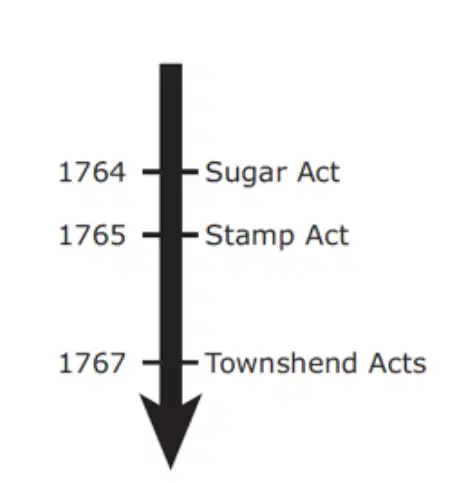
What was the primary reason Parliament passed these acts?
To promote the growth of cottage industries in the colonies.
To encourage foreign trade with the colonies.
To recover the cost of defending the colonies in the French and Indian War.
To fund the establishment of new colonies.
British colonists objected to the Proclamation of 1763 because they--
feared it would provoke attacks from Native Americans
did not want to share control of the fur trade with France
resented the limits it imposed on westward expansion
wanted to be able to trade freely with foreign nations
Why did the colonists write the Declaration of Independence?
To officially break away from Britain
As a final attempt at peace with Britain
To form the U.S. military
To get France on their side

Which event was a major form of protest against British rule?
The Boston Tea Party
The Intolerable Acts
Lexington and Concord
The Boston Massacre

Boston Harbor was closed as part of
The Sons of Liberty
Common Sense
Lexington and Concord
The Intolerable Acts

Colonists wanted representation in
British Parliament
American government
history
independence

Common Sense was
the British response to war
a pamphlet to convince colonists of independence
King George's declaration of war
a concept of the Great Awakening
Colonists thought some of the English laws were unfair. What is one way they tried to change these laws?
not voting in elections
moving out of the area
voting for a new king
holding boycotts
What did Britain create to keep the colonists from fighting with the Native Americans?
French and Indian war
Proclamation Line of 1763
Stamp Act
Quartering Act
Why did Britain create the Coercive Acts (Intolerable Acts)?
to pay for the Boston Massacre
to coerce colonists into being more loyal
to create more money to pay off the French & Indian War
To punish the colonist for dumping tea
What was Britain's response to the Boston Tea Party?
Tea Act
Boston Massacre
Intolerable Acts
Townshend Acts
How did Great Britain increase its control of the colonies?
It forced colonists to work for the government.
It demanded that colonists join the army.
It required that colonists pay taxes.
It took away colonists' land.
What did the colonists resent most about the Stamp Act?
They did not believe in taxation
They had no taxation without representation
People in Great Britain did not have to pay taxes.
People in Great Britain were taxed only on property.
How did Parliament respond to the colonists’ protests against the Stamp Act?
They refused to sell stamps to the colonists.
They arrested those who complained about the Stamp Act.
They increased the tax on paper.
They repealed the Stamp Act.
What did Britain create to keep their troops in the colonies stocked and cared for?
Tea Act
Stamp Act
Quartering Act
Townshend Act
What was the effect of the Townshend Acts?
French and Indian War
Proclamation of 1763
expansion of the British Empire
boycott of British goods
Which group formed the Sons of Liberty?
Tories
British soldiers
Patriots
Loyalists

What was the purpose of the Sugar Act?
To increase the tax on imported molasses
To lower the tax on imported molasses
To restrict the import of molasses
To impose new taxes on tea
Why did the colonists argue that the Sugar Act was unfair?
It was imposed by a British parliament without elected representation
It increased the tax on imported molasses
It restricted the export of certain items
It benefited the British victory in the French and Indian War
What did the Stamp Act tax?
Sugar
All mailings sent throughout the colonies
Tea from India
Paper materials and Legal documents

Bankrupt
To have no money left.
To use force or threats in an attempt to gain obedience.
A formal announcement.
A person chosen or elected by a group to represent them at a meeting.
Coerce
To have no money left.
To use force or threats in an attempt to gain obedience.
A formal announcement.
A person chosen or elected by a group to represent them at a meeting.
Declaration
To have no money left.
To use force or threats in an attempt to gain obedience.
A formal announcement.
A person chosen or elected by a group to represent them at a meeting.
Delegate
To have no money left.
To use force or threats in an attempt to gain obedience.
A formal announcement.
A person chosen or elected by a group to represent them at a meeting.
Desert
To have no money left.
To use force or threats in an attempt to gain obedience.
A formal announcement.
To leave a person, group, or thing and not return.
Grievance
To have no money left.
To use force or threats in an attempt to gain obedience.
A complaint, especially one due to unfair treatment.
A person chosen or elected by a group to represent them at a meeting.
Guerilla Warfare
To have no money left.
To use force or threats in an attempt to gain obedience.
A formal announcement.
To use a small group of forces to carry out irregular attacks and raids on a large force.
Preamble
To have no money left.
To use force or threats in an attempt to gain obedience.
An introduction that states the purpose of a document.
A person chosen or elected by a group to represent them at a meeting.
Revolutionary
To have no money left.
To use force or threats in an attempt to gain obedience.
A formal announcement.
Ideas or actions that bring about great change.
Siege
To have no money left.
To use force or threats in an attempt to gain obedience.
A military operation where one side surrounds its enemy, cutting off essential supplies, with the goal of forcing those surrounded to surrender.
A person chosen or elected by a group to represent them at a meeting.
Treason
To have no money left.
Attempts by a citizen to betray or overthrow his or her own country.
A formal announcement.
A person chosen or elected by a group to represent them at a meeting.
Tyranny
To have no money left.
To use force or threats in an attempt to gain obedience.
Cruel and unreasonable rule.
A person chosen or elected by a group to represent them at a meeting.
Moderate
To have no money left.
To use force or threats in an attempt to gain obedience.
A formal announcement.
A person who can see both sides to an issue, so they can be moved to choose both groups.
1. True or False: The French were the Patriots' greatest ally during the American Revolution
True
False
2. The last MAJOR battle of the American Revolution was the __________.
Battle of Bunker Hill
Battle of Trenton
Battle of Yorktown
Battle of Lexington
- What is considered the first battle of the American Revolution?
Lexington and Concord
Trenton
Bunker Hill
Yorktown
Common Sense was written by
Thomas Jefferson
John Locke
George Washington
Thomas Paine
Who was the main author of the Declaration of Independence?
Thomas Jefferson
George Washington
Ben Franklin
John Adams
What were American's called who supported independence?
Patriots
Loyalists
Colonists who chose to side with the British were known as
Patriots
Loyalists
This treaty formally ended the American Revolution
Treaty of Ghent
Treaty of Boston
Treaty of Paris of 1783
What was one purpose of the Declaration of Independence?
to establish a framework for government
to express reasons for limiting immigration
to state the reasons for the colonies to separate from England
to list arguments for women’s suffrage
The Battle of Saratoga was significant in the Revolutionary War because it
ended the British threat to the South
convinced the French to support the Americans
guaranteed Canadian help for the colonists
forced the British to withdraw from North America
Where was the first battle of the American Revolution fought?
Valley Forge
Saratoga
Lexington and Concord
Yorktown
This American victory was the turning point in the war.
Saratoga
Bunker Hill
Yorktown
Lexington and Concord

What event is depicted in this image?
Battle of Bunker Hill
Boston Massacre
Boston Tea Party
Lexington and Concord

Samuel Adams and Paul Revere led members of the Sons of Liberty in this protest against taxes.
First Continental Congress
Boston Massacre
Boston Tea Party
Stamp Act Congress
Which was a slogan during the time of the American Revolution?
No taxation without representation!
The French the French
What are unalienable rights?
rights given by the president
rights the government can't take away from you
rights given by congress
What are the big 3 unalienable rights?
life, property, and liberty
time, money, and power
life, liberty, and pursuit of happiness
The army of the Thirteen Colonies in the Revolutionary-era United States
Red Coats
Continental Army
minutemen
British Army
A colonist of the American revolutionary period who supported the King and the British (England's) cause.
Loyalist
Patriot
Englishman
Traitor
A colonist who favored independence from Great Britain and war against Britain
Patriot
Loyalist
Ally
War Hawk
The Continental Congress members that signed the Declaration of Independence in 1776 could be tried for this crime.
Treason
Bribery
Espionage
Simony
What was significant about Valley Forge?
It was an important battle
Washington was able to keep the army together through an awful winter
Many soldiers abandoned their posts because they didn't believe in Washington
It was a turning point for the war
How was Spain included in the Treaty of Paris, 1783?
They were not
The became American allies
They received Florida back from England
They received Louisiana from France
The Battle of __________ was the “turning point” of the Revolutionary War as the greatest victory for the American forces.
Valley Forge
Lexington
Concord
Saratoga
What was one result of the Treaty of Paris of 1783?
Great Britain recognized the United States as an independent country.
Competing Seminole and Spanish claims in West Florida were resolved.
The British navy agreed to stop pressing American sailors into service.
British territory in eastern Canada was ceded to France.

What effect did the battles of Trenton and Princeton have on the colonists?
They Americans won and it boosted morale
The Americans lost and many soldiers deserted
The Americans won, but they lost many soldiers
Ben Franklin
Colonial inventor, printer, writer, statesman; contributed to the Declaration of Independence and Co
George Washington
Commander in Chief of the American Army
Thomas Jefferson
Author of the Declaration of Independence.
Thomas Paine
Author of political pamphlets during the 1770’s and 1780’s; wrote Common Sense in 1776.
Which battle led to the surrender of the British?
Battle of Yorktown
Battle of Saratoga
Battle of Massachusetts
Breeds’ and Bunker Hill
The _____________ were patriots who said they could be ready to fight at a minute's notice.
Colonists
Loyalists
Soldiers
Minutemen
Mercantilism placed heavy restrictions on (a) which only allowed the colonies to import/export with England.
What is a grievance?
Compliment
Complaint
Criticism
Which document would you find a grievance?
Constitution
Fundamental Orders of Connecticut
Bill of Rights
Declaration of Independence
At the Battle of Yorktown...
The British won
The British surrendered
The French joined the war
Which battle is known as the "turning point" of the war?
Lexington and Concord
Saratoga
Yorktown
After the Proclamation of 1763 colonists could not expand...
North
South
East
West
Why were most colonists angry about the taxes placed on them?
They were expensive
They felt like they lacked representation
No one likes taxes

Who wrote the Declaration of Independence?
George Washington
Sam Adams
John Adams
Thomas Jefferson

"Unalienable rights" are similar to which of the following ideas?
right to rebel
natural rights
popular sovereignty

What was the first battle of the American Revolution?
Guilford Courthouse
Trenton
Yorktown
Lexington & Concord
Who was the King of England?
George Washington
King George I
King Louis XIV
King George III
Who was the main author of the Declaration of Independence?
Alexander Hamilton
Thomas Jefferson
John Adams
George Washington
The French and (a) War was a battle between Britain and (b) . This battle caused (c) to go deeply into debt.

What is this an image of?
Battle of Lexington and Concord
Boston Massacre
Battle of Saratoga
Boston Tea Party

How did the Stamp Act, the Tea Act, and the Intolerable Acts encourage American colonists to consider revolution against British rule?
by representing an effort in Britain to end the slave trade in the colonies
by increasing conflict between the colonists and neighboring Indian tribes.
by revealing the British plan to expand the American colonies farther west on the continent
by raising taxes in the American colonies without granting the colonies any representation in Parliament

The French-Indian/Seven Years War is often viewed by historians as being a factor in causing the American Revolution. Which of these BEST explains why this might be the case?
The Indians believed the colonists would return seized lands to them
The British were able to defeat the French in North America, Asia, and at sea
The high cost of the war meant Parliament had to create new taxes in the American colonies
The French were never truly expelled and played a large role in stirring-up colonial discontent

A Patriot in North America in the 1770s would have MOST LIKELY supported which of these?
supporting the "Coercive Acts"
boycotting British-made goods
remaining a part of Great Britain
becoming a member of the "red coats"

