
Font size
 Worksheets
Waves
Total questions: 54
Worksheet time: 2hrs 21mins


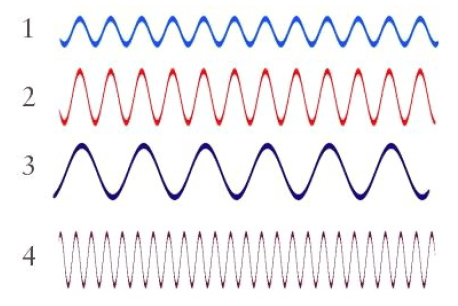
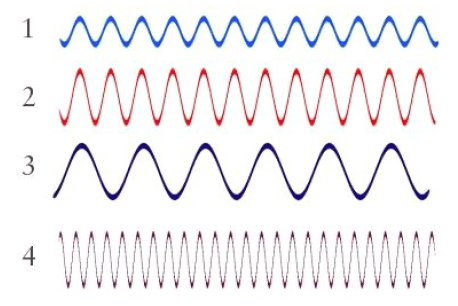
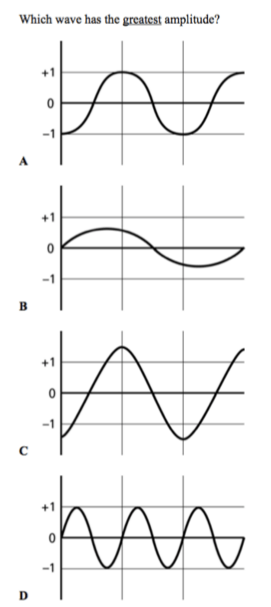


What is the amplitude of this wave?
4
8
2
6.3
What is the wavelength of this wave?
4
8
3.3
6.3
If a wave has a long wavelength, it will have __________ energy.
High
Medium
Low
If a wave has a short wavelength, it will have __________ energy.
High
Medium
Low
If a wave has a high frequency, it will have __________ energy.
High
Medium
Low
If a wave has a high amplitude, it will have __________ energy.
High
Medium
Low


This illustration best depicts which of the following behaviors?
Reflection
Refraction
Diffraction
Resonance

This image best depicts which of the following wave behaviors?
Reflection
Refraction
Diffraction
Resonance

This image depicts which of the following wave behaviors?
Reflection
Refraction
Diffraction
Resonance
Definition: the change in direction of a wave passing from one medium to another
Reflection
Refraction
Diffraction
Polarization
Definition: when a wave reaches the interface between two different media, typically some of the wave will bounce back into the original medium.
Reflection
Refraction
Diffraction
Polarization
Definition: The spreading out of waves as they pass through an opening or around objects.
Reflection
Refraction
Diffraction
Resonance
The two forms that waves can take are...
Transverse
Circular
Diamond
Longitudinal

Why does a music studio likely use digital technology for recording rather than analog technology?
Digital technology has been used longer than analog technology.
Digital technology can store information more reliably than analog technology.
Digital technology produces more background noise in recordings than analog technology.
Digital technology cannot be changed while analog technology can easily be modified.
Which of these statements best describes how digital data compares to analog data?
Digital data takes more space to store than analog does.
Digital data records more unwanted background noise than analog does.
Digital data can be stored for a longer period of time than analog can.
Digital data transmits signals more slowly than analog can.
Remote controls enable users to adjust the volume and channel of televisions without having to touch the television. Which of these best describes the signals sent by remote controls to televisions?
potential energy
sound waves
electromagnetic waves
gravitational energy

Both analog and digital waves can experience noise as they travel. Noise is any unwanted signal that distorts or reshapes the original wave. The diagram below illustrates how the resulting waves might appear. The example above suggests that...
digital waves cannot have noise or other distortions removed from them.
there is no clear advantage to transmitting digital waves over analog waves.
analog waves do not experience as much noise as digital waves.
noise is less of a problem for digital waves than for analog waves.

Why does the apple appear red?
It reflects all the colors except red
It diffracts all the colors except red
It absorbs all the colors except red
It refracts all the colors except red

What wave behavior does the picture show?
diffraction
reflection
refraction
destructive interference

What wave behavior does the picture show?
diffraction
reflection
refraction
destructive interference
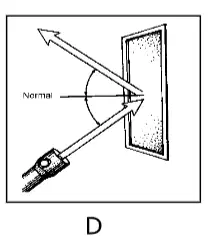
What wave behavior does the picture show?
diffraction
reflection
refraction
destructive interference

Why does the arrow appear to change direction as water is poured into the glass? You can try this experiment at home.
Light waves are bouncing as they pass through air, glass and water.
Light waves are traveling in a straight line as they pass through air, glass, and water.
Light waves are not passing through the air, glass, and water.
Light waves are bending as they pass through the air, glass, and water.
Select the correct order of waves on the EM Spectrum from low to high energy
Radio, Micro, Infra, Visible, Ultra, X-ray, Gamma
Gamma, X-ray, Ultra, Vis, Infra, Micro, Radio
Vis, Micro, Infra, Ultra, X-ray, Gamma, Radio
Micro, Radio, Vis, Infra, Ultra, X-ray, Gamma
Which has the LONGEST wavelength and, therefore, the LOWEST frequency/energy
Gamma Rays
Ultraviolet
Visible Light
Infrared rays
How are Electromagnetic waves different from Mechanical waves?
EM waves have very short wavelengths
EM waves transmit energy instead of matter
EM waves can travel through the vacuum of space (without particles)
EM waves can change direction by reflection
The amount of energy a sound wave carries per sound through a unit of area is its ____.
pitch
amplitude/intensity
loudness
frequency


Which wave produced the loudest sound?
high Amplitude
low Amplitude

