wayground logo

Free Printable Worksheets

Font size

S
M
L
XL
Worksheets

Science Y7 Revision Term 2

Total questions: 60

Worksheet time: 30mins
Name
Class
Date
1.
1. When iron reacts with sulfur through heating, what is the product formed?
a)
iron sulfide
b)
carbon dioxide
c)
iron oxides
d)
iron sulfate
e)
iron chloride
2.
2. The product of a reaction is magnesium oxide; what were the reactants?
a)
magnesium
b)
oxygen
c)
carbon dioxide
d)
magnesium hydroxide
e)
magnesium oxide
3.
3. Which two elements are found in water?
a)
hydrogen
b)
oxygen
c)
potassium
d)
magnesium
e)
zinc
4.
4. When magnesium reacts with hydrochloric acid, what are the products formed?
a)
magnesium chloride
b)
hydrogen
c)
carbon dioxide
d)
magnesium
e)
magnesium nitrate
5.
5. A simple chemical reaction happens when iron rusts. This happens when iron reacts with the oxygen in the air. What is the chemical name for rust?
a)
iron oxide
b)
iron chloride
c)
iron sulfate
d)
iron nitrate
e)
carbon dioxide
6.
6. When carbon reacts with oxygen when it burns, which gas is formed?
a)
carbon dioxide
b)
neon
c)
oxygen
d)
helium
e)
nitrogen
7.
7. When zinc reacts with hydrochloric acid, what are the products formed?
a)
hydrogen
b)
zinc chloride
c)
carbon dioxide
d)
zinc hydroxide
e)
zinc sulfide
8.
8. What are produced in the neutralisation reaction between sodium hydroxide and hydrochloric acid?
a)
sodium chloride
b)
water
c)
carbon dioxide
d)
hydrogen
e)
sodium chlorate
9.
9. What is neutralisation?
a)
Neutralisation is a reaction between a salt and water where a solution of pH7 is produced.
b)
Neutralisation is a reaction between an acid and an alkali where a solution of pH1 is produced.
c)
Neutralisation is a reaction between an acid and an alkali where a solution of pH7 is produced.
d)
Neutralisation is a reaction between an acid and an alkali where a solution of pH14 is produced.
e)
Neutralisation is a reaction between a salt and water where a solution of pH9 is produced.
10.
10. What are the safety measures should be taken in handling concentrated sodium hydroxide solution? Choose best two of the following.
a)
wear safety glasses
b)
wear gloves
c)
use tongs
d)
use beakers
e)
use Bunsen burner
11.
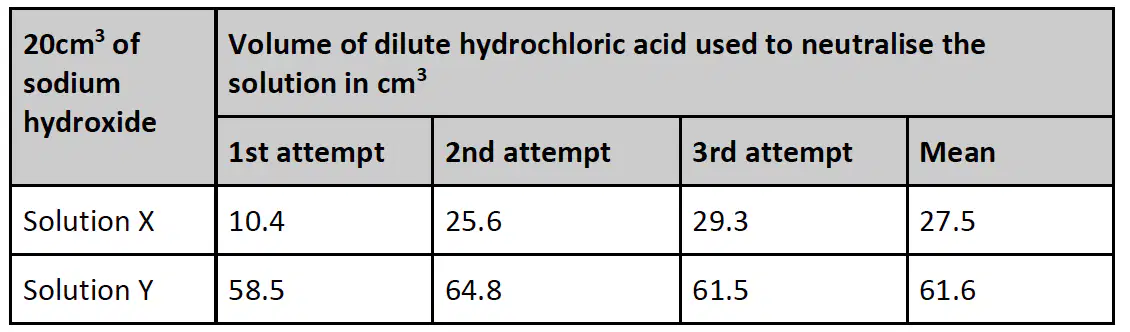
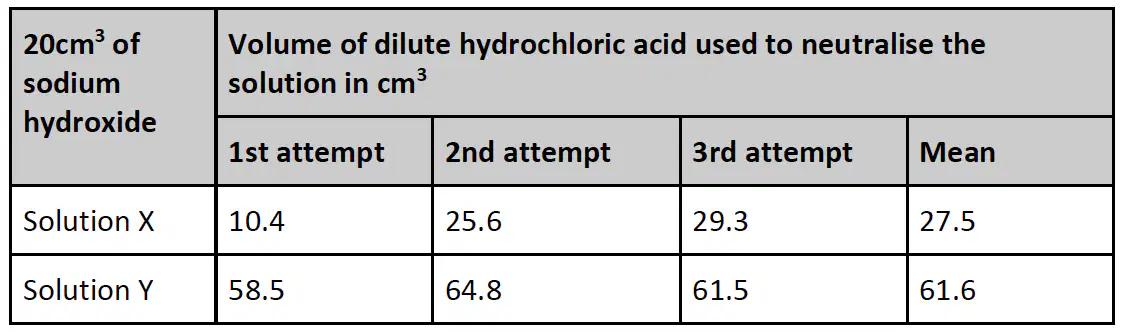
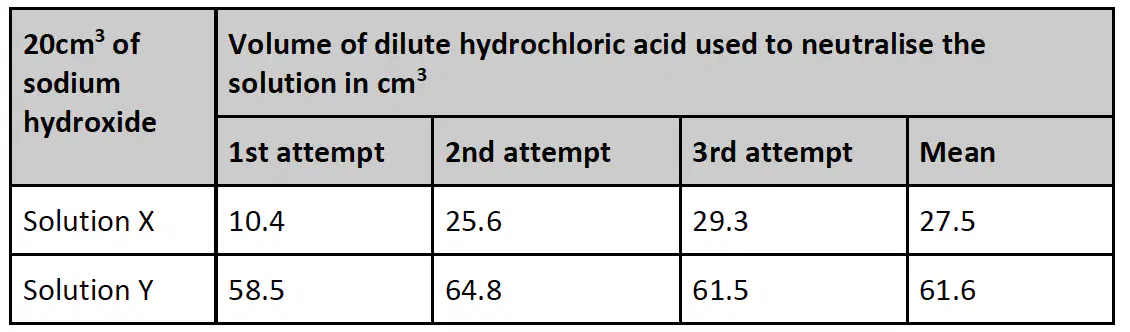
11. Zara has done her investigation into these two sodium hydroxide solutions, X and Y. She used universal indicator for the test. Which is the strongest solution of sodium hydroxide?
a)
Solution X
b)
Solution Y
c)
hydrochloric acid
d)
Universal indicator
12.
12. Zara has done her investigation into these two sodium hydroxide solutions, X and Y. Which of her data is anomalous?
a)
10.4
b)
58.5
c)
61.6
d)
25.6
e)
27.5
13.
13. Zara has done her investigation into these two sodium hydroxide solutions, X and Y. Explain why Zara has written the mean for Solution X as 27.5 and not 21.8.
a)
Zara ignored the 1st attempt, which was much lower than the other two readings.
b)
She has forgotten.
c)
Zara made careless mistake.
d)
Zara is poor in mathematics.
e)
Zara ignored the 2nd attempt, which was not the same as the other two readings.
14.
14. Marcus and Arun put some powdered metal into a test tube containing hydrochloric acid. There were a lot of bubbles as a gas was given off. There was so much fizzing that the contents of the test tube spilled over. They decided to carry out a more careful investigation. They thought that the more powdered metal they added, the quicker the reaction would take place. They decided to measure the quantity of powdered metal by using a spatula. What is the variable that is changed?
a)
The type of powdered metal
b)
The volume of hydrochloric acid used
c)
The bubbles of gas that was given off
d)
The number of spatulas of powdered metal that they use
15.

15. Which of the following are physical property of an unknown substance?
a)
It is acidic
b)
It is alkaline
c)
It is solid at room temperature
d)
It can react readily in water
16.
16. sodium + water ------->
a)
sodium hydroxide + water
b)
sodium chloride + water
c)
sodium hydroxide + hydrogen
d)
sodium chloride + hydrogen
17.
17. In a chemical reaction, a gas that produces 'pop' sound when tested with lighted/burning splint. Which of the following could be the reactants?
a)
calcium and water
b)
magnesium and oxygen
c)
potassium hydroxide and sulfuric acid
d)
nitric acid and lithium hydroxide
18.
18. When sodium reacts with water, a gas is produced. Which of the following tests, when conducted, can yield a positive result?
a)
wooden splint
b)
glowing splint
c)
lighted splint
d)
lime water
19.
19. When calcium carbonate reacts with hydrochloric acid, carbon dioxide gas is produce. How to test the presence of the gas?
a)
wooden splint
b)
glowing splint
c)
lighted splint
d)
lime water
20.
20. When manganese dioxide is added into hydrogen peroxide, oxygen gas is produced. How to test the presence of the gas?
a)
wooden splint
b)
glowing splint
c)
lighted splint
d)
lime water
21.

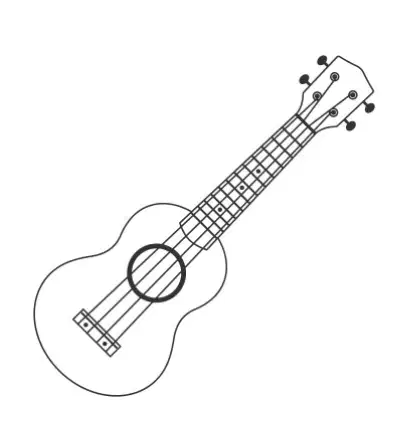
A ukulele is a musical instrument with strings. Which of the following is needed to make a sound from the instrument?

a)
The ukulele is made from wood.
b)
The strings on the ukulele vibrates.
c)
The ukulele has some metal parts.
d)
There is a hole in the ukulele
22.

A student plays the ukulele by plucking the strings. Which statement describes how the student can make the sound louder?

a)
Pluck the strings with less force.
b)
Pluck the strings with more force.
c)
Tighten the strings.
d)
Loosen the strings.
23.

Which of the following statements is true about sound waves?

a)
Sound waves can travel in gasses and liquids but not solids.
b)
Sound waves are transmitted by the vibrations of particles.
c)
The speed of sound waves is always the same.
d)

Sound waves can travel in a vacuum.

24.

Which of the following statements explains how an echo is made?

a)
the pitch of the sound increases.
b)
the pitch of the sound decreases.
c)
the sound vibrations gets louder.
d)
the sound is reflected.
25.

Which of the following is a useful way of using echoes?

a)
Bats can use sound waves to detect its surroundings.
b)
Repeating sounds echoing in a music studio.
c)

Echoes in cinema

d)

Use echoes to cook food

26.

A student wants to practice playing their drums. The drums can sometimes create very loud echoes. Which material should the student use to put on the walls of their room to reduce the echoes when they are practicing?

a)
flat wooden panels.
b)
soft foam panels.
c)
shiny metal sheets.
d)
large flat mirrors.
27.

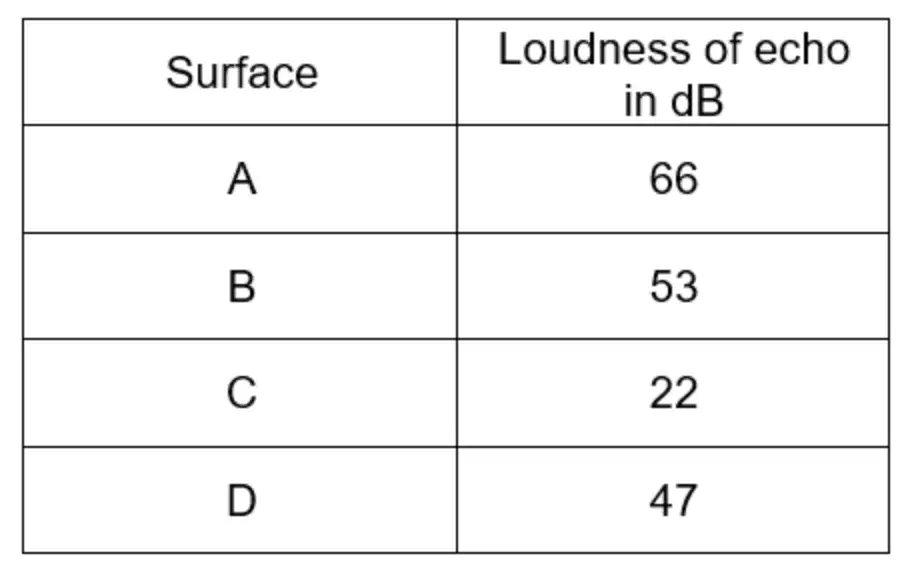
A student is investigating echoes. They made the same sound and measures the loudness of the echo from different surfaces.

The student uses four different surfaces, A-D. The results are shown in the table. dB refers to decibels. The greater the dB value the louder the echo.

What is the independent variable in this experiment?
a)
The loudness of the initial sound.
b)
The loudness of the echo.
c)
The type of surface used.
d)
The speed of the echo.
28.

A student is investigating echoes. They made the same sound and measures the loudness of the echo from different surfaces.

The student uses four different surfaces, A-D. The results are shown in the table.

dB refers to decibels. The greater the dB value the louder the echo.

Which of the following should be a constant variable in the experiment?

a)
The loudness of the initial sound
b)
The loudness of the echo
c)
The type of surface used
d)

Type of echo

29.

Which surface gives the loudest echo?

a)
A
b)
B
c)
C
d)
D
30.

Which surface gives the softest echo?

a)
A
b)
B
c)
C
d)
D
31.

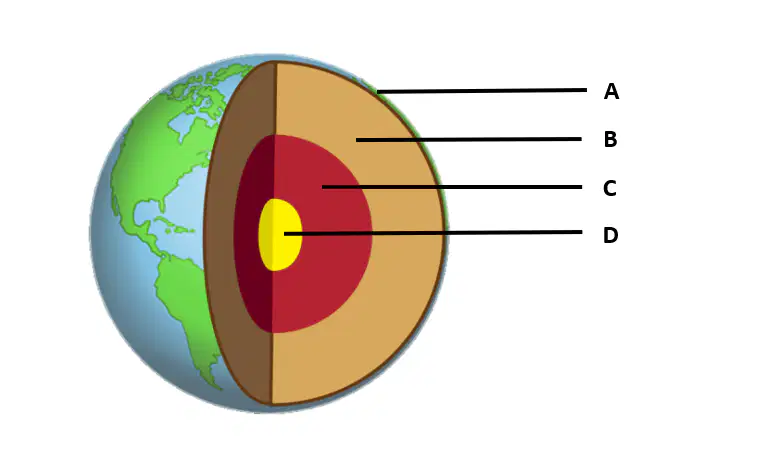
What is the name given to the line where tectonic plates meet?
a)
plate edges
b)
mid plates
c)
plate boundary
d)
ends of plate
32.

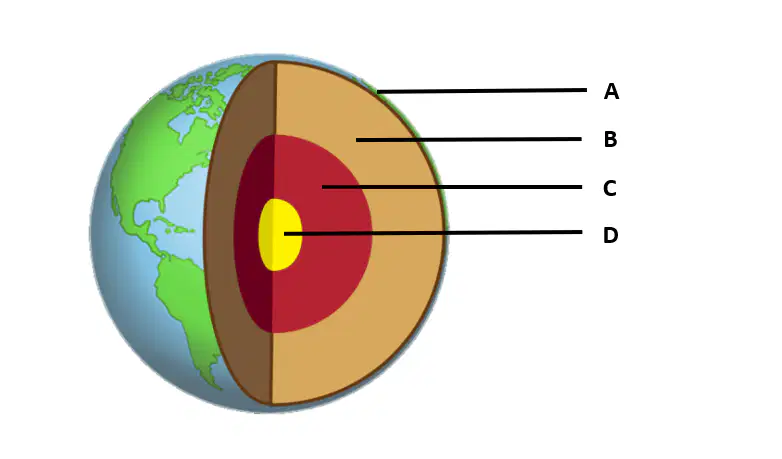
Which layer of the earth is a solid mass of iron and nickel?
a)
A
b)
B
c)
C
d)
D
33.

Which layer of the earth is made from hot molten rock that can flow?

a)
A
b)
B
c)
C
d)
D
34.

Alfred Wegener suggested the theory of continental drift of the Earth's continents. Which of the following evidence supports his theory? Select two correct answers.

a)
The continents float on the liquid oceans of the Earth.
b)

There were matching fossils on different continents.

c)

Types of rocks were all different in each continent.

d)
New continents rose up from the sea that fits together.
35.

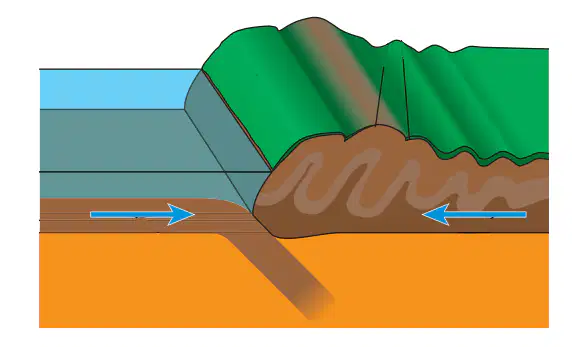
The diagram shows tectonic plates moving into each other. Which of the following is the process of one plate sliding underneath the other?
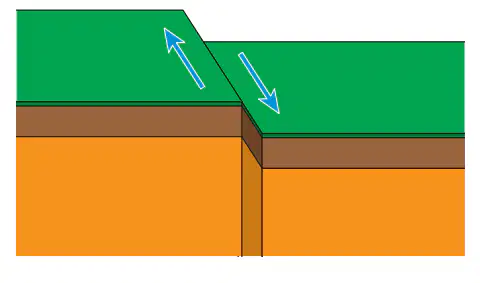
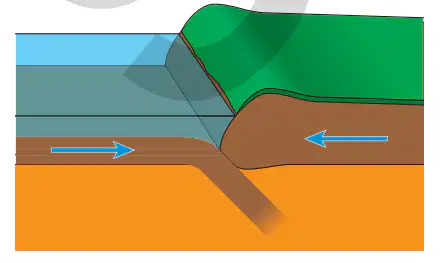
a)
Liquification
b)
Regression.
c)
Subduction
d)
Collision
36.
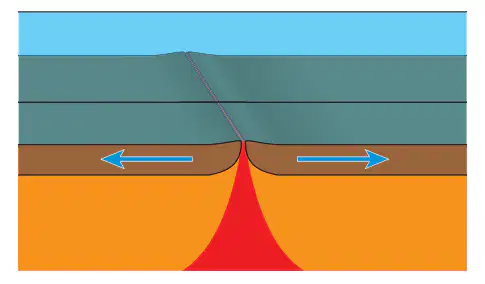
16. The diagrams below show the different ways tectonic plates can move. Which of the following movement of tectonic plates can result in the formation of fold mountains?
a)
Option 1
b)
Option 2
c)
Option 3
d)
Option 4
37.

An earthquake is a violent movement between two tectonic plates. Which of the following is a measure of the strength of an earthquake?

a)
Force
b)
Magnification
c)
Energy
d)
Magnitude
38.

Which characteristic of an object allows it to create shadows when light is shined upon it?

a)
Transparent
b)
Transluscent
c)
See through
d)
Opaque
39.

Which of the following describes how a solar eclipse happens?

a)
The Sun comes between the Moon and the Earth
b)
The Moon comes between the Sun and the Earth
c)
The Earth comes between the Moon and the Sun
40.

Select which statements below is TRUE about a lunar eclipse. Select two correct answers.

a)
The Sun comes between the Moon and the Earth.
b)
A Lunar eclipse happens every month.
c)
The Earth comes between the Moon and the Sun.
d)
A Lunar eclipse can only be seen during the night.
e)
A Lunar eclipse can only be seen during the day.
41.
1) Which of the following is an example of acid?
a)
water
b)
salt
c)
orange juice
d)
soap
42.
2) Which of the following is an example of alkali?
a)
water
b)
salt
c)
orange juice
d)
soap
43.
3) Which of the following is neutral?
a)
car battery
b)
mineral water
c)
apple juice
d)
cooking salt
44.
4) Which of the following pH value indicates that a substance is acidic?
a)
5
b)
7
c)
9
d)
12
45.
5) Which of the following pH value indicates that a substance is alkaline?
a)
1
b)
4
c)
7
d)
10
46.
6) Which of the following pH value indicates that a substance is neutral?
a)
2
b)
6
c)
7
d)
13
47.
7) Which of the following pH value indicates that a substance is the strongest acid?
a)
1
b)
6
c)
8
d)
14
48.
8) Which of the following pH value indicates that a substance is the strongest alkaline?
a)
1
b)
6
c)
14
d)
20
49.
9) Which of the following is the taste of an acid?
a)
sour
b)
sweet
c)
bitter
d)
sweet and sour
50.
10) Which of the following is the taste of an alkali?
a)
sour
b)
bitter
c)
sweet
d)
salty
51.
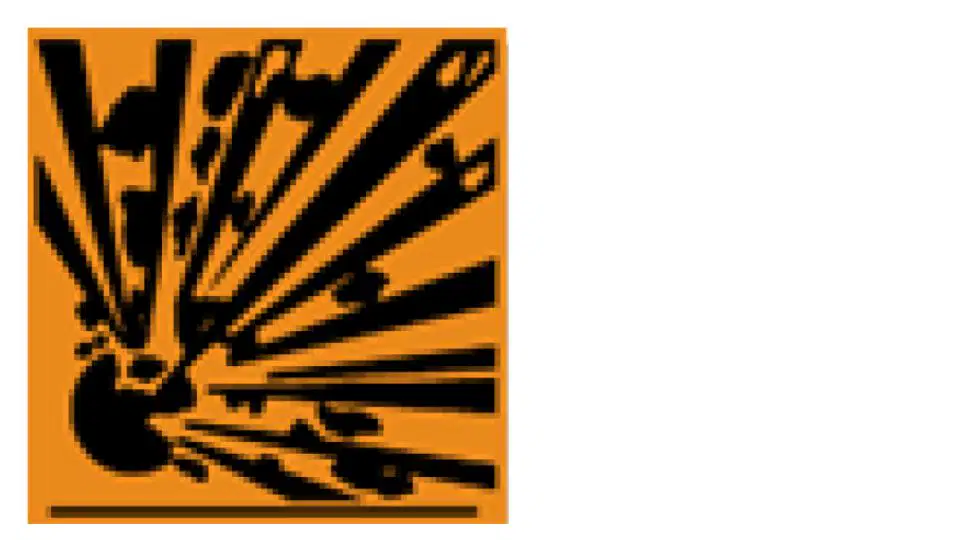
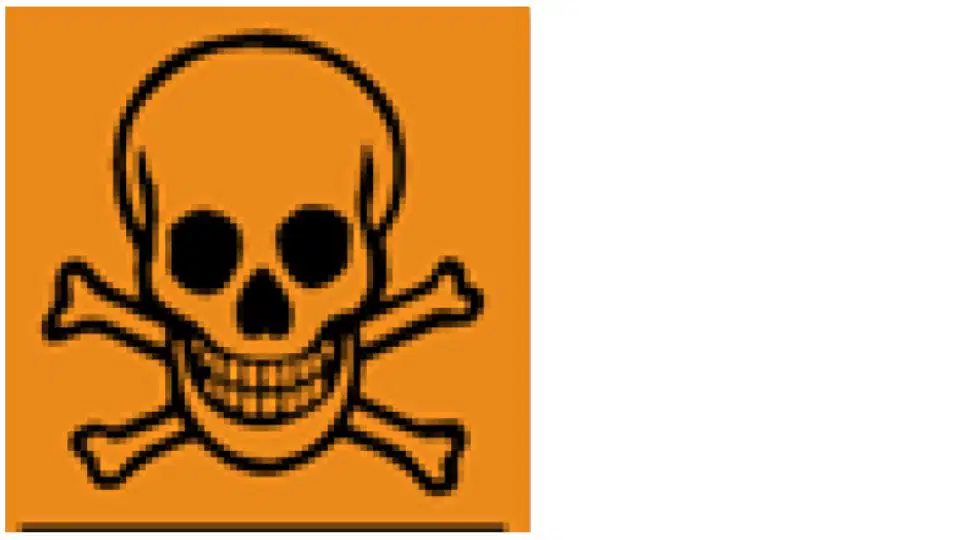
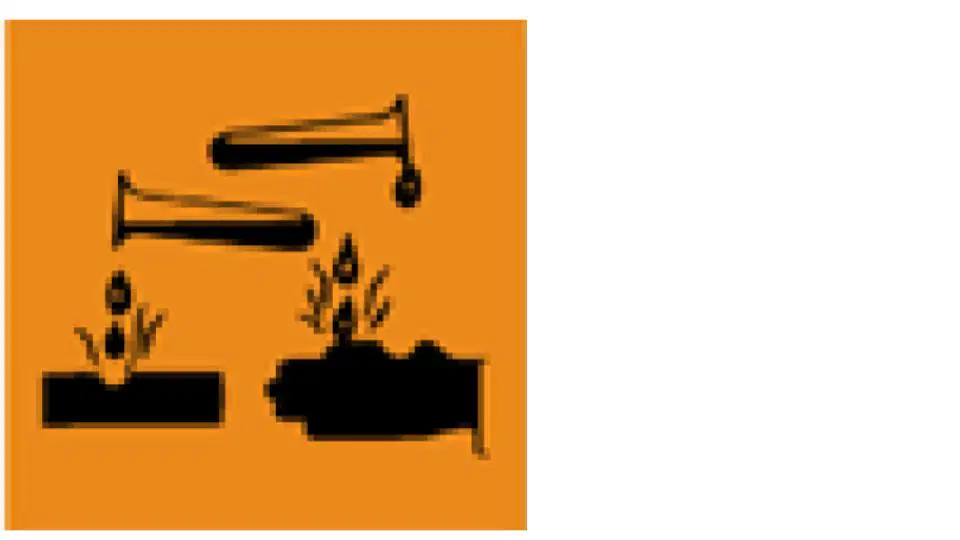
11) What is the meaning of this hazard symbol?
a)
health hazard / irritants
b)
explosive
c)
flammable
d)
oxidising
e)
corrosive
52.
12) What is the meaning of this hazard symbol?
a)
explosive
b)
flammable
c)
oxidising
d)
corrosive
e)
toxic
53.
13) What is the meaning of this hazard symbol?
a)
flammable
b)
explosive
c)
oxidising
d)
corrosive
e)
toxic
54.
14) What is the meaning of this hazard symbol?
a)
toxic
b)
explosive
c)
flammable
d)
oxidising
e)
corrosive
55.
15) What is the meaning of this hazard symbol?
a)
corrosive
b)
explosive
c)
flammable
d)
oxidising
e)
toxic
56.
16) Which of the following are proper safety measure when handling acids and alkalis in the lab? Choose four of the following options.
a)
stand up when doing experiment
b)
wear safety goggles
c)
close the reagent bottle once finish using the chemicals
d)
read the hazard symbol on the reagent bottle
e)
wear safety helmet
57.
17) Bruce rubs some weak alkali between his thumb and his fingers. Which of the following is the possible feeling given by the alkali?
a)
bitter
b)
rough
c)
itchy
d)
sticky
e)
slippery
58.
18) Which of the following chemicals in the lab are an alkali? Choose two of the following options.
a)
sodium chloride
b)
sodium hydroxide
c)
potassium chloride
d)
potassium hydroxide
59.
19) Which of the following are correct concerning indicators? Choose two of the following options.
a)
The neutral colour of the Universal Indicator is green.
b)
The colour of the Universal Indicator turns yellow when it is added to an alkaline substance.
c)
A red litmus paper turns green when it comes into contact with a neutral substance.
d)
An Universal indicator turns red when it comes into contact with an acidic substance.
e)
A cabbage indicator can be used to test the pH of a coffee drink
60.
20) Arnold played football in the rain. His body was soaked, and his skin felt sticky. He tested the rainwater with blue litmus paper, and it turned red. What does this mean?
a)
The rainwater is acidic.
b)
Arnold has a sensitive skin.
c)
The rainwater contains salt that dissolve in it.
d)
The rain is at a lower temperature than the room temperature.
e)
The rainwater is alkaline.