
 Worksheets
7.3 Review
Total questions: 65
Worksheet time: 33mins
Which three statements are part of the cell theory?
Cells are the smallest unit of living things that can perform the processes necessary for life.
The basic components of life consist of a nucleus, cell membrane, and mitochondrion.
All living things are composed of cells
Living cells come only from other living cells
Atoms are composed of cells
What are the most basic building blocks of all organisms?
blood
viruses
cells
tissues
What type of organism is a one-celled organism that functions as a single unit?
precellular
multicellular
unicellular
bicellular
Which of the following is shared by ALL cells and organisms?
made of many cells
needs oxygen
made of a single cell
ability to reproduce
Bacteria, protists, fungi, and animals are all types of living things. Which of the following must be true about all these organisms?
they can all move
they are made up of one or more cells
they can make their own food
they all need oxygen

What does unicellular mean?
Many cells
2 cells
1 cell
0 cells
What is an organism?
A dead animal
A living thing
A pencil
A shoe
Which one is NOT a life process?
Get rid of waste
Nutrition/Energy
Shake it off
Grow and develop
What makes unicellular organisms unique and simple?
They can do all life process as one cell.
They can fly and eat at Zaxby’s.
They can survive working with other single-celled organisms.
Why do multicellular organisms need so many cells?
They need specialized cells to survive. Specialized cells perform a specific job/function.
They need many cells to all do the same job/function.
They need many cells to have a dancing cell party.
What is the difference between multi-celled and single-celled’s organisms?
Single-celled organisms are “simple” and multi-celled organisms are “crazy.”
Single-celled organisms are “super” and multi-celled organisms are “complex.”
Single-celled organisms are “simple” and multi-celled organisms are “complex.”
True or False:
Single-celled organisms are able to live as one cell, and multi-celled organisms need many cells to live because each cell has specialized job.
True
False
Which of the following are single-celled organisms?


Which of the following are multicelled organisms?
Tissues are made of _______.
organs
systems
cells
blood
Which of the following body systems work together for support, protection, and movement?
respiratory and circulatory
skeletal and muscular
skeletal and respiratory
digestive and respiratory
Which of the following shows the levels of organization of an organism from LEAST to MOST complex.
cells-tissues-systems-organs
organs-cells-systems-tissues
systems-organs-tissues-cells
cells-tissues-organs-systems
Which of the human body systems is responsible for exchanging gases between the body and the air?
Nervous System
Digestive System
Respiratory System
Skeletal System
What is the main function of the respiratory system?
It converts food into simpler substances for the body to absorb as nutrients and gives the body energy.
It supplies the blood with oxygen in the lungs, and removes carbon dioxide from the body into the atmosphere.
It allows the body's internal and external organs to move so that they can do their jobs.
It helps the heart communicate with the brain.
What is the main function of the muscular system?
It helps the heart communicate with the brain.
It converts food in simpler substances for the body to absorb as nutrients and gives the body energy.
It supplies blood with oxygen in the lungs, and removes carbon dioxide from the body into the atmosphere.
It allows the body to move when attached to the bone. It also allows movement in internal organs, such as heart and intestines.

Responds to sensory information by transmitting signals to and from different parts of the body.
lymphatic system
endocrine system
cardiovascular system
nervous system

Removes wastes from blood.
excretory system
lymphatic system
endocrine system
digestive system

Uses energy from the Sun to make food for plants.
chloroplast
cell wall
mitochondria
nucleus
Protective layer around cells that controls what goes in and out of the cell.
cell membrane
vacuole
organism
nucleus
Structures in a cell that help with cell life processes.
organ system
cell wall
organelles
virus
Produces energy, heat, and power.
Nucleus
Mitochondria
Cytoplasm
Chloroplast
The smallest unit of an organism that carries on the functions of life.
virus
tissue
organ
cell
Protects and gives shape to plant cells.
chloroplast
cell wall
nucleus
mitochondria
Contains instructions for everything the cell does.
cell wall
cell membrane
vacuole
nucleus
Which is an accurate statement?
Animal cells contain a chloroplast.
Plant cells contain a chloroplast.

This organelle stores the cell's DNA.
Vacuole
Cell Wall
Nucleus
Cytoskeleton


Which organelle is pictured?
Nucleus
Cell Membrane
Cell Wall
Mitochondria
Chloroplast

Which organelle is pictured?
Nucleus
Cell Membrane
Cell Wall
Mitochondria
Chloroplast

Which organelle is pictured?
Nucleus
Cell Membrane
Cell Wall
Mitochondria
Chloroplast

Which organelle is pictured?
Nucleus
Cell Membrane
Cell Wall
Mitochondria
Chloroplast

Which organelle is pictured?
Nucleus
Cell Membrane
Cell Wall
Mitochondria
Chloroplast
What is the difference between osmosis and diffusion?
Diffusion is for water and osmosis is for substances.
Diffusion is for substances and osmosis is for water.
There is no difference
What do osmosis and diffusion have in common?
They are the processes the cell membrane uses to get nutrients into the cell.
They are the processes the nucleus uses to get nutrients into the cell.
They are the processes the cell membrane uses to keep things out of the cell.
They are the processes the nucleus uses to keep things out of the cell.
How does salt affect osmosis?
More salt attracts less water.
More salt attracts more water.
It does't.
Which of the following cell types needs the most energy?
Bone
Blood
Muscle
Skin
Which 2 of the following cell types die to help perform their functions?
Bone
Blood
Muscle
Skin
How do the particles move in diffusion?
From a region of low concentration to a region of high concentration
From a region of high concentration to a region of low concentration
From a region of low concentration to a region of low concentration
From a region of high concentration to a region of high concentration
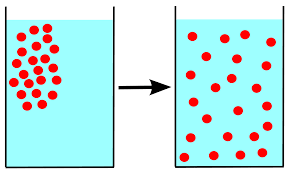
The picture below is an example of _________________.
osmosis
isotonic
diffusion
active transport
How long does diffusion last?
Until the concentration of particles in the system is equal
Until a region in the system has a smaller concentration of particles than the other
Until a region in the system has a greater concentration of particles than the other
Until the particles disappear from the system
Which organelle converts energy found in food into a form that cells can use?
Mitochondria
Ribosomes
Nucleus
Nucleolus
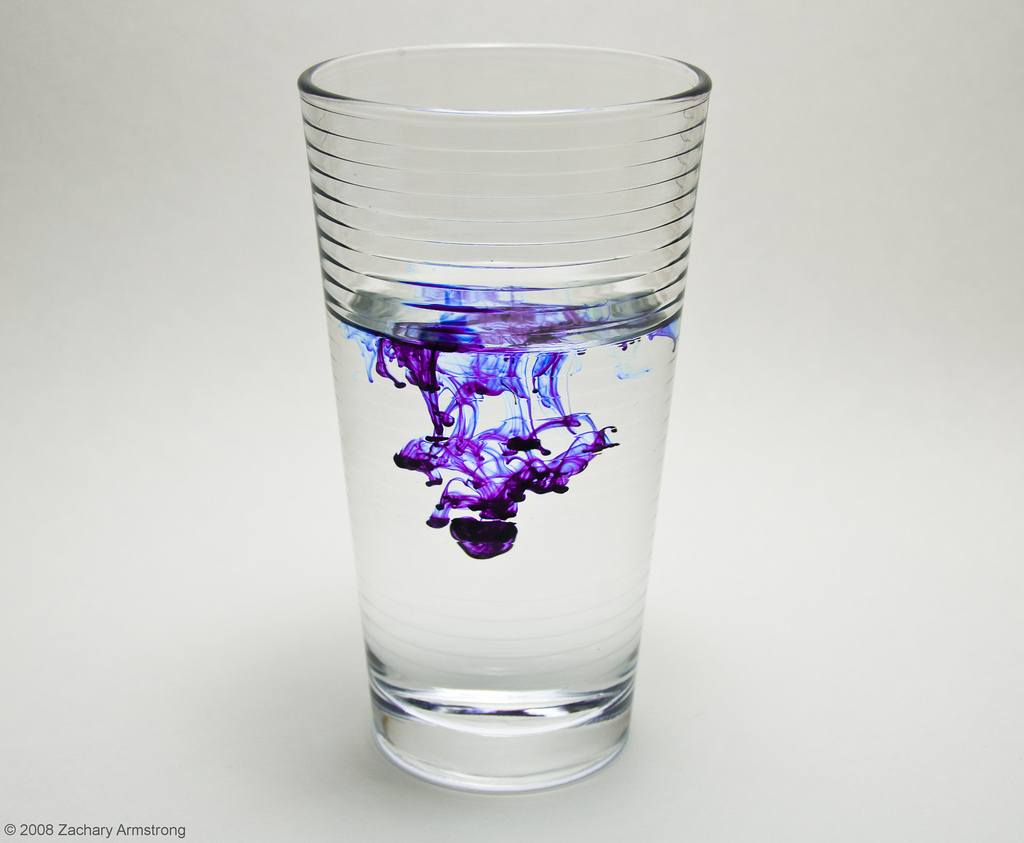
Where is there a low concentration of dye?
at the bottom of cup
in the color
at the top of cup
no concenteraion gradient
Diffusion can occur in liquids and gases.
True
False
What can only be found in plant cells?
Cell membrane
Nucleus
Chloroplast
Mitochondria
True or False:
Chloroplasts are found in both plant and animal cells.
True
False

