
 Worksheets
SCIENCE 4 FIRST PERIODICAL TEST EVIEWER
Total questions: 80
Worksheet time: 46mins
When you group or organize categories, you are using the skill of ______________?
observe
compare
predict
classify


_______________________.

When you use your observations to tell what will happen in the future, you are ____________________.
predicting
inferring
hypothesizing
observing

The tentative answer to a scientific problem.
Inference
Hypothesis
Observation
Prediction

It is the science process skill that is used to tell or find out how much, how long, how wide or how tall something is.
Comparing
Classifying
Observing
Measuring

What science process skill that is used to share what you know, by writing, talking, and drawing.
Classifying
Communicating
Measuring
Predicting
It is the series of steps in science that help you solve problems and answer question.
Inferring
Observing
Scientific Method
Hypothesizing
The summary at the the end of an experiment that explains the result. is the __________________.
observation
conclusion
question
Data gathered during an investigation is called ____________.
evidence
observation
experiment
What must a scientist do after you ask a question?
Share your results
Draw a conclusion
Plan and conduct an experiment
After you do your experiment, what must you do with your evidence?
communicate result/share results
record and analyze results
form an hypothesis
What do you do before you make an hypothesis?
Draw a conclusion
Do an experiment
Ask a question
A scientist gives a truthful report of observations. He / She does not fabricate, trim, destroy, or misinterpret data. He / She also acknowledges the works of others.
Curiosity
Creativity
Objectivity
Honesty
Responsibility
A scientist can generate new and original ideas.
Curiosity
Creativity
Objectivity
Honesty
Responsibility
A scientist seeks data and information to validate observations and explanations with fairness.
Curiosity
Creativity
Objectivity
Honesty
Responsibility
A scientist listens to and respects the ideas of others. He / She accepts criticism and changes his/her mind if reliable evidence contradicts his/her beliefs.
Open-mindedness
Perseverance
Objectivity
Honesty
Responsibility
A scientist never gives up despite difficulties or failure. He / She pursues a problem until a satisfactory solution is found.
Open-mindedness
Perseverance
Objectivity
Honesty
Responsibility
What attitude is useful when you are beginning a scientific study and thinking of problems that you want to solve?
Open-mindedness
Perseverance
Objectivity
Honesty
Curiosity
This organ is the primary control center of the body.
brain
heart
stomach
kidney
The heart is about the size of a _____________.
fist
stone
fish
cup
This organ pumps blood throughout the body.
brain
heart
kidney
liver
What is made possible by the lungs?
eating
breathing
thinking
chewing
This organ absorbs and churns food to make it easier for the intestines to digest.
intestines
liver
stomach
kidney
This organ breaks down food into nutrients.
stomach
saliva
intestines
mouth
It is an accessory organ of the digestive system.
stomach
large intestine
small intestine
liver
These organs filter out waste products from the blood and control water content of the blood.
heart
kidney
lungs
muscles
These support the body and protect the internal organs.
muscles
blood
brain
bones
These are responsible for the movement of the body.
muscles
blood
heart
bones
It is the basic unit of life.
cell
organ
tissue
system
It breaks down excess proteins, maintain cholesterol and glucose levels in the blood.
stomach
small intestines
large intestines
liver
It is a group of tissues.
cells
organs
systems
organism
It secretes the final enzymes that completes the digestive process.
kidney
small intestines
brain
large intestines
An ____________ is any trait that helps a living thing survive.
prey
predator
adaptation
teeth
Adaptations that are a part of a plant or animal's body.
Physical
Behavioral
Emotional
Instinct
Camels have brown fur to blend in the sand surrounding them, this is called _____.
camouflage
hibernate
migrate
mimicry
Penguins stay together in groups to stay warm, this action is called _______ adaptation.
behavioral
structural
What defense adaptation has the dual purpose of protecting an animal as well as providing shelter for an animal?
feathers
fur
shell
scales
Birds travel long distances in the fall and spring due to seasonal changes. This is called?
feathers
shedding
hibernation
migration

What is one reason that some plants have a strong scent?
to shed extra water off the plant
to take in nutrients from the soil
to attract animals to spread its pollen
to conserve water during dry periods

Desert plants have a coat of wax on their leaves to
keep water from escaping
protect them from animals eating them
absorb water from the air
release scent to attract animals
What type of animal lives far away from humans and can cause harm or danger?
Domestic animal
Pet animal
Farm animal
Wild animal
This type of animal mostly live and grow in bodies of water.
Farm animal
Aquatic animal
Domestic animal
Pet animal
Which animal does not belong to the group of farm animals?
Rat
Sheep
Pig
Rooster
What are the two major kinds of animals?
Domestic and wild animals
Terrestrial and Aquatic animals
Terrestrial and Aquatic Habitats
Pet and Farm animals
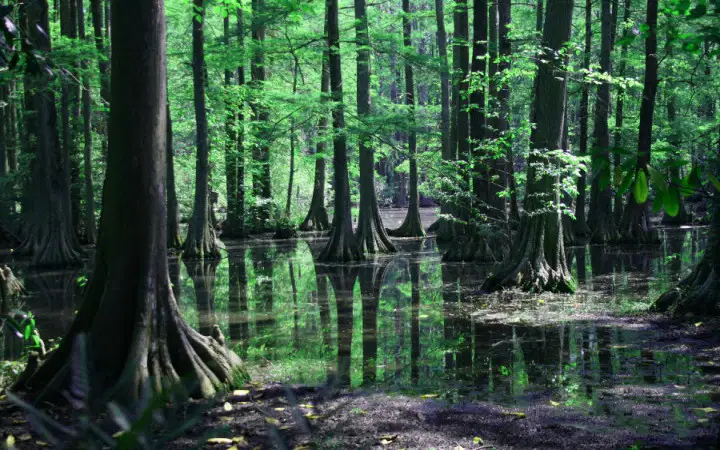
Which animal cannot live in this habitat?
Horse
Crocodile
Crab
Fish
Plants grow on land are called terrestrials.
TRUE
FALSE
Photosynthesis is the process by which a plant makes its own food.
TRUE
FALSE
Plants that grow in places with little amounts of water like deserts are called hydrophytes.
TRUE
FALSE
Where does a water lily live?
It lives in the ocean.
It lives in the pond.
It lives in the mountain.
It lives in the forest.
Where does a cactus live?
It lives in the ocean.
It lives in the grassland.
It lives in the river.
It lives in the desert.
Where does a pine tree live?
It lives in the pond.
It lives in the river.
It lives in the forest.
It lives in the mountain.
Where does a fern live?
It lives in the mountain.
It lives in the grassland.
It lives in the ocean.
It lives in the forest.
Where does duckweed live?
It lives in the river.
It lives in the ocean.
It lives in the swamp.
It lives in the forest.
Where does seaweed live?
It lives in the pond.
It lives in the ocean.
It lives in the forest.
It lives in the swamp.
Why do desert plants not grow close together?
so that they can get water and minerals from the large area
so that they won't hit each other's leaves
so that animals will be tired to getting into them

The stages of an organisms life are known as its
life cycle
polination
heredity

The first stage of a butterfly's life cycle is
egg
pupa
adult

What happens when a plant germinates?
It begins to grow
It blooms
It dies

Riding a bicycle is an example of what kind of behavior?
Learned trait
inherited trait
heredity trait

How are birds, reptiles, and fish alike?
They all begin as eggs
The all have legs
They all breathe through lungs

The process through which an organisms body changes form is called
metamorphosis
traits
larvae
All of the organisms of the same species that live in the same place at the same time.
Population
Community
Ecosystem
All of the living and nonliving parts of an environment interacting as a system.
Population
Community
Ecosystem
All of the populations that live in the same place at the same time.
Population
Community
Ecosystem
Which one below is abiotic?
Snail
Rock
Human
Plants
Which of the following is biotic?
Air
Minerals
Soil
Plants
An organism that makes its own food (Example: plants)
Carnivore
Predator
Consumer
Producer
An organism that eats other organisms (plants/and or animals) for food
Consumer
Producer
Omnivore
Food Chain
An animal that hunts other animals
Herbivore
Carnivore
Decomposer
Predator
An animal that eats only plants
Carnivore
Herbivore
Food Chain
Consumer

