
 Worksheets
Unit 2 Force and Motion
Total questions: 93
Worksheet time: 1hrs 2mins
What Law is F=MA
Newtons First
Newtons Second
Newtons Third
Law of conservation of momentum
What does the 'M' stand for in the equation F=MA?
Mass
Momentum
Magnitude
Motion
Which law explains why we need to wear seatbelts in a car?
Newton's First Law
Newton's Second Law
Newton's Third Law
Law of Universal Gravitation
To make an object move you must first apply ---
an opposing force
an unbalanced force
a stationary force
a vertical force
a force is best defined as ---
the application of weight
a push or pull that is exerted on matter
the flow of electric charges
a bond in which electrons are shared
A student pushes against a wall with 20 N of force and the wall does not move. In this situation, the wall exerts --
0 N of force
less than 20 N of force
20 N of force
more than 20 N of force

Which change would require more force to pull the wooden block up the ramp?
Have the student use two hands
Reduce the mass of the wooden block.
Restack the books so the thinnest book is on the bottom.
Glue sandpaper to the surface of the ramp.
Oliver stepped onto a three-car subway train with standing room only. What caused him to fall backward into other riders when the train suddenly moved forward?
He was riding in the last car of the train.
He had heat exhaustion from the overcrowded train.
Oliver's body resisted a change in the subway train's inertia.
Oliver's body was responding to the force of gravity.
Which law of motion predicts that a moving hockey puck will continue to move in the same direction at the same speed unless acted upon by another force?
Newton's First Law of Motion
Newton's Second Law of Motion
Newton's Third Law of Motion
Newton's Law of Universal Gravitation
Which law explains the relationship among mass, force and acceleration?
Universal Law of Gavitation
Newton's First Law of Motion
Newton's Second Law of Motion
Newton's Third Law of Motion
The force of an object, with a certain mass accelerating at a certain rate, can be determined by using the equation below.
force = mass x acceleration
Which object would have the greatest force?
A 5 kg object accelerating at 10 m/s
A 5 kg object accelerating at 20 m/s
a 20 kg object accelerating at 4 m/s
a 20 kg object accelerating at 3 m/s
Which of these would be different for an object if measured on the Earth and on the Moon?
Mass
Weight
Volume
Density

The diagram below show the forces acting on a soccer ball.
In which of the diagrams will the ball remain motionless?
W
X
Y
Z

In the diagram below, a girl sits on a sled and slides down a hill of snow. Which arrow represents the force of friction opposing the motion of the sled down the hill?
Arrow A
Arrow B
Arrow C
Arrow D
Which of these examples best illustrates Newton's Second Low of Motion?
A 100 Ib boy has twice as much inertia as a 200 Ib boy.
A truck needs a more powerful engine than a small car.
A hockey puck slides easily across the ice.
A satellite stays in orbit for a long time.
Which setup below would require the least force to lift a 100-gram mass a distance of 10 centimeters?


According to Newton's Third Law of Motion, if Mike pushes down on the springboard to being his dive, what is the reaction force?
Mike splashing into the water
The springboard pushing Mike into the air
The height of the water when Mike enters the water
The sound the board makes as he pushes into the air

Which principle best explains why the sprinkler spins?
Every action has an equal and opposite reaction.
Solid substances are usually more dense than liquid substance.
Energy is released when water condenses.
Most substances expand when heated and contract when cooled.
Ana pushed on a big rock in her back yard. She was unable to get it to move because she did not -
apply enough force
have a good grip on the rock
have enough mass
weigh enough
Many bicycles use a hand brake to control their speed. When the brake is engaged, a rubber pad presses against the tire. What force of motion does the hand brake rely upon to slow the bicycle?
Gravity
Friction
Electricity
Magnetism
Which of the following situations is an example of Newton's third law of motion?
A boy jumping on a trampoline
A boy falling forward when a bus stops
A chair sitting on the floor
An apple falling from a tree
In a head-on collision, a person who is not wearing a seat belt continues to move forward at the original speed of the car because of -
weight
mass
gravity
inertia
A recent space shuttle mission carried a piece of cargo that had a mass of 122 kg with a weight of 1195.6 N. While orbiting the Earth, the astronauts weighted the equipment again and found it to be 24.4 N.
What was the mass of the equipment at this point?
122 kg
7.6 kg
4.88 kg
2.49 kg
A student used 12 newtons of force to push a box 4 meters down the driveway. Using the formula, how much work, measured in joules (J), did they do to move the box? Work = force x distance
3 J
8 J
16 J
48 J
What will happen to the mass of a ball if it is moved from Earth to the Moon?
The mass will increase
The mass will remain the same
The mass will decrease
The mass will not exist
Which term refers to the tendency of an object to maintain its state of motion?
What is the difference between speed and velocity?
Velocity is always greater than zero, but speed can be greater or less than zero.
Which scenario best demonstrates an example of Newton's first law of motion?
A rocket lifts off from a launch pad.
A car passenger moves forward when a car suddenly stops.
A shopping cart accelerates when it is pushed.

What force, in newtons, is required to keep the object in the picture below at rest?
0 N
12 N
18 N
48 N

A force of 6.0 N is applied horizontally to a 3.0 kg crate initially at rest on a horizontal frictionless surface. After the crate is pushed for 1.5 seconds, it has a velocity of 3.0 m/s. Does this support Newton's second law of motion, that force equals mass times acceleration? Explain.
No, because the mass and the velocity of the crate are equal.
Yes, because the mass and the velocity of the crate are equal.
No, because the acceleration of the crate is 2.0 m/s2.
Yes, because the acceleration of the crate is 2.0 m/s2.
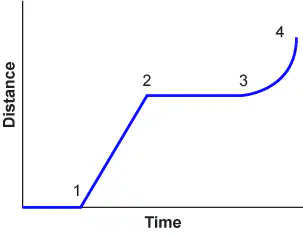
At which point in the car's motion is the magnitude of its acceleration the largest?
4
3
2
1
Kartianna is pushing a lawn mower using a force of 300 N. If she pushes the mower a distance of 800 m, how much work has she done?
80,000 J
480,000 J
240,000 J
110,000 J
A student used 12 newtons of force to push a box 4 meters down the driveway. How much work, measured in joules (J), did they do to move the box?
8 J
48 J
16 J
24 J
A car is driving 18 meters per second. It then merges on to a highway and accelerates at a rate of 6 meters per second per second for 2.0 seconds. It then remains at this speed. What is the speed of the car on the highway?
30 km/s
3 km/s
30 m/s
3 m/s

The table shows the mass and velocity of four objects. Which object has the least inertia?
Z
X
Y
W

What was the race car's average speed along the track in meters per second to the nearest integer?
60 m/s
54 m/s
100 m/s
185 m/s
Jenny drives her car 7 kilometers north. She stops for lunch and then drives 5 kilometers south. What is her displacement?
2 kilometers south
Karmiah goes cruising on her dirt bike. She rides 700m north, 300m south, 400m north, 600m south, 1200m south 300m north and finally 100m north. What distance did she cover?
2000km
3600m
3600km
A delivery truck drives 4 miles West before turning right and driving 6 miles North to make a delivery. Find the delivery truck’s distance and displacement.
10 mi SE
8.32 mi SE
7.21 mi NW
2 mi NW
What should go in the blank, to make the following statement be TRUE?
Vector (Δd) quantities have a (____________________) Scalar(d) quantities only have a one of these things.
magnitude and a direction
mass and acceleration
distance and time
speed and velocity
If you go around a 400 m track and finish where you started, you traveled a distance of 400 m, but you have been displaced by how much?
800m South
400m North
800m
0m
What kind of forces can change the direction of an object?
balanced forces
speed and inertia
friction and gravity
mass and velocity
What is the difference between average speed and instantaneous speed?
average speed is a calculation of the total speed you averaged when traveling a specific distance and instantaneous speed is a snapshot of your speed right now
average speed is the speed at a specific point in the journey, while instantaneous speed is the speed at the end of the journey
average speed is the speed at a particular moment in time, while instantaneous speed is the total distance traveled divided by the total time taken.
average speed and instantaneous speed are the same thing.
In a collision, because the forces acting on the two objects are equal and opposite, the transfer of momentum must be the same. What does this statement apply to?
Law of Conservation of Energy
Law of Conservation of Momentum
Law of Conservation of Movement
Law of Conservation of Matter

What does this graph represent?
The object is moving at a constant speed, so it has 0 acceleration
The object is speeding up, therefore it has a positive acceleration
The object is not moving, therefore it has 0 acceleration
The object is slowing down, so it has a negative acceleration
An old trick to determine an approximate distance to a storm is to count the number of seconds it takes to hear a peal of thunder after seeing a lightning bolt and divide that number by 5 to get the number of miles to the storm. If it takes 15 seconds for thunder to reach an observer 3 miles away, about how fast is the sound of the thunder traveling in miles per second to the nearest tenth?
2.0
5.2
0.2
0.5
Which of the following objects has the greatest inertia?
A 20.0 kg object at rest
A 10.0 kg object at rest
A 5.0 kg object moving at 5.0 m/s
A 15 kg object moving at 1.0 m/s
A sports car accelerates at a constant rate from rest to a speed of 27.8 m/s in 8.00 s. What is the displacement of the sports car in this time interval?
114 m
111 m
221 m
A swimmer starting from rest has a final velocity of 2.0 m/s after 20 seconds. What is her average acceleration?
If a train is traveling west at a rate of 30 kilometers per hour, how could a passenger on the train be moving west at a rate of 28 kilometers per hour?
the passenger is walking east on the train at a rate of 28 kilometers per hour.
The passenger is walking west on the train at a rate of 28 kilometers per hour.
The passenger is walking west on the train at a rate of 2 kilometers per hour.
the passenger is walking east on the train at a rate of 2 kilometers per hour.
What Laws did Isaac Newton help create?
What is the formula for speed?
What is the formula for momentum?
What do you call a push or pull on an object?
Chemical
Force
Magnet
Which force holds us to earth's surface?
Friction
Mass
Gravity
The amount of matter in an object is known as?
Mass
Weight
Volume
At which location would your mass be the greatest?
Earth
Moon
Your mass stays the same everywhere.
Gravity affects which of the following?
Mass
Weight and Mass
Weight
What force keeps the moon in orbit around the Earth?
weight
mass
gravity
Which surface would cause the greatest friction?
carpet
ice
snow
Which force acts on an object by touching the object?
Electricity
Friction
Gravity
When sand is poured on an icy road, what force are we increasing to help cars stay on the road?
Electricity
Friction
Gravity
On which surface would a toy car travel the furthest when pushed?
Ice
Carpet
Snow
Which of these objects would be attracted to a magnet?
nails
wood
paper
The north pole of one magnet will be attracted to the _________ pole of another.
east
south
north
What will happen if you try to put the south pole of one magnet and the south pole of another magnet together?
The magnets will attract or move together
The magnets will repel or move away.
The magnets will not attract or repel
The amount of matter in an object.
mass
volume
density
Anything that has mass and takes up space.
mass
matter
volume
The force of attraction between two objects that depends on the masses of the objects and the distance between the objects
friction
pull
gravity
Gravitational force exerted on an object.
gravity
weight
mass
The level of the surface of the ocean
sea level
mountain level
water level
Objects in motion tend to stay in motion, objects at rest tend to stay at rest, unless acted upon by a force.
gravity
friction
inertia
Force can be defined as
A push
A pull
Both 1 and 2
Strong
The force that keeps you on the ground is
Acceleration
Gravity
Speed
Vertical
Newton’s Second Law of Motion states that
An object acted upon by a force will accelerate in the direction of the force
An object acted upon by a force will decelerate in the direction of the force
An object acted upon by a force will accelerate in the direction opposite the force
An object acted upon by a force will decelerate in a direction opposite the force
The mathematical formula for Newton’s second law is
W=mg
F=ma
S=d/t
F=a/m
Mass is the amount of space an object occupies, while weight is the force acting upon the object
True
False
Force is measured by the unit called
Meters
Newtons
Joules
Foot-pounds
The force acting between two objects sliding past each other is called
Sliding friction
Static friction
Rolling Friction
Hydrofriction
The slowing effect of friction is caused by
Gnomes
Bumps and dips on the opposing surfaces
Gravity
Invisible force
According to Newton’s second law, as mass increases acceleration does what?
Increases
Decreases
Does not change
Air resistance is a type of friction between what two things?
Rising objects and air
Falling objects and air
A parachute increases the air resistance on a sky diver. This allows the skydiver to reach a safe what?
Patch of ground
Jump zone
Terminal velocity
Motion is
A vector
Unchangeable
A change in position of objects over time
Motion can be measured by
Speed
Velocity
Acceleration
All of these
Speed is defined as
Stimulants
Distance and direction
Distance traveled over time (D/t)
Distance over time plus direction
A change in speed or direction due to outside forces is called
Displacement
Motion
Gravity
Acceleration
Speed is stated as ____________, while velocity is stated as _______________.
Distance/time with direction; only distance/time
Only distance/time; Distance/time with direction
A bowling ball rolled with a force of 15 N accelerates at a rate of 3 m/sec squared. What is its mass?
4 kg
3 kg
5 kg
1 kg
An object with a mass of 15 kg would weigh how much on Earth?
147 N
14.7 N
1470 N
1.47 N
Which graph shows the acceleration of the object with the largest mass? Assume that the force applied is equal for each graph.


Distance is
Total length of the path taken.
Total length of the path taken plus direction
The difference in initial and final positions
The difference in initial and final positions plus direction
Displacement is
The total length of the path taken
The total length of the path taken plus direction
The difference in initial and final positions
The difference in initial and final positions plus direction

