
 Worksheets
Test: Fossilization and the Age of the Earth Env Sci BWHS
Total questions: 60
Worksheet time: 2hrs 30mins
Define fossil.
petrified bones that have been preserved over a very long time.
any remains or trace of a formerly living thing preserved by natural processes.
animal-shaped voids found in pyroclastic tephra
insects encased in tree sap
In which type of rock are most fossils found?
Igneous
Sedimentary
Metamorphic
(a) : the study and classification of fossils
Match the following
Dinosaur footprints
Trace fossil
Insect trapped in hardened tree sap
Amber
Microscopic clamshells found in lake sediments.
Microfossil
A coquina clam that has been cemented in sedimentary rock
Original material
Trees that have turned to rock
Petrified fossil
Which of the following substances contains fossils?
amber
magma
liquid
all options
Identify the following statement as a creationist or evolutionist perspective.
"Index fossils can be used to help establish the absolute ages of rock strata, which then helps date other fossils in that rock layer.
Creationist
Evolutionist
Which of the following scientists developed the system used today to classify organisms?
Charles Darwin
Carolus Linnaeus
Charles Lyell
James Hutton
When the population of a species begins to shrink due to having more deaths than births in a generation, it is possibly headed towards _______________.
fossilization
succession
exinction
superposition
Why are fossils not forming today when so many organisms continue to die?
Most dead organisms need to be covered quickly with sediment to be preserved and we do not observe that happening today.
The climate of current Earth is not suitable for preserving dead organisms and so they decay.
Fossils are being made, we just can't see them because it takes millions of years to create them.
Why are fossils not forming today when so many organisms continue to die?
Most dead organisms need to be covered quickly with sediment to be preserved and we do not observe that happening today.
The climate of current Earth is not suitable for preserving dead organisms and so they decay.
Fossils are being made, we just can't see them because it takes millions of years to create them.
An index fossil refers to
a fossil that is used to classify other fossils based on the shape of the bones
a fossil that is used to date other fossils in the same rock layer as it
a fossil of an insect
the first fossil of a species that is discovered
(a) gases: gases that contain carbon dioxide, a product of the combustion of fossil fuels, and trap heat in out atmosphere.
Why do igneous rocks not usually contain fossil?
it does not have enough minerals to form fossils
it only forms in the crust of the Earth so it cannot cover dead organisms
it is made up of molten lava which would typically burn up most things
it does not form in the places that organisms typically live

Ferns, such as the one in the picture, can be found today. They are usually found growing in warmer climates. However, fossils of ferns have been found in places with cold climates where it often snows today. What can we conclude about the places where the fossils of ferns have been found?
Ferns used to live in cold climates.
These places once had a warmer climate.
These places once had a colder climate.
Someone tried to grow ferns in cold climates.
A _______ is a solid copy of the shape of an organism.
mold
cast
petrified fossil
trace fossil
Which parts of an organism are more likely to fossilize?
the soft parts - skin, muscle
the hard parts - bones, shells, stems
all parts can become fossilized easily because the organism becomes buried by sediments
The fossil record gives us _____.
accurate data on the number of life-forms that lived.
accurate insight on how animals reproduced.
information on past life and environments on Earth.


Which step in fossilization comes first?
An organism dies and the soft part of it decay.
Over time, layers build pressure that turn the layers to stone.
Wind and water erosion expose the fossil to the surface.
Minerals around the skeleton preserve the bones.
What can fossils tell us about an organism?
How long ago an organism lived
Where an organism lived
How an organism lived
All of the above
which explaination best supports how fossils form?
fossils can only form in dry, cold conditinos
water keeps minerals from replacing remains
fossils usually form in only a few hundred years.
water helps minerals replace the original remains

If fossils in layer D are 100 million years old and in layer B they are 110 million years old, how old might are the fossils in layer C? Choose the best answer.
90 million years old
120 million years old
105 million years old
50 million years old

Most fossils are formed within which kind of rock?
sedimentary
metamorphic
igneous
they form equally in all types of rock

Which type of fossil is seen here?
cast
mold
true
trace

The Precambrian Eon is known for
Age of Reptiles
Age of Invertebrates
88% of Earth’s time
Pangea Split

The Mesozoic Era is known as
Age of Invertebrates
Age of Reptiles
Age of Mammals

The Cenozoic Era is known as
Age of Invertebrates
Age of Reptiles
Age of Mammals

Match the time period with what lived during that time.
Paleozoic Era
Trilobites
Precambrian Eon
Stromatolites
Cenozoic Era
Saber-Toothed Tigers
Mesozoic Era
Pterosaur
Geologic time is divided into segments based on
types of life forms during certain time periods
geologic changes over time
fossils and rocks from certain periods
all of the choices
Geologic time is divided into segments based on
types of life forms during certain time periods
geologic changes over time
fossils and rocks from certain periods
all of the choices
Geologic time is divided into segments based on
types of life forms during certain time periods
geologic changes over time
fossils and rocks from certain periods
all of the choices
Order these divisions of time in order from longest(1) to shortest(4)
Eon
Era
Period
Epochs
Order these divisions of time in order from longest(1) to shortest(4)
Eon
Era
Period
Epochs
___determines the order of events by comparing the positions of rocks.
Superposition
Index Fossils
Absolute Dating
Relative Dating
___determines the order of events by comparing the positions of rocks.
Superposition
Index Fossils
Absolute Dating
Relative Dating

Which layer is the oldest?
Layer 1 because it is closest to the surface.
layer 2 because it is the thickest.
Layer 3 because it has the most fossils.
Layer 4 because it is on the bottom.

What are the layers in order from oldest (1) to youngest (5)?
B
C
D
E
A
What are the layers in order from oldest (1) to youngest (5)?
B
C
D
E
A
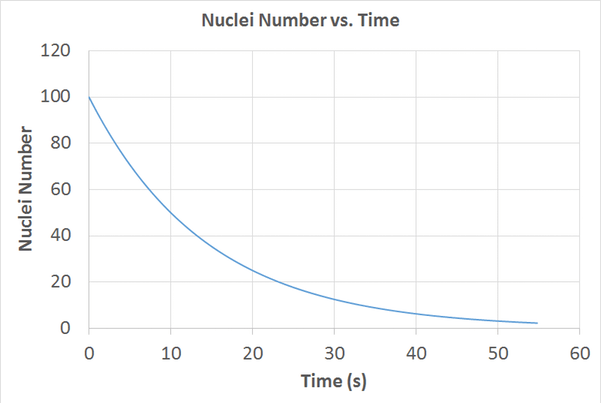
What is the Half life of this isotope?
5 seconds
10 seconds
15 seconds
20 seconds
What is the Half life of this isotope?
5 seconds
10 seconds
15 seconds
20 seconds
What is the Half life of this isotope?
5 seconds
10 seconds
15 seconds
20 seconds
You have 100 grams of radioactive C-14. The half life of C-14 is 5730 years.
How many grams are left after 1 half life?
100 grams
25 grams
2 grams
50 grams
Radioactive carbon-14 is often useful in determining the absolute age of geologic samples because radioactive isotopes
decay at a regular rate
become less stable during decay
remain unchanged over time
stabilize after four half-lives
Scientists use radioactive decay to measure...
relative time
absolute time
half-lives
time of day
An element that has broken down and released particles and energy is said to be _______________.
radioactive
subatomic
The Earth is estimated to be how old?
4.6 Million years old
6,000 years old
4.6 Billion years old
Who knows

Thicker tree rings indicate poor growing conditions for plants and trees.
True
False

How old is this tree?
13 years old
26 years old
5 years old
10 years old

Why would a tree have a scar?
drought
too much sunlight
insect attack, fire or broken limb
it was sad
Scientists can extract samples of ancient air from ice cores
True
False
Studying tree rings is a way of gathering evidence for climate change. This is called _______________.
Biology
Dendrochronology
Ice Sheet Retreat
Sunspot Cycles
By examining ice cores, we know that when carbon dioxide levels are high, temperatures are also higher.
True
False

How can monitoring glaciers provide evidence for climate change?
When climate gets warmer, glaciers get larger.
When glaciers retreat it means that it is getting colder.
Glaciers contain old thermometers to measure temperatures.
When climate is warmer, glaciers retreat. When climate is colder, glaciers expand and get larger.

Which of the following is the best conclusion that can be made from this graph?
atmospheric carbon dioxide levels have been decreasing since 1960
Hawaii has a lot of carbon dioxide
humans have been working hard to decrease carbon dioxide levels
atmospheric carbon dioxide levels have increased steadily since 1960
What is the most common method of absolute dating?
Radiometric Dating
Relative Dating
Index Fossil Dating
Prehistoric Dating
Which makes a good index fossil?
a fossil not commonly found in rocks
a fossil that lived throughout geological time
a fossil that lived during three geologic time periods
a fossil that lived during only one geologic time period

Can you identify this type of fossil?
Mold
Petrified
Cast
Preserved
In which eon did the formation of our Earth happen?
Hadean
Archean
Proterozoic
Phanerozoic
A geologist identifies the identical index fossils in rock layers from two different areas. Which conclusion is best supported by this discovery?
The deposition rate of the two rock layers was identical.
The fossil organism evolved independently in the two separate areas
The two rock layers were deposited at approximately the same time.
The index fossil will also occur in sediment deposited on top of these rock layers

