
 Worksheets
Q1 Science Study Guide
Total questions: 16
Worksheet time: 12mins
Name
Class
Date
1.
Name:
4 lines
2.
3.2 Explain why you them in that order
4 lines
3.
4. Why do we find more fossils of organisms such as snails and vertebrates than organisms such as jellyfish?
4 lines
4.
6. How do fossils of limb structures provide evidence that ancient and modern tetrapod's are related?
4 lines
5.
7. Trilobite fossils have been found in rock that is 521 million years old. They have also been found in rocks that are more than 252 million years old. Trilobite fossils have not been found in younger or older rocks. What does this tell you?
a)
Trilobites became extinct 252 million years ago.
b)
Trilobites became extinct 521 million years ago.
c)
Trilobites lived on Earth for 252 million years.
d)
Trilobites lived on Earth more than 521 million years ago.
6.
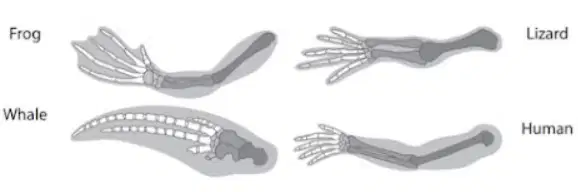
8. Compare the limbs of the modern vertebrates. Which statement best explains the similarities between the limbs? (Mark the one best answer.)
a)
All four vertebrates move in the same way.
b)
These four vertebrates share a common ancestor.
c)
The limbs can be used in water or on land.
d)
A lizard is an ancestor of a frog.
7.
9. An organism from the past that is related to all the organisms in the group
a)
Fossil
b)
Common ancestor
c)
Cladogram
d)
Descendant
8.
10. The variety of life forms that exist on Earth
a)
Chromosome
b)
DNA
c)
Biodiversity
d)
Evolution
9.
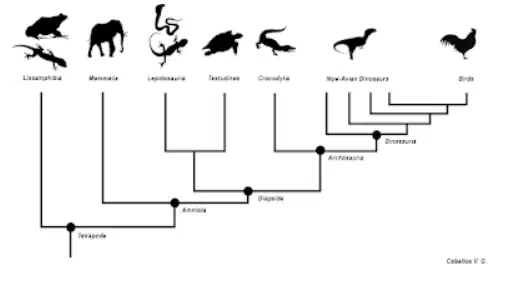
11. An evolutionary tree diagram based on shared characteristics
a)
Family Tree
b)
Chromosome
c)
DNA
d)
Cladogram
10.
12. A rock that forms when layers of sediments are stuck together.
a)
Fossil
b)
Sedimentary rock
c)
Body fossil
d)
Tetrapod
11.
13. A trait that helps identify an organism
a)
Feature
b)
Characteristic
c)
Genetics
d)
Gene
12.
14. Variations of genes that determine traits in organisms
a)
DNA
b)
Allelle
c)
Chromosome
d)
Nucleus
13.
15. The basic unit of heredity carried by chromosomes, codes for proteins which determine the traits of organisms
a)
Nucleus
b)
Cell
c)
Genes
d)
Chromosomes
14.
16. A vertebrate with 4 limbs is called a _______________.
a)
Amphibian
b)
Tetrapod
c)
Fish
d)
Microorganism
15.
17. A fundamental molecule that is part of cells and cell structures, that determines the traits of an organism. An example is Keratin found in hair and nails.
a)
Chromosome
b)
Gene
c)
Protein
d)
Trait
16.
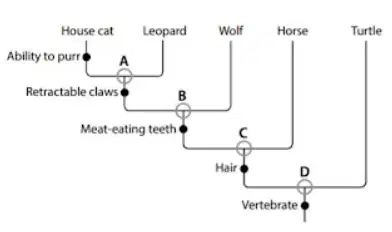
19. The circles at A, B, C, D on the cladogram represent _____ for the leopard and the cat.
a)
Descendants
b)
Common descendants
c)
Common ancestors
d)
Most recent common ancestors
100 %

