wayground logo

Free Printable Worksheets

Font size

S
M
L
XL
Worksheets

Ch 21 ℚ𝕦𝕚𝕫 𝕠𝕟 𝔸𝕟𝕔𝕚𝕖𝕟𝕥 𝕁𝕒𝕡𝕒𝕟 "Heian Period"

Total questions: 75

Worksheet time: 44mins

Name
Class
Date
1.
Noblemen, dressed in silk robes and court hats, enjoy a game of ___________.
a)
kyoto
b)
heian-kyo
c)
kemari
d)
kyo
2.
13. Who wrote the masterpiece novel Tale of Genji?
a)
Amida Buddha
b)
Murasaki Shikibu
c)
Minamoto
d)
Heian-Kyo
e)
Fujiwara Michinaga
3.
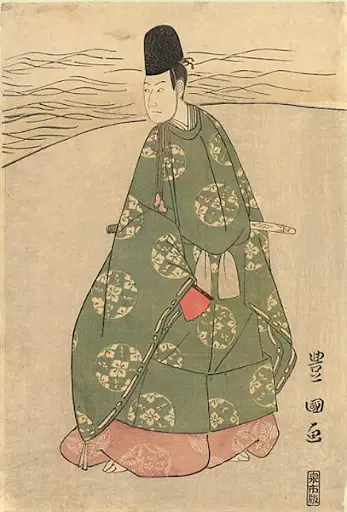
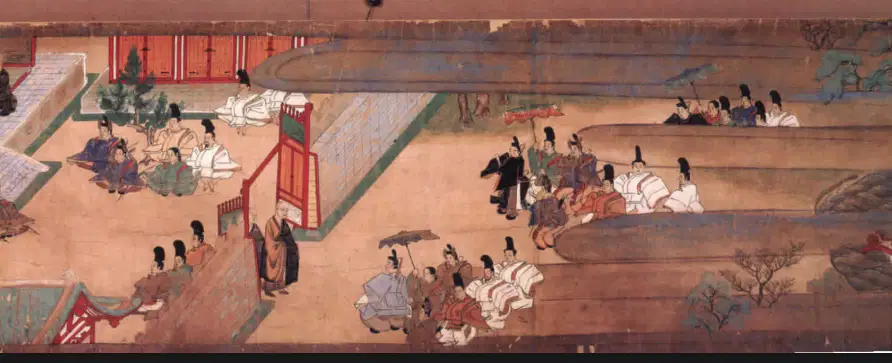
Which term does this picture represent?
a)
Corruption
b)
Courtier
c)
Imagery
d)
Noh theater
e)
Heian period
4.
Which term does this picture represent?
a)
Imagery
b)
Corruption
c)
Courtier
d)
Noh theater
e)
Heian period
5.
Which term does this picture represent?
a)
Noh theater
b)
Corruption
c)
Courtier
d)
Imagery
e)
Heian period
6.
Which term does this picture represent?
a)
Tale of Genji
b)
Corruption
c)
Courtier
d)
Imagery
e)
Noh theater
7.
Which term does this picture represent?
a)
Heian period
b)
Corruption
c)
Courtier
d)
Imagery
e)
Noh theater
8.
Which term does this picture represent?
a)
Courtier
b)
Corruption
c)
Imagery
d)
Noh theater
e)
Heian period
9.
Which term does this picture represent?
a)
Regent
b)
meditation
c)
syllable
d)
aristocracy
e)
Pagoda
10.
Which term does this picture represent?
a)
syllable
b)
Regent
c)
meditation
d)
aristocracy
e)
Pagoda
11.
Which term does this picture represent?
a)
Pagoda
b)
Regent
c)
meditation
d)
syllable
e)
aristocracy
12.
Which term does this picture represent?
a)
meditation
b)
Regent
c)
syllable
d)
aristocracy
e)
Pagoda
13.
Courtier
a)
a member of a ruler's court
b)
descriptive or imaginative language, especially when used to inspire mental "pictures"
c)
classic form of Japanese drama involving heroic themes, a chorus, and dance
d)
corruption dishonest or illegal practices, especially involving money
14.
Corruption
a)
a member of a ruler's court
b)
descriptive or imaginative language, especially when used to inspire mental "pictures"
c)
classic form of Japanese drama involving heroic themes, a chorus, and dance
d)
corruption dishonest or illegal practices, especially involving money
15.
Imagery
a)
a member of a ruler's court
b)
descriptive or imaginative language, especially when used to inspire mental "pictures"
c)
classic form of Japanese drama involving heroic themes, a chorus, and dance
d)
corruption dishonest or illegal practices, especially involving money
16.
Noh theater
a)
a member of a ruler's court
b)
descriptive or imaginative language, especially when used to inspire mental "pictures"
c)
classic form of Japanese drama involving heroic themes, a chorus, and dance
d)
corruption dishonest or illegal practices, especially involving money
17.
In 794 the Emperor moved Japan’s capital from Nara to what city?
a)
Chang'an
b)
Heian-kyo
c)
Tokyo
d)
Yodo
e)
Beijing
18.
Emperor Kammu began building a new city called Heian-kyo which means?
a)
The Capital of Peace and Tranquility
b)
The Way of the Warrior
c)
Nirvana
d)
Land of the Rising Sun
e)
Bushido
19.
What is this new city called today?
a)
Nara
b)
Chang'an
c)
Tokyo
d)
Kyoto
e)
Beijing
20.
Name the family that controlled Japan for nearly 300 years?
a)
Shogun
b)
Heian-kyo
c)
Fujiwara
d)
Ohaguro
e)
Kyoto
21.
5. The Japanese believed that the emperor's family was descended from?
a)
Japan's Sun Goddess named Amaterasu
b)
Japan's Sun God
c)
Fujiwara
d)
Shogun
e)
Shinto Moon Kami
22.
6. Who was the most successful Fujiwara leader?
a)
Amaterasu
b)
Fujiwara Michinaga
c)
Fujiwara Kyoto
d)
Fujiwara Nara
e)
Heian-kyo
23.
What was attractive on male courtiers during the Heian Period?
a)
Pointed beards
b)
A clean shaved face
c)
blackened teeth
d)
long hair down to the ground
e)
golden skin
24.
What was NOT attractive on women during the Heian Period?
a)
Short hair
b)
White face powder
c)
Small red mouth
d)
Plucked out eyebrows
e)
Blackened teeth
25.
What is kemari?
a)
Kyoto
b)
Shinto Shrine
c)
Capital of peace and tranquillity
d)
Ancient Japanese game
e)
meditation type
26.
Ch. 21 Title: Heian-kyo - The Heart of Japan’s ____ Age
a)
Medieval
b)
City
c)
Golden
d)
Aristocrats
e)
Warlike
27.
Ch. 21 Essential Question - What was life like for ___________ during the Heian period?
a)
Medieval
b)
City
c)
Golden
d)
Aristocrats
e)
Farmers
28.
Japanese artists during the Heian period were influenced by ____ art.
a)
Chinese
b)
Korean
c)
Mongolian
d)
Indian
29.
What is the greatest masterpiece of Heian sculptures?
a)
The Amida Buddha
b)
The Kyoto Buddha
c)
The Horiyuji Temple
d)
The Amida Amaterasu
30.
14. In 1185, who seized power ending the Heian period?
a)
Amida Buddha
b)
Murasaki Shikibu
c)
MINAMOTA YORITOMO
d)
Noh Theater
e)
Fujiwara Michinaga
31.
What is centuries old but still a popular form of entertainment in Japan?
a)
chariot racing
b)
Samurai fights
c)
jousting
d)
Noh Theater
32.
Tanka poems are devoted to what?
a)
government and politics
b)
military victories
c)
Mongol yurts and statues
d)
Nuclear power plants
e)
Love of beauty and nature
33.
meditation
a)
a spiritual discipline that involves deep relaxation and an emptying of distracting thoughts from the mind
b)
a unit of sound in a word
c)
tower-shaped structure with several stories and roofs
d)
belonging or related to an emperor
e)
a ruling class of noble families
34.
aristocracy
a)
a ruling class of noble families
b)
a spiritual discipline that involves deep relaxation and an emptying of distracting thoughts from the mind
c)
a unit of sound in a word
d)
tower-shaped structure with several stories and roofs
e)
belonging or related to an emperor
35.
Name Japan’s original religion.
a)
Islam
b)
Shinto
c)
Confucianism
d)
Christianity
36.
If people saw two Heian men carrying fans with different numbers of folds, they could conclude that the men?
a)
A. had different tastes.
b)
B. held different ranks and status.
c)
C. had reached different ages.
d)
D. belonged to different clans.
37.
What features gave natural beauty to Heian-kyo?
a)
A. vast desert sands
b)
B. lakes and streams
c)
C. plains and grasslands
d)
D. rocks along the seacoast
38.
Why is the "Tale of Genji" especially famous?
a)
A. It records the lives of ordinary farmers.
b)
B. It reveals secrets about the royal family.
c)
C. It was retold as an oral history.
d)
D. It may have been the world's first novel.
39.
What action did the emperor Kammu take to reduce the political power of Buddhist priests?
a)
A. He taught a new religion.
b)
B. He introduced high taxes.
c)
C. He moved the capital city.
d)
D. He tore down old temples.
40.
Some of the original buildings of Heian-kyo were later rebuilt on the same sites. Where might a tourist go to see them today?
a)
A. Nara
b)
B. Kyoto
c)
C. Tokyo
d)
D. Nagaoka
41.
Read these three facts about Heian-kyo. These facts show that the Japanese leaders in the late 700s valued • It was surrounded by a wall. • Its site was easy to defend. • Part of its name meant “tranquility.”
a)
A. natural beauty.
b)
B. political power.
c)
C. wealth and riches.
d)
D. peace and security.
42.
The Fujiwara family gained political power by
a)
A. taking over the position of emperor.
b)
B. getting support from unhappy peasants.
c)
C. marrying daughters into the royal family.
d)
D. creating a monopoly on international trade.
43.
Most of the leading writers of the Heian period were
a)
A. priests.
b)
B. women.
c)
C. peasants.
d)
D. foreigners.
44.
Which group was most responsible for the achievements of Japan’s golden age?
a)
A. aristocrats
b)
B. farmers
c)
C. emperors
d)
D. merchants
45.
Some of the original buildings of Heian-kyo were later rebuilt on the same sites. Where might a tourist go to see them?
a)
A. Nara
b)
B. Kyoto
c)
C. Tokyo
d)
D. Nagaoka
46.
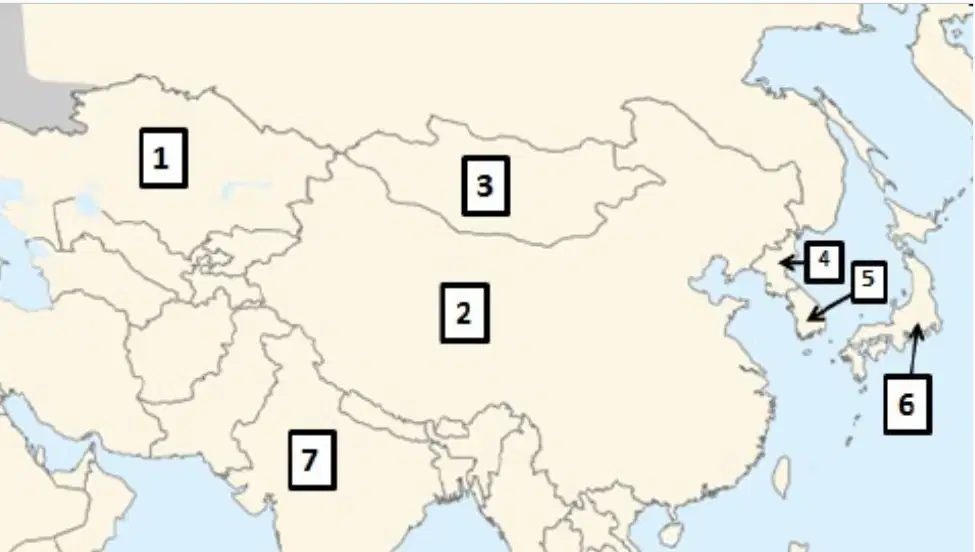
Where is Japan?
a)
6
b)
1
c)
2
d)
3
e)
4
47.
Where is China?
a)
2
b)
1
c)
3
d)
4
e)
5
48.
Where is India?
a)
7
b)
1
c)
2
d)
3
e)
4
49.
Where is Mongolia?
a)
3
b)
1
c)
2
d)
4
e)
5
50.
Where is South Korea?
a)
5
b)
1
c)
2
d)
3
e)
4
51.

Can you guess where Buddhism originated? Here's a hint: It's not Japan, China, Mongolia, or France!

a)

Japan

b)

India

c)

China

d)

Mongolia

e)

France

52.

What is this a picture of?

a)

Mandate of Heaven

b)

Civil servant

c)

Zhou

d)

Yin and Yang

e)

Dao

53.

What is the real color of jade?

(a)  

54.

What is the color of Asia?

(a)  

55.

The Chinese "south-pointing

spoon" is the oldest known

(a)   .

56.

What is this picture of?

a)

acupuncture

b)

anesthetic

c)

moxibustion

d)

lodestone

57.

(a)   is the Second Most Consumed Beverage in China.

58.
Question Image
a)

1

1.

China

b)

2

2.

India

c)

4

3.

Indonesis

d)

5/6

4.

North and South Korea

e)

7

5.

Japan

59.

Match the following

a)

1.

catapult

b)

2.

immune system

c)

3.

inoculate

d)

4.

vaccine

e)

5.

canal locke

60.

Match the following

a)

1.

Moveable type

b)

2.

porcelain

c)

3.

mass produce

d)

4.

gunpowder

e)

5.

alchemy

61.

Match the following

a)

1.

harrow

b)

2.

currency

c)

3.

economy

d)

4.

junk

e)

5.

Marco Polo

62.

Match the following

a)

1.

urbanization

b)

2.

commerce

c)

3.

barge

d)

4.

chain pump

63.

Match the following

a)

1.

bureaucracy

b)

2.

aristocracy

c)

3.

warlord

d)

4.

Confucius

e)

5.

mandate of heaven

64.

Match the following

a)

1.

meritocracy

b)

2.

imperial

c)

3.

emperor

d)

4.

dynasty

e)

5.

civil service examinations

65.

What goes up but never comes down?

a)

Height

b)

Age

c)

Future

d)

Balloon

66.

What month of the year has 28 days

a)

February

b)

January

c)

December

d)

All of them

67.

What gets sharper the more you use it?

a)

School

b)

Comany

c)

Brain

d)

pencil

e)

lead pencil

68.

What bird lifts the most?

a)

Big Bird

b)

Crane

c)

Flamingo

d)

Crab

e)

Hawk

69.

What fruit is always sad?

a)

raspberry

b)

poisonberry

c)

opinion berry

d)

blues clues

e)

blueberry

70.

What is the 7th letter of the Alphabet?

a)

F

b)

A

c)

G

d)

J

71.
Who is Simba's dad in The Lion King?
a)
Scar
b)
Mufasa
c)
Rafiki 
72.
What logo is this?
a)
Toyota
b)
Lexus
c)
Cadillac
d)
Nissan
73.
What is the fluffiest dog breed alive?
a)
Yorkshire Terrier
b)
Siberian Husky
c)
Chow Chow
d)
German Short-Haired Pointer
74.

What dog is this?

a)

Wolf

b)

Husky

c)

Doberman

d)

German Shepherd

75.

What breed is this?

a)

Pomeranian

b)

Bichon Frise

c)

Maltese

d)

Shih Tzu