

wayground logo

Free Printable Worksheets

Font size

S
M
L
XL
Worksheets

Unit 2 – Exponentials and Logarithms

Total questions: 113

Worksheet time: 8hrs 17mins

Name
Class
Date
1.
Given f(x) = 2x and
g(x) = x2+3 , find f(g(x)).
a)
x2+2x+3
b)
4x2+3
c)
2x2+3
d)
2x2+6
2.
Given f(x)= -3x+7 and g(x)=2x2 - 8, find f(g(x)).
a)
f(g(x))= -6x2+31
b)
f(g(x))= -6x2+24
c)
f(g(x))=18x2-84x+6
d)
f(g(x))=9x2-42x-1
3.
Given f(x)= -3x + 7 and g(x)=2x2 - 8, find g(f(x)).
a)
g(f(x))= -6x+ 31
b)
g(f(x))= -6x+ 24
c)
g(f(x))=18x- 84x + 90
d)
g(f(x))=9x- 42x - 41
4.
f(x) = 3x + 10
g(x) = x - 2
Find g(f(-10))
a)
-42
b)
-26
c)
-18
d)
None of these.
5.
If h(a) = 3 - 2a

Find h(-3).
a)
12
b)
-2
c)
-3
d)
9
6.

Which one is the same as fοg(x)

a)

g(f(x))

b)

f(g(x))

7.
f(x) = 3x + 10
g(x) = x - 2
Find (f∘g)(0)
a)
16
b)
4
c)
-4
d)
None of these.
8.
f(x) = 3x2 + 7x and g(x) = 2x2 - x - 1, find (f - g)(x).
a)
x2 + 8x + 1
b)
x2 + 6x - 1
c)
5x2 + 8x - 1
d)
x2 + 8x -1
9.
a)
136
b)
4
c)
8
d)
147
10.
a)
2
b)
11
c)
-11
d)
-9
11.

The relation in the graph is..

a)

a function but not a one-to-one function.

b)

a one-to-one function.

c)

not a function

12.

The relation in the graph is..

a)

a function but not a one-to-one function.

b)

a one-to-one function.

c)

not a function

13.

The relation in the graph is..

a)

a function but not a one-to-one function.

b)

a one-to-one function.

c)

not a function

14.

The relation in the graph is..

a)

a function but not a one-to-one function.

b)

a one-to-one function.

c)

not a function

15.

The relation in the graph is..

a)

a function but not a one-to-one function.

b)

a one-to-one function.

c)

not a function

16.

The relation in the graph is..

a)

a function but not a one-to-one function.

b)

a one-to-one function.

c)

not a function

17.

The relation in the graph is..

a)

a function but not a one-to-one function.

b)

a one-to-one function.

c)

not a function

18.

The relation in the graph is..

a)

a function but not a one-to-one function.

b)

a one-to-one function.

c)

not a function

19.

The relation in the graph is..

a)

a function but not a one-to-one function.

b)

a one-to-one function.

c)

not a function.

20.

The relation in the graph is..

a)

a function but not a one-to-one function.

b)

a one-to-one function.

c)

not a function.

21.

Find the inverse of  f(x)=3x+2f(x)=3x+2  

a)

f1(x)=3x2f^{-1}(x)=3x-2

b)

f1(x)=2+3xf^{-1}(x)=2+3x

c)

f1(x)=x23f^{-1}(x)=\frac{x-2}{3}

22.

Find the inverse of  f(x)=2x+1f(x)=2x+1  

a)

f1(x)=2xf^{-1}(x)=2x

b)

f1(x)=x12f^{-1}(x)=\frac{x-1}{2}

c)

f1(x)=2f^{-1}(x)=2

23.

Find the inverse of  f(x)=4xf(x)=4x  

a)

f1(x)=x4f^{-1}(x)=\frac{x}{4}

b)

f1(x)=4f^{-1}(x)=4

c)

f1(x)=14f^{-1}\left(x\right)=\frac{1}{4}

24.

Find the inverse of  f(x)=x53f(x)=\frac{x-5}{3}  

a)

f1(x)=35+xf^{-1}(x)=\frac{3}{5}+x

b)

f1(x)=3x+5f^{-1}(x)=3x+5

c)

f1(x)=5x+3f^{-1}(x)=5x+3

25.

Find the inverse of  f(x)=10+7xf(x)=10+7x  

a)

f1(x)=x710f^{-1}(x)=\frac{x-7}{10}

b)

f1(x)=x107f^{-1}(x)=\frac{x-10}{7}

c)

f1(x)=110+7xf^{-1}(x)=\frac{1}{10+7x}

26.

The inverse of f(x)=x+30f(x)=x+30   is  f1(x)=x30f^{-1}(x)=x-30  .

a)

True

b)

False

c)

I have no idea how to do this.

27.

The inverse of f(x)=8x+30f(x)=8x+30  is f1(x)=830f^{-1}(x)=\frac{8}{30}  .

a)

True

b)

False

28.

The inverse of  f(x)=x21f(x)=x^2-1  is f1(x)=(x+1)12f^{-1}(x)=(x+1)^{\frac{1}{2}}  .

a)

True

b)

False

29.

Find the inverse of f(x)=1xf(x)=\frac{1}{x}  .

a)

f1(x)=1xf^{-1}\left(x\right)=\frac{1}{x}  

b)

f1(x)=xf^{-1}\left(x\right)=x  

c)

no solution

30.

The notation for an inverse is

a)

f1(x)f^{-1}\left(x\right)

b)

g1(x)g^{-1}\left(x\right)

c)

All of the above

31.
Using the parent function y=3x what would the graph of y=3x+1 look like?
a)
Horizontal shift left one unit!
b)
Horizontal shift right one unit!
c)
Vertical shift up one unit!
d)
Vertical shift down one unit!
32.
Using the parent function y=3x what would the graph of y=3x+1 look like?
a)
Horizontal Shift to the right 1 unit
b)
Horizontal shift to the left one unit
c)
Vertical shift one unit up
d)
Vertical shift one unit down
33.
Using the parent function y=3x what would the graph of y=3x+1 look like?
a)
Horizontal Shift to the right 1 unit
b)
Horizontal shift to the left one unit
c)
Vertical shift one unit up
d)
Vertical shift one unit down
34.
Using y=3x as the parent function, what will y=3-x look like?
a)
Reflection on the x axis?
b)
Reflection on the line y=x
c)
Reflection on the y axis
d)
Reflection on y=0
35.

What transformations have occurred from f(x)=2xf\left(x\right)=2^x   to  g(x)=(2)x+5g\left(x\right)=\left(2\right)^{-x}+5  

a)

Reflection across the y-axis, horizontal shift right 5

b)

Reflection across the y-axis, vertical shift up 5

c)

Reflection across the asymptote, horizontal shift right 5 

d)

Reflection across the asymptote, vertical shift up 5 
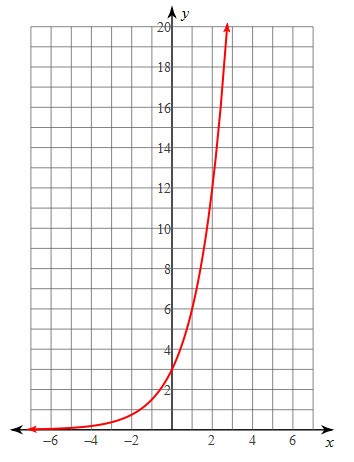
36.
What is the y-intercept of the function?
a)
2
b)
3
c)
1
d)
-2
37.

This is the horizontal line which the values of the function cannot fall below :

a)

Asymptote

b)

Growth Factor

c)

Axis of symmetry

d)

Curve

38.
Which of the following functions is represented by this graph?
a)
f(x)=2(1.2)x
b)
f(x)=2(0.75)x
c)
f(x)=6(0.75)x
d)
f(x)= −2(0.75)x
39.
Describe the transformation of y = f(x) for the new function
 y = f(x) - 5
a)
The graph of y = f(x) was shifted to the right 5 units. 
b)
The graph of y = f(x) was shifted to the left 5 units. 
c)
The graph of y = f(x) was shifted up 5 units. 
d)
The graph of y = f(x) was shifted down 5 units.
40.
What type of function is shown?
a)
exponential
b)
logarithm
c)
quadratic
d)
square root
41.

log(4x)

a)

log4-logx

b)

log4+logx

c)

4logx

d)

xlog4

42.

log(xy2)

a)

logx+2logy

b)

logx+logy2

c)

logx-2logy

d)

logx+logy+log2

43.

log(xy)\log\left(\frac{x}{y}\right)  

a)

logx+logy

b)

xlogy

c)

log(x-y)

d)

logx-logy

44.

log(m3n)\log\left(\frac{m^3}{n}\right)  

a)

logm-log3-logn

b)

3logm+logn

c)

3logm-logn

d)

3log(m-n)

45.

ln(4xy)

a)

ln4+lnx+lny

b)

4lnxy

c)

4lnx+lny

d)

4ln(x+y)

46.

log(3x)2

a)

2log(3+x)

b)

2log3+logx

c)

log3+2logx

d)

2(log3+logx)

47.

ln(2x2yz4)\ln\left(\frac{2x^2y}{z^4}\right)  

a)

ln2+2lnx+lny+4lnz

b)

ln2+2lnx+lny-4lnz

c)

2ln(2xy)-4lnz

d)

2ln2x+lny-4lnz

48.

log(8xyz) \log\left(\frac{8x}{yz}\right)\  

a)

log8+logx-logy-logz

b)

log8+logx-logy+logz

c)

log(8x)-log(yz)

d)

8logx-ylogz

49.

log(x7)

a)

log(7x)

b)

log7+logx

c)

xlog7

d)

7logx

50.

log(94)\log\left(\frac{9}{4}\right)  

a)

log9+log4

b)

log(9-4)

c)

log9-log4

d)

4log9

51.

Which of the following is true about the general form of a logarithmic function,

f(x)=alogb(xh)+kf\left(x\right)=a\log_b\left(x-h\right)+k  ? Select ALL that apply

a)

The horizontal asymptote is  y=ky=k  

b)

The vertical asymptote is  x=hx=h  

c)

hh  is the horizontal shift

d)

kk  is the vertical shift

e)

aa  reflects the graph over the x-axis if it's negative

52.

What is the vertical asymptote for the graph of

f(x)=log4xf\left(x\right)=\log_4x  ?

a)

y=0y=0  

b)

y=4y=4  

c)

x=0x=0  

d)

x=4x=4  

53.

Describe the end behavior of the graph of

f(x)=log4xf\left(x\right)=\log_4x  

a)

As  xx\rightarrow\infty  ,  yy\rightarrow\infty  

b)

As  xx\rightarrow\infty  ,  yy\rightarrow-\infty  

c)

As  x0+x\rightarrow0^+  ,  yy\rightarrow\infty  

d)

As  x0+x\rightarrow0^+  ,  yy\rightarrow-\infty  

54.

Describe the transformation on

g(x)=log2(x3)g\left(x\right)=\log_2\left(x-3\right)  

a)

The graph has been shifted 3 units up

b)

The graph has been shifted 3 units to the right

c)

The graph has been shifted 2 units right

d)

The graph has been shifted 3 units left

55.

What is the domain for

g(x)=log2(x3)g\left(x\right)=\log_2\left(x-3\right)  ?

a)

All real numbers

b)

(3,)\left(3,\infty\right)  

c)

(0,)\left(0,\infty\right)  

d)

(,3)\left(-\infty,3\right)  

56.

Describe the transformation for

h(x)=log3(x+1)h\left(x\right)=-\log_3\left(x+1\right) . Select ALL that apply.

a)

hh  has been reflected over the x-axis

b)

hh  has shifted 3 units to the left

c)

hh  has shifted 1 unit to the left

d)

hh  has reflected over the y-axis

57.

Describe the end behavior for

h(x)=log3(x+1)h\left(x\right)=-\log_3\left(x+1\right)  . Select ALL that apply.

a)

As  x1x\rightarrow-1^-  ,  yy\rightarrow-\infty  

b)

As  xx\rightarrow\infty  ,  yy\rightarrow\infty  

c)

As  x1+x\rightarrow-1^+  ,  yy\rightarrow\infty  

d)

As  xx\rightarrow\infty  ,  yy\rightarrow-\infty  

58.

Describe the transformation(s) for 

k(x)=log10(x6)4k\left(x\right)=\log_{10}\left(x-6\right)-4  .

a)

k has been shifted 6 units right and 4 units down

b)

k has been shifted 6 units right and 4 units up

c)

k has been shifted 6 units left and 4 units down

d)

k has been shifted 6 units left and 4 units up

59.

What is the equation for the graph?

a)

y=log4(x+1)+2y=\log_4\left(x+1\right)+2

b)

y=log4(x+2)+1y=\log_4\left(x+2\right)+1

c)

y=log4(x1)+2y=\log_4\left(x-1\right)+2

d)

y=log4(x2)+1y=\log_4\left(x-2\right)+1

60.

When you have two log expressions separated by a minus sign (-), we really need to ___________ them to simplify into one log expression.

a)

add

b)

subtract

c)

multiply

d)

divide

61.

When you have a log expression with a number in front of it, we really need to ___________ .

a)

make the number an exponent at the end of the log expression.

b)

multiply it with the log expression.

c)

add it to the log expression.

d)

subtract it from the log expression.

62.

When you have two log expressions separated by a plus sign (+), we really need to ___________ them to simplify into one log expression.

a)

add

b)

subtract

c)

multiply

d)

divide

63.

Simplify: log73+log76\log_73+\log_76  

a)

log79\log_79  

b)

log7(12)\log_7\left(\frac{1}{2}\right)  

c)

log7729\log_7729  

d)

undefined 

64.

Simplify: log4(x+4)log4(x5)\log_4\left(x+4\right)-\log_4\left(x-5\right)  

a)

log49\log_49  

b)

log4(2x1)\log_4\left(2x-1\right)  

c)

log4(x2x20)\log_4\left(x^2-x-20\right)  

d)

log4(x+4x5)\log_4\left(\frac{x+4}{x-5}\right)  

65.

Simplify: 2log3(11x)2\log_3\left(11x\right)  

a)

log3(22x)\log_3\left(22x\right)  

b)

log3(121x)\log_3\left(121x\right)  

c)

log3(121x2)\log_3\left(121x^2\right)  

d)

log3(11x2)\log_3\left(11x^2\right)  

66.

Simplify: 14log516+3log5x\frac{1}{4}\log_516+3\log_5x  

a)

log5(4x3)\log_5\left(4x^3\right)  

b)

log5(2x3)\log_5\left(2x^3\right)  

c)

log5(6x)\log_5\left(6x\right)  

d)

log5(2x3)\log_5\left(\frac{2}{x^3}\right)  

67.

Simplify: 2log2xlog2(x+3)2\log_2x-\log_2\left(x+3\right)  

a)

log2(x3+3x2)\log_2\left(x^3+3x^2\right)  

b)

log2(2x2+6x)\log_2\left(2x^2+6x\right)  

c)

log2(x2x+3)\log_2\left(\frac{x^2}{x+3}\right)  

d)

log2(2xx+3)\log_2\left(\frac{2x}{x+3}\right)  

68.

Simplify: 14log281+12log249\frac{1}{4}\log_281+\frac{1}{2}\log_249  

a)

log221\log_221  

b)

log210\log_210  

c)

log2(37)\log_2\left(\frac{3}{7}\right)  

d)

log244.75\log_244.75  

69.

Simplify: 12log964+log9x\frac{1}{2}\log_964+\log_9x  

a)

log9(32x)\log_9\left(32x\right)  

b)

log9(32x)\log_9\left(\frac{32}{x}\right)  

c)

log9(8x)\log_9\left(\frac{8}{x}\right)  

d)

undefined 

70.

Solve for x:

2(3x1)=322^{\left(3x-1\right)}=32  

a)

5

b)

2

c)

-2

d)

3

71.

Solve for x:

22x= 1162^{2x}=\ \frac{1}{16}  

a)

-1

b)

1

c)

-2

d)

2

72.

Solve for x:

4x3=84^{x-3}=8  

a)

3

b)

2/9

c)

-9/2

d)

9/2

73.

Solve for x:

54x=16255^{4-x}=\frac{1}{625}  

a)

-8

b)

8

c)

4

d)

-4

74.

Solve for x:

53x25 = 6005^{3x}-25\ =\ 600  

a)

4/3

b)

3/4

c)

4

d)

-4

75.

Solve for x:

2(3x+1)=4x2^{\left(3x+1\right)}=4^x  

a)

0

b)

1

c)

-1

d)

2

76.
log5(4x-7)=log5(x+5)
a)
3
b)
12
c)
4
d)
7
77.

log2(x2 - 6) = log2(2x+2)

a)

4, -2

b)

No Solution

c)

4

d)

-2

78.

log2(x+3)=4

a)

16

b)

13

c)

3

d)

10

79.

log8(4x+4)=2

a)

15

b)

12

c)

10

d)

3

80.

Solve for x.
8+log6(x1)=68+\log_6\left(x-1\right)=6  

a)

3736\frac{37}{36}  

b)

13318-\frac{1331}{8}  

c)

128-\frac{1}{28}  

d)

11

81.
log5(4x-7)=log5(x+5)
a)
3
b)
12
c)
4
d)
7
82.

log2(x2 - 6) = log2(2x+2)

a)

4, -2

b)

No Solution

c)

4

d)

-2

83.

log2(x+3)=4

a)

16

b)

13

c)

3

d)

10

84.

log8(4x+4)=2

a)

15

b)

12

c)

10

d)

3

85.

Solve for x.
8+log6(x1)=68+\log_6\left(x-1\right)=6  

a)

3736\frac{37}{36}  

b)

13318-\frac{1331}{8}  

c)

128-\frac{1}{28}  

d)

11

86.
log5(4x-7)=log5(x+5)
a)
3
b)
12
c)
4
d)
7
87.

log2(x+3)=4

a)

16

b)

13

c)

3

d)

10

88.

log8(4x+4)=2

a)

15

b)

12

c)

10

d)

3

89.
Log with a base "e" (loge) is the same thing as...
a)
"e"
b)
Natural Logarithm (LN)
c)
Common Logarithm (Log)
d)
Natural Log, base "e"
LNe
90.
log(2x) - log(5) = log(30)
a)
6/5
b)
45/2
c)
75
d)
-3/8
91.

log4(3x-1)=log4(2x+3)

a)

4

b)

3

c)

1

d)

8

92.

logx1000=3

a)

1

b)

10

c)

30

d)

3

93.
log2(2) + log2(8x) = 6
a)
x = 3
b)
x = 2
c)
x = 6
d)
x = 4
94.

log2(x2 - 6) = log2(2x+2)

a)

4, -2

b)

No Solution

c)

4

d)

-2

95.

Solve:


log6(2x + 3) = 3

a)

x = 106.5

b)

x = 100

c)

x = 16

d)

x = 50

96.

Which formula(s) should you use for compound interest?


select ALL that apply.

a)


I=(P)(r)(t)I=\left(P\right)\left(r\right)\left(t\right)

b)

A=P(1+r)tA=P\left(1+r\right)^t

c)

P+I=AP+I=A

d)

A=P(1+r)tA=P\left(1+r\right)t

97.

Ms. Pierson is working out a compound interest problem. This is what she plugged into her calculator:


500(1+3100)7500\left(1+\frac{3}{100}\right)7  

Did she do that correctly?

a)

Yes, everything looks good!

b)

No, she made a mistake :(

98.

Your 3 year investment of $20,000 received 5.2% interest compounded annually. What will your total balance be at the end?

a)

$23,285.05

b)

$3,285.05

c)

$2,385

d)

$32,285

99.

The Arnold's took out a loan for $195,000 to purchase a home. At a 4.3% interest rate compounded annually, how much interest will they have paid over the course of 30 years?

a)

$494,546.99

b)

$529.305.61

c)

$689,546.99

d)

$640,891.53

100.
You borrowed $59,000 for 2 years at 11% which was compounded annually.  What total will you pay back?
a)
$13,693.90
b)
$1,363.90
c)
$72,693.90
d)
$73,793.90
101.

You borrowed $1,690 for 5.5 years at an interest of 5.7% compounded annually. How much extra did you pay by taking out the loan?

a)

$602.45

b)

$2,292.45

c)

$1,87.55

d)

$3,982.45

102.

Your $440 gets 5.8% interest compounded annually for 8 years. What will your total balance be in 8 years?


Don't forget to round your answer to 2 decimal places.

(a)  

103.

Jay'den earned $475 from mowing lawns last summer. He deposited this money in an account that pays an interest rate of 3.8% compounded annually.

How much interest will he end up earning over the course of 15 years?


Don't forget to round your answer to 2 decimal places.

(a)  

104.
If $1,000 is invested at 16% interest, compounded continuously, for five years, what is the ending balance?
a)
$1,225,54
b)
$2,225.54
c)
$22,255.40
d)
$225.54
105.
The poplulation of Eden is growing continuously at a rate of 1.9%. If the current population is 15,230, about how many years to reach 20,000?
a)
31
b)
2
c)
15
d)
68
106.
P = 26,000 | Rate = 2.4% | 4 years | Compounded Continuously | Amount owed???
a)
$2,496
b)
$28,496
c)
$3,406,924
d)
$28,619.74
107.
If $1,000 is invested at 16% interest, compounded continuously, for five years, what is the ending balance?
a)
$1,225,54
b)
$2,225.54
c)
$22,255.40
d)
$225.54
108.
Compounded Continuously an investment of  $400 at a rate of 35% for 2 years
a)
$280
b)
$680
c)
$1,034.47
d)
$805.50
109.
Compounded Continuously Invested $400 at a rate of 35% for 8 months
a)
$520.07
b)
$505.12
c)
$460.11
d)
$7,643.74
110.
a)
$128,660
b)
$77,724
c)
$80,234
d)
$155,351
111.
a)
$105,654
b)
$133,105
c)
$164,133
d)
$112,822
112.
a)
$94,649
b)
$107,235
c)
$110,235
d)
$88,123
113.
a)
$128,660
b)
$166,280
c)
$175,335
d)
$250,354
