wayground logo

Free Printable Worksheets

Font size

S
M
L
XL
Worksheets

Plate Tectonics Practice Test

Total questions: 50

Worksheet time: 38mins

Name
Class
Date
1.

What is Pangea?

a)
Pangea is a type of dinosaur.
b)
Pangea is a modern country in Europe.
c)
Pangea is a famous ocean current.
d)
Pangea is a supercontinent that existed millions of years ago.
2.

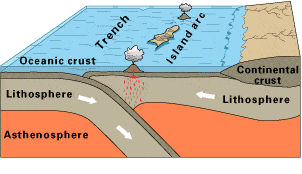
Observe this diagram of a plate boundary. One statement BEST describes what is happening. It is that

a)

the oceanic crust is melting.

b)

the denser oceanic crust is subducting under the less dense oceanic crust

c)

volcanic islands are forming.

d)

the tectonic plates are moving away from each other.
3.

Where would sea floor spreading most likely occur?

a)

At convergent boundaries (oceanic vs. oceanic)

b)

At convergent boundaries (oceanic vs. continental)

c)

At divergent plate boundaries (oceanic vs. oceanic)

d)

At transform plate boundaries

4.
This boundary is described by two plates moving away from eachother along the edges and separating. The resulting gap allows magma to rise and create new crust, forming new lithosphere. 
a)
Convergent Boundary 
b)
Divergent Boundary  
c)
Transform Boundary
5.
This boundary is described as two plates moving past eachother ALONG THE EDGES horizontally.  These boundaries will get stuck or lock against eachother causing earthquakes when they slip and release. 
a)
Convergent Boundary
b)
Divergent Boundary
c)
Transform Boundary
6.
This boundary is described as moving toward one another  When the plates are both continental plates the will crumple up and form a mountains. When they are continental and oceanic plates, subduction occurs  and earthquakes and volcanoes form. 
a)
Convergent Boundary
b)
Divergent Boundary
c)
Transform Boundary
7.
Trenches, deep underwater canyons on the sea floor are created at this type of boundary 
a)
Divergent
b)
Convergent, Subduction Zone
c)
Transform 
8.
New crust is created at this type of  boundary.
a)
Divergent
b)
Convergent, Subduction Zone
c)
Transform 
9.
Mountains are created at this type of  boundary.
a)
Divergent 
b)
Convergent
c)
Transform 
10.
Mid Ocean Ridge Formation  is created at this type of  boundary.
a)
Divergent 
b)
Convergent
c)
Transform 
11.
What is the outermost layer of the Earth called?
a)
Core
b)
Mantle
c)
Crust
12.

This famous fault in California has a lot of earthquakes!

a)

New Madrid

b)

Denali Fault

c)

Ramapo Seismic Zone

d)

San Andreas Fault

13.

What type of boundary is shown in the diagram?

a)

Divergent

b)

Convergent

c)

Transform

14.

What type of boundary is shown in the diagram?

a)

Divergent

b)

Convergent

c)

Slide/Transform

15.

What type of plate boundary is shown in the picture?

a)

Convergent

b)

Divergent

c)

Transform

16.

What geologic event would most likely be found at a transform boundary?

a)

Volcano

b)

Mountain

c)

Earthquake

d)

Mid-Ocean Ridge

17.

What landform would you most likely find at a divergent boundary between two pieces of continental crust?

a)

Mid-Ocean Ridge

b)

Rift Valley

c)

Mountain

d)

Volcano

18.

When one tectonic plate sinks under another, this is called...

a)

Convegent

b)

Divergent

c)

Subduction

d)

Transform

19.

What landform would you most likely find at a convergent boundary between two pieces of continental crust?

a)

Mid-Ocean Ridge

b)

Oceanic Trench

c)

Mountain

d)

Volcano

20.

Plate movement is caused by ____________.

a)

the rotation of the Earth

b)

convection currents in the mantle

c)

ocean tides

d)

the moon's gravity

21.

The Great Rift Valley in Africa and the Mid-Atlantic Ridge were both created by this type of plate boundary.

a)

Convergent

b)

Divergent

c)

Transform

22.

What was the major flaw in Wegener's theory of continental drift?

a)
The lack of a mechanism for continental movement.
b)
Wegener proposed that continents were fixed in place.
c)
He believed oceans were expanding, not continents moving.
d)
The theory was based on incorrect fossil evidence.
23.

What is the correct order (starting from the surface) of Earth’s layers?

a)

crust, outer core, inner core, mantle

b)

mantle, outer core, inner core, crust

c)

crust, mantle, outer core, inner core

d)

outer core, inner core, crust, mantle

24.
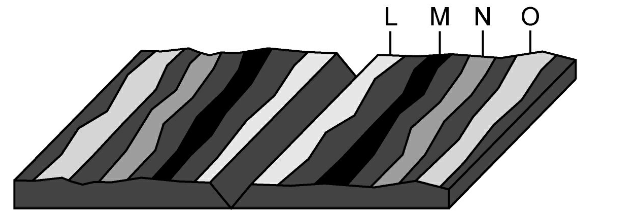
Where would the oldest rock be found?
a)
L
b)
M
c)
N
d)
O
25.
How is it possible for new crust to be formed without increasing the surface area of the Earth?
a)
Crust is destroyed at the same time it is created
b)
New crust is underwater where it sinks
c)
New crust breaks more easily than old crust
26.

The youngest rocks on the ocean floor are located ____.

a)

near continents

b)

at mid-ocean ridges

c)

far from mid-ocean ridges

d)

near Asia

27.

___________ is the hypothesis that states that the continents once formed a single landmass, broke up, and drifted to their present locations.

a)

Continental drift

b)

Sea-floor spreading

c)

Plate tectonics

d)

Mid-ocean range

28.

What technology did scientists use in the mid-1900s to map the mid-ocean ridge?

a)

satellites

b)

deep-sea diving

c)

submarines

d)

sonar

29.

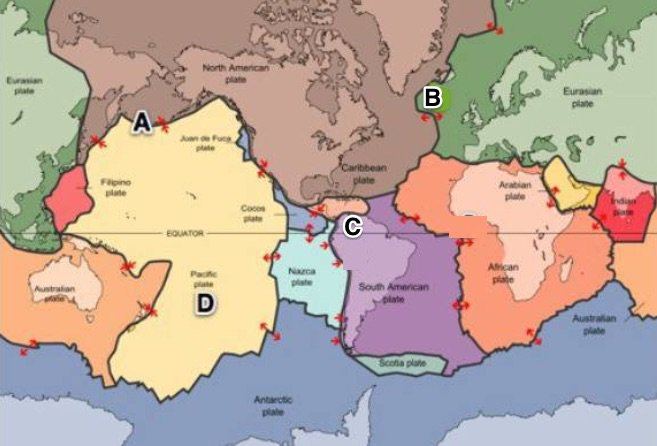
What feature is at C?

a)

Deep ocean trench

b)

Mid ocean ridge

c)

sea floor spreading

d)

subduction

30.

What words describe M? choose all

a)

deep ocean trench

b)

mid ocean ridge

c)

sea floor spreading

d)

subduction

31.

The mesosaurus is an example of which type of evidence?

a)

matching fossil

b)

matching land formation

c)

climate change

d)

memorial movement

32.

Which of the following was not used by Wegener as evidence of continental drift?

a)

Evidences of glacial scratches continents found near the equator

b)

Fossils that were found on different continents

c)

Magnetic reversals on the seafloor

d)

The fit of the continents

33.
What are the two types of crust?
a)
continental and oceanic
b)
ocean and basin
c)
lower and upper
d)
thick and thin
34.

What did we learn from the ring of fire activity?
a)
The ring of fire is a major area in the world for earthquakes and volcanic activity.
b)
The ring of fire is a famous tourist destination for its beaches.
c)
The ring of fire is primarily a desert region with no geological activity.
d)
The ring of fire is known for its calm seas and stable weather.
35.
What discovery caused scientists to rethink Wegener's continental drift theory?
a)
discovery of earthquake activity in California
b)
discovery of the ring of fire in the Pacific Ocean
c)
discovery of seafloor spreading in the Atlantic Ocean
d)
discovery of deep trenches off the coast of South America
36.
Which of the following is evidence that supports continental drift?
a)
the presence of penguins at both the equator and Antarctica
b)
fossils of the same plant have been found on several continents
c)
the presence of glacial features in Antarctica
d)
the presence of volcanic rock in Antarctica
37.
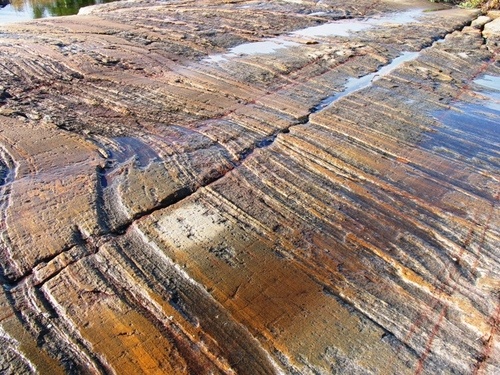
This is a picture of glacier scars found in Africa.  What are these evidence for?
a)
Africa has always been near the equator
b)
Africa was once in an area of the Earth that had a very cold climate
c)
The continents have not moved
d)
sea floor spreading
38.

What evidence did Wegener use to support his theory?

a)

Continents and fossils fitting together/matching-up like puzzle pieces

b)

glacier scars and other climate evidence from temperature

c)

mountain ranges and rocks line up across continents

d)

all of the above

39.

Wegener found fossils of land reptiles on two different continents. This was important because

a)

Land reptiles are often found all over the world, showing that they can survive in most climates

b)

Land reptiles cannot swim, so the continents must have been connected for them to get across

c)

Land reptiles are never moved around the Earth by humans, so they must have travels to these continents by themselves

d)

Land reptiles fossilized much better than other animal species

40.

Wegener observed scratches from glaciers in Africa and India where it is currently too hot for glaciers to form. This is considered...

a)

Fossil Evidence

b)

Rock Formation Evidence

c)

Climate Evidence

d)

Objective Evidence

41.

Wegener found fossils of ancient ferns on Antarctica, this shows

a)

That some ferns can survive temperatures well below freezing

b)

That humans put ferns on Antarctica millions of years ago

c)

That Antarctica drifted from a warmer climate where plants could grow

d)

That fossils can be formed in cold climates

42.

The area around the pacific plate where boundaries form is called...

a)

death ring

b)

fire zone

c)

ring of fire

d)

zone of fire

43.

The Hawaiian island chain is formed from a hot spot. As a result:

a)
The Hawaiian island chain helps determine the speed and direction of the Pacific Plate's movement.
b)
The Hawaiian island chain indicates the age of the ocean floor.
c)
The Hawaiian islands show the location of tectonic boundaries.
d)
The Hawaiian island chain is used to measure ocean currents.
44.

What is the significance of magnetic patterns on the seafloor?

a)
They indicate the presence of underwater volcanoes.
b)
They show the location of ancient shipwrecks.
c)
They reveal the depth of ocean currents.
d)
They provide evidence for seafloor spreading and plate tectonics.
45.

What happens as an oceanic plate converges with a continental plate?

a)
Both plates move apart from each other.
b)

The oceanic plate is subducted beneath the continental plate

c)
The oceanic plate rises above the continental plate.
d)
The continental plate is subducted beneath the oceanic plate.
46.

Why does an oceanic plate subduct under a continental plate?

a)
An oceanic plate subducts under a continental plate because it is denser.
b)
Continental plates are always thicker than oceanic plates.
c)
An oceanic plate is lighter than a continental plate.
d)
Oceanic plates cannot subduct under any circumstances.
47.

From the ring of fire activity we learned volcanoes' and earthquakes usually occur where?

a)
Oceanic trenches
b)
Mountain ranges
c)
Deserts
d)
Tectonic plate boundaries
48.

Plate boundary formed above a rising convection current in the mantle

a)
Convergent plate boundary
b)
Divergent plate boundary
c)
Transform plate boundary
d)
Subduction zone boundary
49.

Formed above a sinking convection current in the mantle.

a)
Divergent boundary
b)
Transform boundary
c)

Convergent /Subduction zone

d)
Continental collision zone
50.

What drives the convection currents in the mantle?

a)
Magnetic field fluctuations
b)
Wind patterns in the atmosphere
c)
Ocean currents from surface temperatures
d)

Heat transfer and differences in density