
 Worksheets
WWI Test
Total questions: 24
Worksheet time: 12mins
Name
Class
Date
1.
His assassination sparked World War I.
a)
Count Alfred von Schlieffen
b)
Woodrow Wilson
c)
Archduke Franz Ferdinand
d)
Allies
2.
This British liner was sunk by a German U-boat.
a)
Zimmermann note
b)
Lusitania
c)
trench warfare
d)
socialists
3.
These people opposed World War I because they perceived all wars as evil.
a)
nationalism
b)
Allies
c)
Central Powers
d)
Pacifists
4.
Extreme pride in your country.
a)
nationalism
b)
imperialism
c)
Militarism
d)
"no man's land"
5.
In 1914, this alliance consisted of France, Great Britain, and Russia.
a)
Central Powers
b)
Allies
c)
Pacifists
d)
imperialism
6.
In 1914, this alliance consisted of Germany, Austria-Hungary, and the Ottoman Empire.
a)
Pacifists
b)
Allies
c)
Central Powers
d)
nationalism
7.
This contained a suggestion of an alliance between Mexico and Germany that deeply angered the American people
a)
Lusitania
b)
"no man's land"
c)
trench warfare
d)
Zimmermann note
8.
This long-term cause of the war involved the development of the armed forces and their use as a tool of diplomacy.
a)
nationalism
b)
imperialism
c)
trench warfare
d)
Militarism
9.
Closely linked with industrialization, this long-term cause of the war involved a contest for colonies.
a)
imperialism
b)
Militarism
c)
nationalism
d)
"no man's land"
10.
Many Americans wanted to join WWI after the ______ was sunk by a German u-boat.
a)
Lusitania
b)
Zimmerman
c)
Titanic
d)
Carnival
11.
Which of the following was not a cause of World War I?
a)
American isolationism
b)
imperialist competition
c)
the stockpiling of weapons
d)
European nationalism
12.
Which of the following was a result of the Selective Service Act?
a)
African Americans could not become Army officers.
b)
Women could not work in factories.
c)
Troops were segregated by race.
d)
Men were required to register for the draft.
13.
In 1917, Germany attempted to get _____ to attack the southern United States
a)
Canada
b)
Italy
c)
Mexico
d)
Spain
14.
Who rejected Wilson's "Fourteen Points" peace plan?
a)
Allied leaders
b)
the Germans
c)
the U.S. Senate
d)
the League of Nations
15.
What reason did Senators give for opposing U.S. membership in the League of Nations?
a)
It would lead to international instability.
b)
It would drain American finances.
c)
It would interfere with free-trade agreements.
d)
It would drag the United States into European conflicts.
16.
The Espionage and Sedition Acts affected freedom of speech because they
a)
forced restaurant owners to offer "liberty sandwiches" rather than “hamburgers."
b)
allowed the government to silence ideas that challenged its authority.
c)
forced all Americans to be drafted.
d)
promoted a free exchange of ideas.
17.
Which weapons of mechanized warfare were introduced in World War I?
a)
battlefront trenches
b)
airplanes and tanks
c)
hydrogen bombs
d)
pistols and bayonets
18.
WWI became the deadliest war in history up to that point due to:
a)
Outbreak of deadly diseases (Spanish Flu)
b)
Massive Famines
c)
Trench Warfare
d)
New types of weapons
19.
The policy that kept the United States out of the war for three years was called
a)
nationalism.
b)
the alliance system.
c)
neutrality.
d)
the convoy system.
20.
Germany was punished for WWI in all of the following EXCEPT:
a)
Had to pay reparations
b)
Had to disarm a majority of their military
c)
German leader Kaiser Wilhelm was executed
d)
Had to give up land
21.
Which country was not allowed to participate in peace talks at the Treaty of Versailles?
a)
United States
b)
Italy
c)
Russia
d)
Germany
22.
“The people of the United States are drawn from many nations, and chiefly from the nations
now at war. It is natural and inevitable that some will wish one nation, others another, to
succeed in the momentous struggle. Such divisions among us would be fatal to our peace of
mind and might seriously stand in the way of our duty as the one great nation at peace, the
one nation ready to play a part of mediator* (helps different sides reach agreement) and counselor of peace.”
President Wilson is calling for?
a)
Imperialism
b)
Neutrality
c)
Declaration of war on Germany
d)
Isolationism
23.
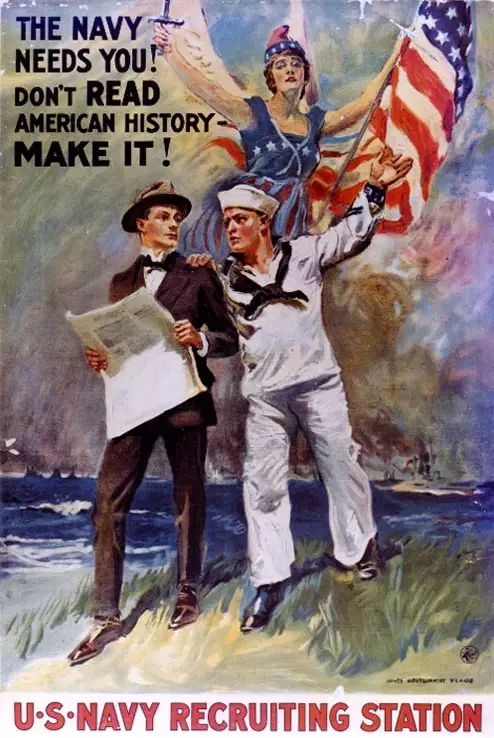
What does the WWI poster ask young men to do?
(a)
24.
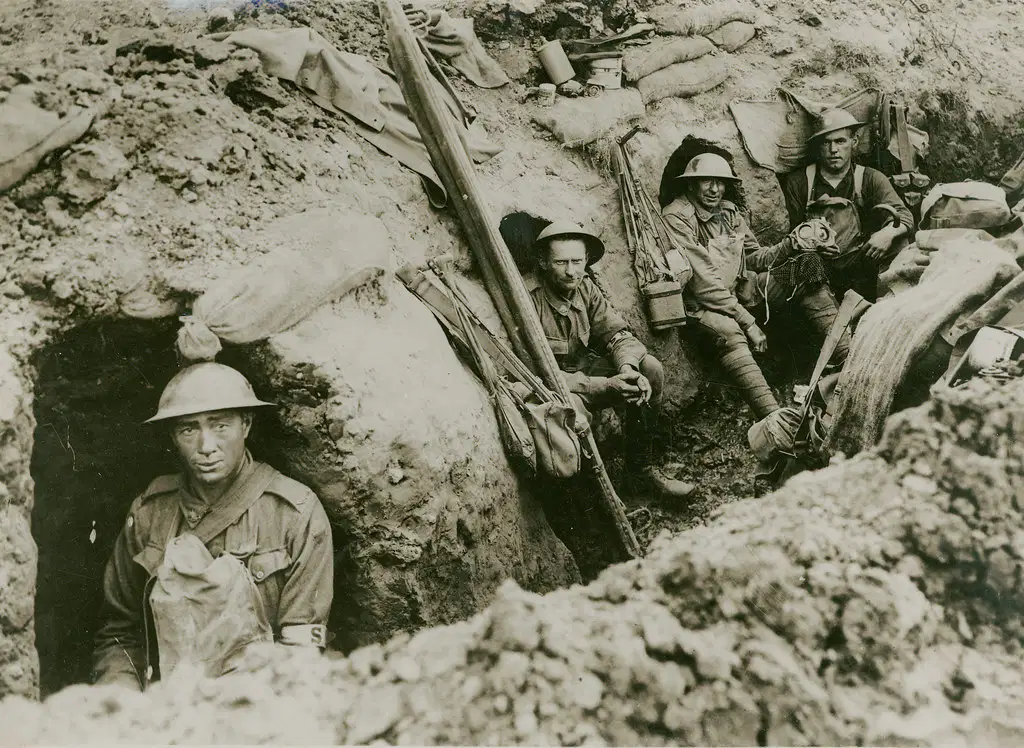
What are the soldiers in this photograph doing?
(a)
100 %

