
 Worksheets
ESS1-2
Total questions: 15
Worksheet time: 8mins
Name
Class
Date
1.
The pull of gravity on Earth is a direct result of the
a)
weight of the Earth's atmosphere
b)
rotation of Earth on its axis
c)
magnetic field of Earth
d)
mass of Earth
2.
A person on Pluto's surface would experience a(n) _____________________ gravitational force compared to on Earth
a)
Weaker, because Pluto is further from the Sun
b)
Weaker, because Pluto has less mass than Earth
c)
Equal, because both planets orbit the Sun
d)
Stronger because Pluto's surface is closer to its core
3.

The diagrams below represent the same star near four
different planets. The star has the same mass in each
picture. The data table shows the mass of each planet
and the distance between the star and the planet. Which
combination would have the greatest pull of gravity?
a)
A
b)
B
c)
C
d)
D
4.
If a spacecraft travels from Earth to the edge of the solar system, what will happen to the (V2)
gravitational pull between Earth and the spacecraft?
The gravitational pull between Earth and the spacecraft will ___________________ .
a)
Increase
b)
Decrease
c)
Remain the same
5.
How would the properties of a golf ball change if it were moved from Earth to Jupiter, a planet that
has a much higher mass than Earth?
a)
It would have the same mass, but a different weight.
b)
It would have the same weight, but a different mass.
c)
It would have the same density, but a different mass.
d)
It would have the same mass, but a different density.
6.

Satellite B has three times more mass than Satellite A.
Which satellite experiences a stronger gravitational attraction with the Earth?
a)
Neither, because they are in space.
b)
A, because it is easier to move.
c)
Neither, since they are at the same distance.
d)
B, because it has more mass.
e)
Cannot be determined with the given information
7.
Which of the following best describes the role of gravity in the formation of stars?
a)
Gravity converts solid matter into gases and light energy.
b)
Gravity causes gases and dust particles to condense into spheres.
c)
Gravity cools gases and liquids until they become one solid mass.
d)
Gravity pushes rocks and dust particles outward from a dense center.
8.

The table to the below shows the mass and weight of an object on Earth. The force of gravity on the Moon is about one-sixth the force of gravity on Earth. What are the approximate mass and the approximate weight
of the same object on the Moon?
a)
Mass: 36, Weight 360
b)
Mass: 6 ; Weight: 360
c)
Mass: 6 ; Weight : 10
d)
Mass: 1 ; weight 10
e)
9.
One factor responsible for the strength of gravitational attraction between a planet and the Sun is
a)
degree of tilt of the planet's axis
b)
how much sunlight reaches the planet
c)
how long a planet takes to rotate on its axis
d)
distance between the planet and the Sun
10.
The gravitational force between 2 objects _________________ as the distance between them decreases
a)
Increases
b)
Decreases
c)
Stays the same
11.
The gravitational force between two objects __________________ as the mass of one or both of them decreases
a)
Increase
b)
decreases
c)
stays the same
12.
You weigh more on planets with higher surface gravity, but your ____________________ does not change
a)
Distance
b)
Mass
c)
volume
d)
gravity
13.
The two factors that affect how strong the force of gravity between two objects are:
a)
mass/volume
b)
mass/distance
c)
volume/gravity
d)
volume/distance
14.
Did you know that the Earth and the Sun are NOT always the same distance apart? In fact, the Earth is farther away from the Sun in the summer (June, July, August) than the winter (December, January, February). Given this information and what you know about gravity,
decide which graph best represents the force of gravity between Earth and the Sun during
one year.
a)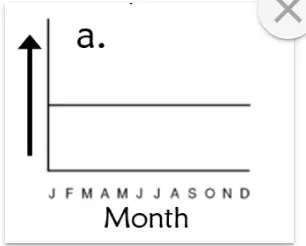
b)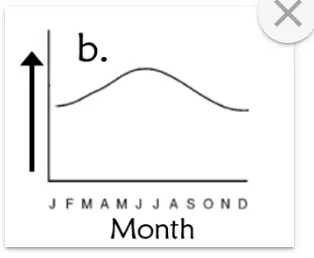
c)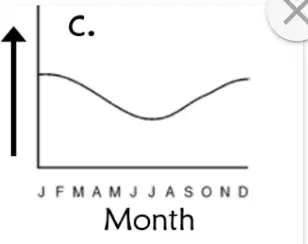
d)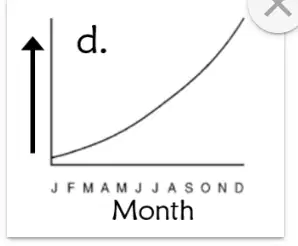
15.

The diagram to the right shows a moon revolving around a planet in an elliptical orbit. At which location is the
gravitational attraction between the moon and the planet strongest?
a)
1
b)
2
c)
3
d)
4
100 %

