wayground logo

Free Printable Worksheets

Font size

S
M
L
XL
Worksheets

Energy Pre-snapshot

Total questions: 10

Worksheet time: 5mins

Name
Class
Date
1.
1. Two friends went to the park to go on the swings. As the swings went back and forth, what happened to the total amount of energy?
a)
The amount of potential and kinetic energy decreased.
b)
The amount of potential energy increased while the kinetic energy decreased.
c)
The amount of potential energy decreased while the kinetic energy decreased.
d)
The total amount of energy stayed the same.
2.
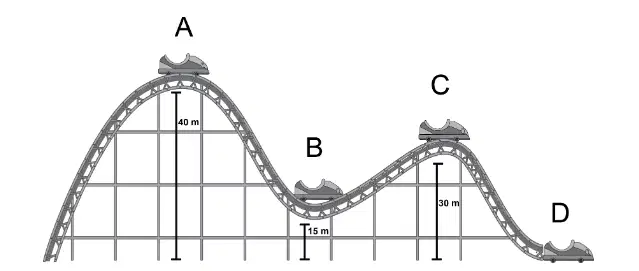
2. An illustration of a rollercoaster is shown below . At which point in the roller coaster’s journey along the track does it have the greatest gravitational potential energy and the least kinetic energy?
a)
Point A
b)
Point B
c)
Point C
d)
Point D
3.
3. Which of the following does NOT correctly pair a source of chemical energy with the kinetic energy that it is transformed into?
a)
Food → animal running
b)
Fuel → plane flying
c)
Batteries → toy car moving
d)
Spring → pop-up toy jumping
4.
4. In an outdoor plant, the process of photosynthesis converts carbon dioxide and water to glucose and oxygen. How is energy conserved within this system during this process?
a)
Thermal energy from the Sun transforms into light energy that is given off by the plant.
b)
Light is transformed into chemical and heat energy as the plant gets warmer in the sunlight.
c)
Chemical energy is transformed into mechanical energy as the plant grows.
d)
Radiant or light energy is transformed into chemical energy.
5.
5. What types of energy transformations occur in a battery-operated flashlight?
a)
Chemical energy light energy electrical energy
b)
Chemical energy electrical energy light energy
c)
Light energy chemical energy electrical energy
d)
Electrical energy chemical energy light energy
6.
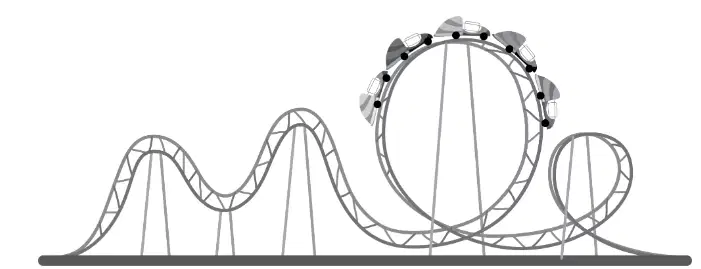
6. What is the most accurate description of the energy conservation and transformations that are taking place in the roller coaster below?
a)
The roller coaster never has any potential energy because it is always moving.
b)
Potential energy is converted to kinetic energy and back again throughout the ride.
c)
The amount of potential energy is always equal to the amount of kinetic energy throughout the ride.
d)
The roller coaster has more total energy at the bottom of the track because more kinetic energy has been created.
7.
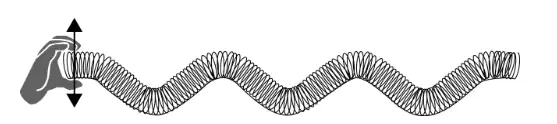
7. What type of wave is demonstrated in the model below? How is energy transferred through it?
a)
Transverse wave; energy travels in the same direction, and particles vibrate.
b)
Transverse wave; energy travels up and down in the direction of the wave.
c)
Longitudinal wave; energy travels in the same direction, and particles vibrate.
d)
Longitudinal wave; energy travels up and down in the direction of the wave.
8.
8. What kind of wave is represented in the image below?

a)
Longitudinal wave
b)
Transverse wave
c)
Ultraviolet wave
d)
Radio wave
9.
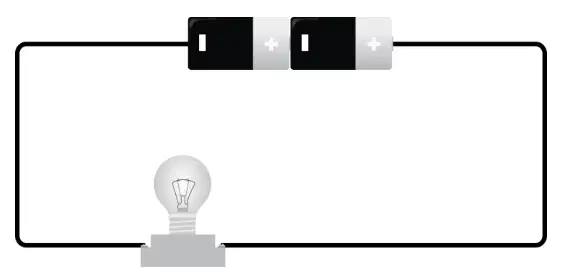
9. Gabrielle built a simple circuit in science class. She knows that energy transforms within this system. Which of the following statements best describes the energy conservation and transformation in this electric circuit?
a)
Chemical energy in the batteries is transformed into light and heat energy but does not leave the system.
b)
Chemical energy leaves the batteries and transforms into light and heat energy, and then it is released from the system.
c)
Electrical energy travels from the light bulb to the batteries, where it is stored within the system.
d)
Heat and light energy leave the system but are replaced when the batteries are changed.
10.

When a drum is struck, what type of energy transformation primarily takes place?

a)

Thermal energy is converted to electrical energy.

b)

Light energy is converted to mechanical energy.

c)

Mechanical energy is converted to sound energy.

d)

Sound energy is converted to chemical energy.