
 Worksheets
Physics Quiz First Trimester
Total questions: 99
Worksheet time: 33mins

A curved groove is place on the top of a level table as shown in the diagram. A ball is pushed in the groove at P so that it leaves at Q. Which picture shows how the ball will move when it leaves the groove at Q?


At the instant shown in the diagram, the car's centripetal acceleration is directed-
toward E
toward N
toward W
clockwise

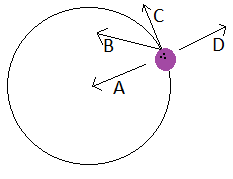
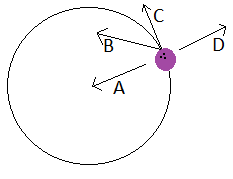
At the position shown in the diagram, which arrow indicates the direction the instantaneous (tangential) velocity of the cart?
A
B
C
D


The drum of a washing machine rotates 600 times in 1 minute. What is the frequency of the drum?
600 Hz
10 Hz
0.1 Hz
0.002 Hz

moving or tending to move toward a center...
centripetal force
centrifugal force
Tangent
Curvature

the process or act of turning or circling around something
Curvature
Rotation
Radius
Orbit
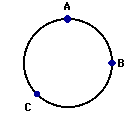



A ball is moving at constant speed around the circle. Which letter represents the acceleration of the ball?
A
B
C
D
Nonsense. The ball can't be accelerating while moving at a constant speed.

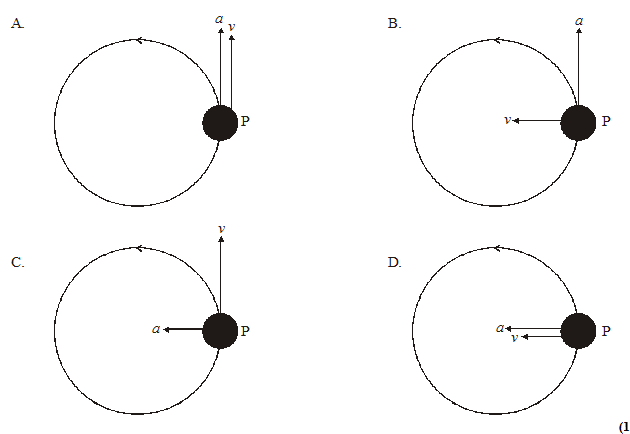
A 10kg car travels at a constant speed of 20.0 m/s around a horizontal circular track. Which diagram correctly represent the direction of the car's velocity (v) and the direction of the centripetal force (Fc) acting on the car at a particular moment?


A car moves in a horizontal circle with a radius of 10 m. The tangential velocity of the car is 30 m/s. What is the car's acceleration?
3 m/s2 toward the center
3 m/s2 away from the center
90 m/s2 toward the center
90 m/s2 away from the center
270 m/s2 toward the center
The centripetal acceleration on a 1000-kg car in a turn is 1 x 10⁵ m/s2. The radius of the turn in 10 m. What is the car's speed?
10 m/s
100 m/s
1000 m/s
10000 m/s
100,000 m/s
What is the formula for centripetal force?
Fc = mvr^2
Fc = m/r^2v
Fc = mv^2/r
Fc = mr^2/v
Gravitational potential energy is defined as
the energy an object has due to its height above the ground
the energy an object has due to its motion
the energy a spring has due to its stretch
the chemical energy stored in the molecules of atoms
Kinetic Energy is defined as
Energy stored due to its location
Energy of motion
Energy stored in the bonds of molecules
Heat energy
What is the definition of Mechanical Energy?
a change in speeed or direction
the ability to do work
a force that works against motion as surfaces rub together
the energy an object has because of its motion
True or False
Negative work means that energy is being removed from the object.
True
False
True or False
Gravity does negative work on you when you walk up some stairs.
True
False
How are work and energy related?
The work done by an external force acting on an object causes a change in the mechanical energy of the object.
Work is the same thing as energy. They are equal.
Energy is mass times gravity times height, ad work is one half times mass times velocity squared.
An object is projected vertically upward from ground level. It rises to a maximum height H. If air resistance is negligible, which of the following must be true for the object when it is at a height H/2?
Its speed is half of its initial speed.
Its kinetic energy is half of its initial kinetic energy.
Its potential energy is half of its initial potential energy.
Its total mechanical energy is half of its initial value.
In which of the following situations is kinetic energy decreasing?
A lit tinsel llama is dropped from a building.
A satellite is moving in a circular orbit around the moon.
A baseball is headed upward after being thrown up in the air.
An elevator is moving upward at a constant velocity.
A pilot experiences centripetal acceleration of 2g's (2 x 9.8 m/s2) while maneuvering a loop at a speed of 400 m/s. What is the radius of the loop?
203 m
8163 m
80,003 m
23 m
For us humans (and in AP Physics), what is our basic reference frame?
Earth
The Sun
The Universe
The Milky Way Galaxy
A place or object used for comparison to determine if another object is in motion is called a
comparison point
reference frame
point of view
motion detector
An object that is launched and is acted by gravitational force alone is called the
point mass
cannonball
rocket
projectile
What are the characteristics of the vertical and horizontal motions of a projectile? Check all that apply.
The vertical and horizontal motion are independent of each other
The time interval is the same for both.
As the projectile goes up, the acceleration of vertical motion increases while the acceleration of horizontal motion decreases.
The vertical motion has constant velocity while the horizontal motion has constant acceleration.
The vertical motion of a projectile is characterized by the motion of a free-falling body.
True
False
Insufficicent information to answer
The acceleration of a projectile in its vertical motion is
zero
equal to g
decreasing on its way up and increasing on its way down
dependent on the given
The acceleration of a projectile in its horizontal motion is
zero
equal to g
decreasing on its way up and increasing on its way down
dependent on the given
When a projectile reaches the highest point, the acceleration is
Both horizontal and vertical
entirely horizontal
entirely vertical downward
entirely vertical upward
zero
When a projectile reaches the highest point, the velocity is
Both horizontal and vertical
entirely horizontal
entirely vertical downward
entirely vertical upward
zero

What is the correct graph for the vertical velocity of a projectile that is launched at a certain angle and comes back down?
A
B
C
D
A horizontally-launched projectile arcs out and hits the ground below. The vertical displacement and the horizontal displacement are measured. What is the best equation to use to find the time the projectile was in the air?
Δx=vx⋅Δt
Δy=vyi⋅Δt+21⋅g⋅Δt2
vyf=vyi+g⋅Δt
Δt=g2⋅Δy

This could be the graph of a projectile's...
Horizontal Acceleration vs Time
Horizontal Velocity vs Time
Horizontal Position vs Time
Vertical Velocity vs Time

This graph could show a projectile's ...
Vertical Position vs. Time
Vertical Velocity vs. Time
Vertical Acceleration vs Time
Horizontal Velocity vs Time
A projectile has a path shaped like a _____.
ebola
parabola
elliptical
circle
A ball is thrown horizontally from the top of a hill. Is it accelerating?
Yes, but only vertically
Yes, but only horizontally
Yes it is accelerating horizontally and vertically
No, it is not accelerating at all
A projectile can accelerate in the _________ direction.
leftward
horizontal
vertical
rightward
A projectile CANNOT accelerate in the ____ direction
rightward
vertical
horizontal
leftward
What force acts on a projectile in the horizontal direction?
air resistance
gravity
tension
none of the above
Which force is the only one that acts on a projectile?
friction
gravity
normal force
tension force
Which object would NOT follow a path shaped like a parabola?
a ball bounding around the room
a yo-yo being spun in circles
a baby being thrown across a field
a volleyball being hit across a net
You kick a football to the best football player of all time, Eli Manning, off a 13.5 m high hill and it lands a distance of 19.0 m from the edge of the hill. What is the initial horizontal velocity? Use formula and a calculator.
11.4 m/s
5.49 m/s
18.7 m/s
4.32 m/s
You kick a football to the best football player of all time, Eli Manning, off a 13.5 m high hill and it lands a distance of 19.0 m from the edge of the hill. What is the flight time? Use formula and a calculator.
9.8 s
19.0 s
1.66 s
5.8 s
You kick a football to the best football player of all time, Eli Manning, off a 13.5 m high hill and it lands a distance of 19.0 m from the edge of the hill. What is the vertical displacement? No math required.
13.5 m
19.0 m
6.5 m
NY Giants
You kick a football to the best football player of all time, Eli Manning, off a 13.5 m high hill and it lands a distance of 19.0 m from the edge of the hill. What is the horizontal displacement? No math required.
13.5 m
19.0 m
6.5 m
NY Giants (Superbowl champions 2021)
This is a force that moves a roller coaster car down the tracks.
push
magic
gravity
slide
The scientific law that states "for every action there is an equal and opposite reaction."
Newton's 1st Law
Newton's 2nd Law
Newton's 3rd Law
Newton's 4th Law
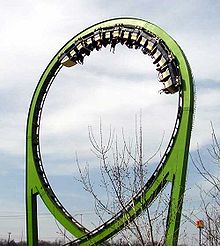
What is the physics that keeps an object from falling out when a coaster goes through a loop?
centripetal force
inertia
gravity
velocity
What is gravity?
stored energy
a force acting to pull two objects together
energy and acceleration in motion
the speed of an object
What is acceleration?
resistance an object to change its motion
energy in motion
the push or pull of an object
an object changing speed or direction
At zero gravity, the people _____________ around the plane just like astronauts.
float
travel
cheap
expensive
1 G forces typically occur on
when a train goes around an un-banked corner, or a corner not banked far enough.
when a train crests a hill at speed, or suddenly dips sharply downwards.
banked turns or when the train pulls up a hill after going down a drop.
The regular force of gravity when still.
A 2.0 kg rock is moving in a 0.5 m horizontal circle every 0.25 s. Which of the following does the rock experience?
no net force
a centripetal acceleration
only the acceleration of gravity
motion due only to its inertia
When dealing with an object in circular motion, the distance the object covers in one revolution is called the:
circumference.
radius.
tangent.
distance.
When dealing with circular motion, the time that it takes to make one revolution of the circle is called the:
rotation.
orbit.
period.
segment.
Why does an object experiencing uniform circular motion have an acceleration?
because it ir changing speed
because it is changing direction
because it is moving n a straight line
because it has mass

The _______________________ supplies the centripetal force requirement for the car to move in a horizontal circle. Without it, the car would turn its wheels but would not move in a circle (as is the case on an icy surface).
friction force
centrifugal force
normal force
applied force

In this diagram, what do the red arrows represent?
the acceleration vector
the velocity vector
the centripetal force vector
the force of gravity

Where is the car moving fastest?
A
B
C
D
Where does the car have the most gravitational PE?
A
B
C
D
The car is not moving at point A -
what type of energy is present at point A?
(Select all that apply)
KE
PE
No Mechanical Energy Present
The car has 200 J of PE at point A and is not moving. What is the total ME at point A?
200 J
150 J
100 J
50 J
0 J
A 1000kg car is moving at 5m/s, what is the Kinetic Energy of the car?
6250000 J
25000 J
12500 J
2500 J


