
 Worksheets
CP2 review
Total questions: 66
Worksheet time: 3hrs 52mins
Which of the following represents balanced forces?
7N -> ->7N
11 N -> <- 11 N
8 N <- -> 4 N
I don't know
Calculate the Net Force:
16 N <- -> 5 N
12 N to the Left
11 N to the left
21 N to the left
I don't know
Calculate the Net Force:
120 N --> --> 50 N
12 N to the right
125 N to the left
170 N to the right
I don't know
Calculate the Net Force:
10 N --> <-- 4 N + <-- 7 N
7 N to the left
21 N to the right
1 N to the left
I don't know

Calculate the Net Force
0 N
7 N Right
28 N Right
I don't know

Calculate the Net Force
2 N Right
12 N Right
2 N Left
I don't know
Two students kick a soccer ball at the same time. Student A kicks the ball with a force of 80 N to the right. Student B kicks the ball with a force of 45 N to the left. Calculate the net force.
45 N Right
35 N Right
30 N Right
I don't know

Calculate the net force of the baseball batter. Make sure to include direction and balanced or unbalanced.
(a)
When an object has no motion or is stationary FORCES are . . .
(a)

When two force act in the same direction, how would you calculate the net force?
Subtract the forces
Balance the forces
Add the forces
Divide the forces.

LT#3: Calculate the net force on the box shown.
50 N
140 N
190 N
240 N
Forces that are equal in size but in opposite directions are called ______________ forces.
Strong
Crazy
Balanced
Unbalanced
Newton's First Law States........
Objects at rest tend to stay at rest unless acted on by an outside force.
Objects accelerate often and it is difficult to know when or how they will accelerate.
Objects in motion tend to stay in motion unless acted on by an outside force.
Both A & C
Newton's second law states.....
If there is more mass then there is more acceleration
An object at rest wants to be in motion
Force = Mass x Acceleration
The force exerted on an object is not related to mass or acceleration
What formula is used to calculate force?
Acceleration = Force x Mass
Force = Mass x Acceleration
Work = Force x Distance
Mass = Force + Acceleration
An object with a mass of 100 kg is observed to accelerate at the rate of 5 m/s2. Calculate the force required to produce this acceleration.
20N
500 M/S
500 Kg
500N
A force of 40 N acts upon a 2 kg block. Calculate the acceleration of the object.
20 m/s2
20 m/s
80 m/s2
80 m/s
Newton's third law states.......
For each action there is a larger reaction associated with it.
None of these choices
For each action there is an equal and opposite reaction.
For each action there is a smaller reaction associated with it.
A 1,100 kg car comes uniformly to a stop. If the vehicle is accelerating at 1.2 m/s, which force is closest to the net force acting on the vehicle?
-9,600 N
-1,300 N
-900 N
-94 N

The picture shows an aerialist walking on a tightrope and holding a balancing bar.
An action–reaction pair of forces exists between —
the aerialist’s feet and the rope
the rope and the balancing bar
the two ends of the rope
the aerialist’s arms and legs
Four boxes are sliding with constant speed before each box experiences an unbalanced force of 8 N. Which box would experience the greatest acceleration when the unbalanced force is applied?
The box with a mass of 2 kg
The box with a mass of 4 kg
The box with a mass of 6 kg
The box with a mass of 8 kg

A block is pulled 0.90 m to the right in 2.5 s.
What is the block’s average speed to the nearest hundredth of a m/s?
36 m/s
0.36 m/s
0.036 m/s
036 m/s

Two forces are applied to a 17
kg box, as shown. The box is on a smooth surface.
Which statement best describes the acceleration of the box?
The box accelerates at 1.0 m/s2 to the right because the net force is 17 N to the right.
The box accelerates at 1.9 m/s2 to the right because the greater force is to the right.
The box accelerates at 3.0 m/s2 because the combined forces cause the box to accelerate.
The box does not accelerate, because neither force is large enough to move the box.



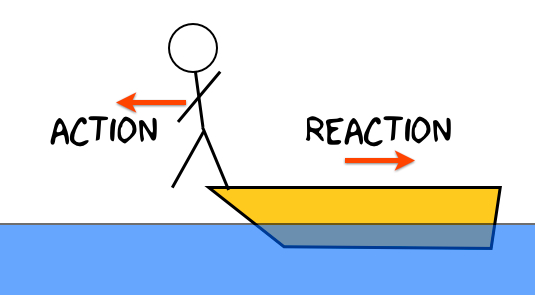
When a person jumps horizontally off of the end of an unanchored boat in a lake, the person goes forward and the boat goes backward. This is an example of what Law of Motion?
(a)

Newton's First Law (Inertia)
Newton's Second Law (F = m*a)
Newton's Third Law (Action-Reaction)

Newton's First Law (Inertia)
Newton's Second Law (F = m*a)
Newton's Third Law (Action-Reaction)

Newton's First Law (Inertia)
Newton's Second Law (F = m*a)
Newton's Third Law (Action-Reaction)

Newton's First Law (Inertia)
Newton's Second Law (F = m*a)
Newton's Third Law (Action-Reaction)

Newton's First Law (Inertia)
Newton's Second Law (F = m*a)
Newton's Third Law (Action-Reaction)

Newton's First Law (Inertia)
Newton's Second Law (F = m*a)
Newton's Third Law (Action-Reaction)

What is the speed of a car that travels 78 miles in 2 hours?
50 miles per hour
39 miles per second
156 miles per hour
39 miles per hour

What is the speed of a ship that takes 4 hours to sail 68 km?
17 miles per hour
17 kilometers per hour
272 kilometers per hour
272 miles per hour

What is the speed of a horse that runs 300 meters in 20 seconds?
15 meters per second
15 miles per hour
600 meters per second
20 meters per second

What is the speed of a train that travels 120 miles in 1.5 hours?
180 kilometers per hour
180 miles per hour
80 miles per hour
80 kilometers per hour

Shane can sprint 100 meters in 12 seconds. What is Shane's speed?
8.33 m/s
8.33 mi/hr
8 m/s
8 mi/hr

A car travels 90 kilometers in 2.5 hours. What is the speed of the car?
40 km/hr
36 km/hr
36 mi/hr
36 m/s

- What is the average speed of Tom’s Journey throughout the second segment, which is between 50 seconds and 70 seconds?

- What is the average speed of Tom’s journey throughout the first segment, which is between 0 seconds, and 50 seconds?

Avery rides her bike 15 miles in 5 hours. Which girl rides her bike faster?
What is the speed of a bus that travels 250 km in 2 hours?
Formula ?
Answer ?
S= D/T
125 km/hr
S= T/D
521 km/meters
S= D/T
251 km/hr
S= D/T
135km/hr


What is this graph showing?
Acceleration (Speeding up)
Acceleration (Slowing down)
An object moving at a constant speed
Object at rest

What line has the greatest speed?
Line A
Line B
Both
Neither
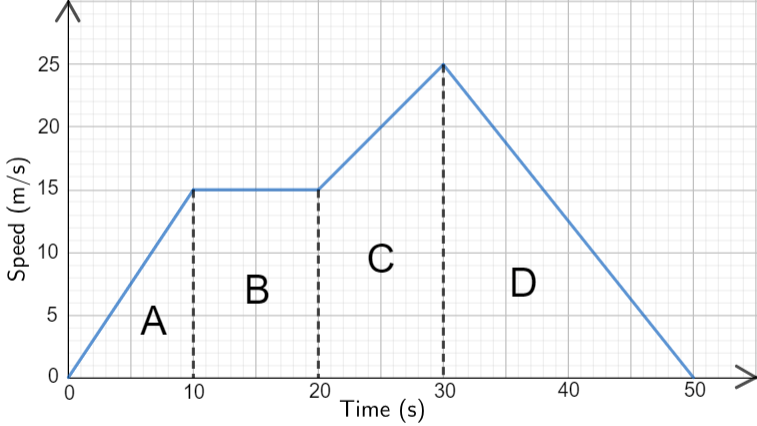
What is happening to the object's speed in section D?
Increasing speed
Decreasing speed
Constant speed
Not moving
A toy car moved along a 1.2 km track in 6 min. Find the speed of the toy car.
0.2 km/h
1.2 m/min
12 km/h
200 m/h


Fast
Slow

Fast
Slow

Fast
Slow
Stopped

Who's Faster?
Barkus
Arctica

Speeding Up
Slowing Down

Speeding Up
Slowing Down


