
 Worksheets
Genetics
Total questions: 50
Worksheet time: 30mins
What is the study of heredity called?
Genetics
Biology
Ecology
Anatomy
Which of the following is an example of a heritable characteristic?
Skin color
Tanned skin
Dyed hair
Acquired skills
What type of variation refers to traits that have a defined form?
Discrete variation
Continuous variation
Environmental variation
Genetic variation
Which of the following is an example of a non-heritable characteristic?
Freckles (if genetic)
Eye color
Dyed hair
Hair color
What does "nurture" refer to in the context of nature versus nurture?
Genetic advantage
Inherited traits
Time, effort, and care put into advancing a skill
Environmental factors

What are the four chemicals called that make up the steps of the DNA ladder?
Proteins
Lipids
Nucleotides
Carbohydrates
Match the base pairs.
Cytosine pairs with
(a) .
Thymine pairs with (b)
Uracil
What is the function of an allele?
Stores energy
Provides information for a trait
Transports oxygen
Breaks down nutrients
What is genetics?
The study of heredity
The study of cells
The study of ecosystems
The study of anatomy
A (a) represents a generalized feature.
A (b) represents a specific feature.
Hair colour is a (c) and brown hair or blonde hair are the (d)
What is the difference between heritable and non-heritable traits?
Heritable traits are not passed down
Non-heritable traits can be passed down
Heritable traits are passed from one generation to the next
Non-heritable traits are always genetic
What are chromosomes made of?
Proteins
Lipids
Tightly coiled DNA
Carbohydrates
Deoxyribonucleic Acid is more commonly referred to as
(a)
What is a dominant trait?
A trait that is expressed only when both alleles are recessive.
A trait that is expressed when the dominant allele is present on the gene.
A trait that is never expressed in the offspring.
A trait that requires two dominant alleles to be expressed.
What does a genotype with two capital letters (e.g., BB) represent?
Heterozygous recessive
Homozygous dominant
Heterozygous dominant
Homozygous recessive
What is the purpose of a Punnett square?
To determine the exact DNA sequence of an organism.
To predict the potential outcomes of offspring.
To identify the dominant traits in a population.
To calculate the probability of genetic mutations.
If brown eyes are dominant to green eyes, what is the phenotype of an organism with the genotype Bb?
Green eyes
Blue eyes
Brown eyes
Hazel eyes
What does the term "homozygous recessive" refer to?
A genotype with two dominant alleles
A genotype with one dominant and one recessive allele
A genotype with two recessive alleles
A phenotype that is always expressed
What is the difference between genotype and phenotype?
Genotype is the physical appearance; phenotype is the genetic makeup.
Genotype is the genetic makeup; phenotype is the physical appearance.
Genotype and phenotype are the same.
Genotype is the number of offspring; phenotype is the number of parents.
In the cross between a heterozygous black cat and a homozygous white cat, how many offspring have black fur?
0
1
2
4
What is the genotype for a homozygous large pumpkin plant?
ll
Ll
LL
L
How many hybrid offspring result from crossing a homozygous small plant with a homozygous large plant?
0
2
4
6
In a genetic cross between two heterozygous parents with widow's peak hairline, what is the expected number of offspring with a straight hairline?
1
2
3
4
When a heterozygous red apple is crossed with a purebred red apple, how many offspring are expected to have red skin?
4
3
2
1
In a cross between two green-skinned apple parents, how many offspring are expected to have green skin? Green is recessive to red skin.
4
3
2
1
What is the expected phenotype ratio in the offspring of a cross between two heterozygous tall plants?
3 tall : 1 short
1 tall : 1 short
2 tall : 2 short
All tall
Which of the following best describes a recessive allele?
An allele that is always expressed
An allele that is masked by a dominant allele
An allele that determines the phenotype
An allele that is never expressed
What is the probability of obtaining a homozygous recessive offspring from a cross between two heterozygous parents?
0%
25%
50%
75%

Sections of DNA that have instructions for a specific trait are called _______________
Blueprints
Genes
Heterozygous
Fragments

Different versions of the same gene are called
Jeans
Editions
Varieties
Alleles

The passage of genetic instructions from one generation to the next is known as
Alleles
Ancestry
Heredity
Variation

If a gene is always expressed or always shown with a capital letter it is
Bossy
Recessive
Yelling
Dominant

If a certain trait has two different alleles (one dominant and one recessive) it is called __________________
Homozygous
Confused
Differentiated
Heterozygous

Physical traits that are expressed are known as ____________
Mutation
Personality
Genotype
Phenotype

If two alleles are the same for a certain trait they are considered
Homozygous
Twins
Heterozygous
Common

The genes of an organism that are written with capital or lowercase letters
Pant size
Deoxyribonucleic acid
Genotype
Gretchentype
Organisms that carry one trait from each parent are called (a) .
True or False.
If the genotype of BOTH parents are GG, then the offspring could be GG or Gg.
False
True
Select homozygous or heterozyous for each genotype
Homozygous
Recessive
hh
Heterozygous
Tt
Homozygous
Dominant
KK
Which of the following is an example of a trait?
A) Speaking multiple languages
B) Having brown hair
C) Ability to play an instrument
D) Knowledge of mathematics
Where does an individual inherit alleles from?
Mother only
Father only
Both mother and father
Neither mother nor father

What is the probability of a gg offspring?
1/4
2/4
3/4
4/4

What allele combination should go in the missing box?
AA
Aa
aa

"S" is the dominant allele for smooth pea plants, while "s" is the recessive allele for wrinkled plants. If we cross two heterozygous round pea plants, what percent of the cross will be wrinkled?
25%
50%
75%
100%

The Punnett square predicts the ratio of genotypes in the offspring, based on the genotypes of the parents. In this cross, tallness (H) is dominant to shortness (h).
Based on the Punnett square, what is the phenotype of the offspring?
Hh
HH
tall
short
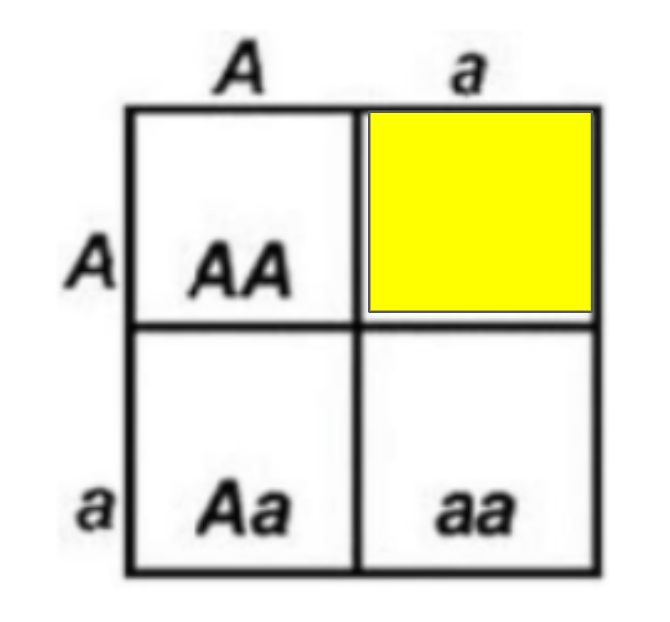
Fill in the Yellow Box
AA
Aa
aa
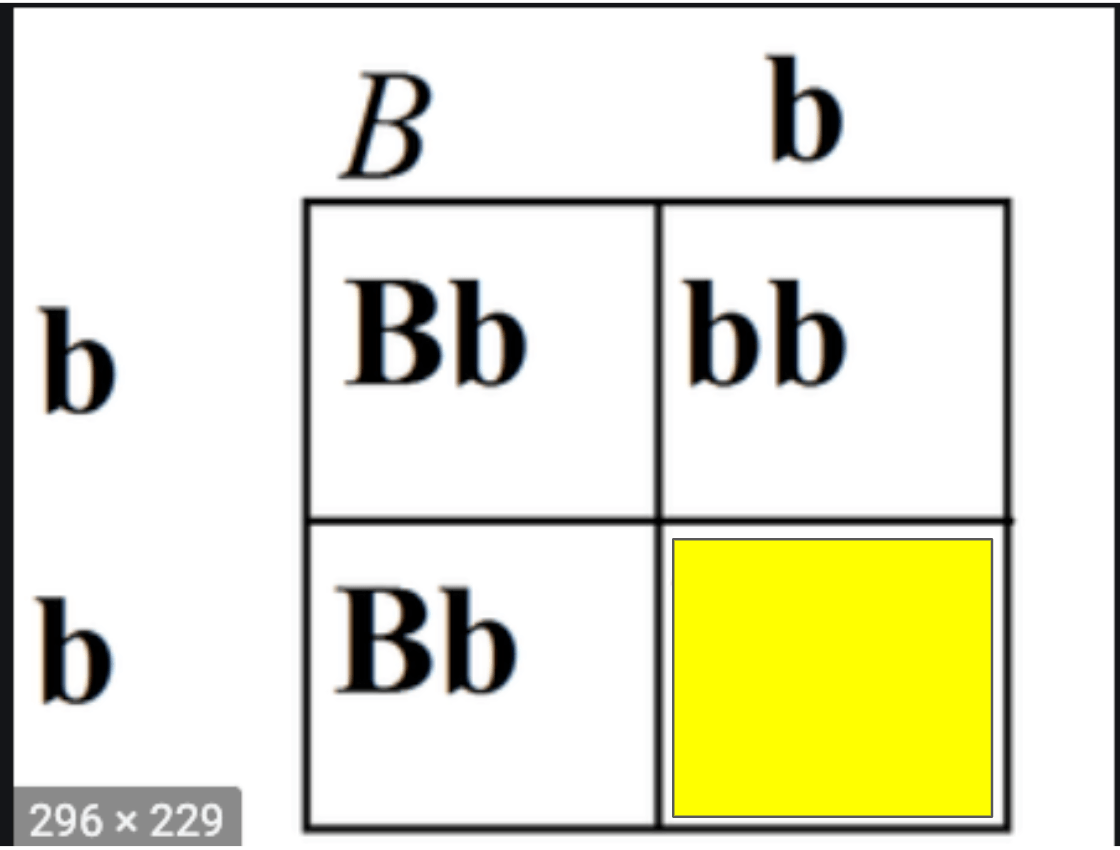
Fill in the Yellow Box
Bb
BB
bb

How many are heterozygous?
0%
25%
50%
100%

How many are homozygous dominant?
100%
50%
25%
0%
A tool used to determine the probable genotypes of offspring (children) of two parents
Dihybrid cross
Codon Chart
Punnett square
Monohybrid cross

