
 Worksheets
Review - Cell Membrane
Total questions: 45
Worksheet time: 27mins
What is the outer boundary called on ALL cells that controls what goes in and out of that cell?
Cell Wall
Nucleus
Cell Membrane

How many layers does the phospholipid bilayer have?
Two
One
Three
The polar head of the phospholipid (a) water. (loves or hates?)
What is the smallest, most basic unit of life?
Atom
Cell
bacteria
Molecule
Atoms are smaller than cells. Can atoms be considered living?
Yes
No
What is the least amount of cells an organism can have and still be considered living.
1
3
5
more than 5
The three functions of the cell membrane are to:
protect the contents of the cell
control all the functions of the cell
control what enters and leaves the cell
signal to other cells and communicate
What is it called when the cell membrane selects what can and cannot go into the cell
selection process
selective choosing
selective permeability
selective choice

This is a
cell
cholesterol
lipid
phospholipid
How many layers of phospholipids are in a cell membrane?
one
two
three
four
The head of a phospholipid is
hydroblast
hydrophobic
hydrophilic
hydropump
The tail of a phospholipid is
hydrophilic
hydroblast
hydrophobic
hydropump

The arrow is pointing to the
hydrophobic head
hydrophilic head
hydrophobic tail
hydrophilic tail

The arrow is pointing to the
hydrophilic head
hydrophobic head
hydrophilic tail
hydrophobic tail
The prefix hydro- means
earth
water
sun
cells
The suffix -philic means
hating
loving
cells
Philis

The _______________ of the phospholipids in a cell membrane face inward towards each other.
heads
tails
stems
sticks

Diffusion & Facilitated Diffusion are both __________ transport.
Passive
Active
Easy
Free
Passive Transport is the movement of particles across the membrane from an area of [ ___ ] to an area of [ ___ ]
high to low
low to high
low to low
high to high
Passive Transport uses ____ energy
no
a lot of
a little bit of
some

The type of transport that requires the use of transport proteins
Passive Transport
Facilitated Diffusion
Active Transport
Vesicular Transport

The passage of a substance from an area of high concentration to an area of low concentration
Active Transport
Diffusion
Vesicular Transport
Exocytosis

The energy molecule that powers some modes of transport
ADP
ATP
AGP
ABP
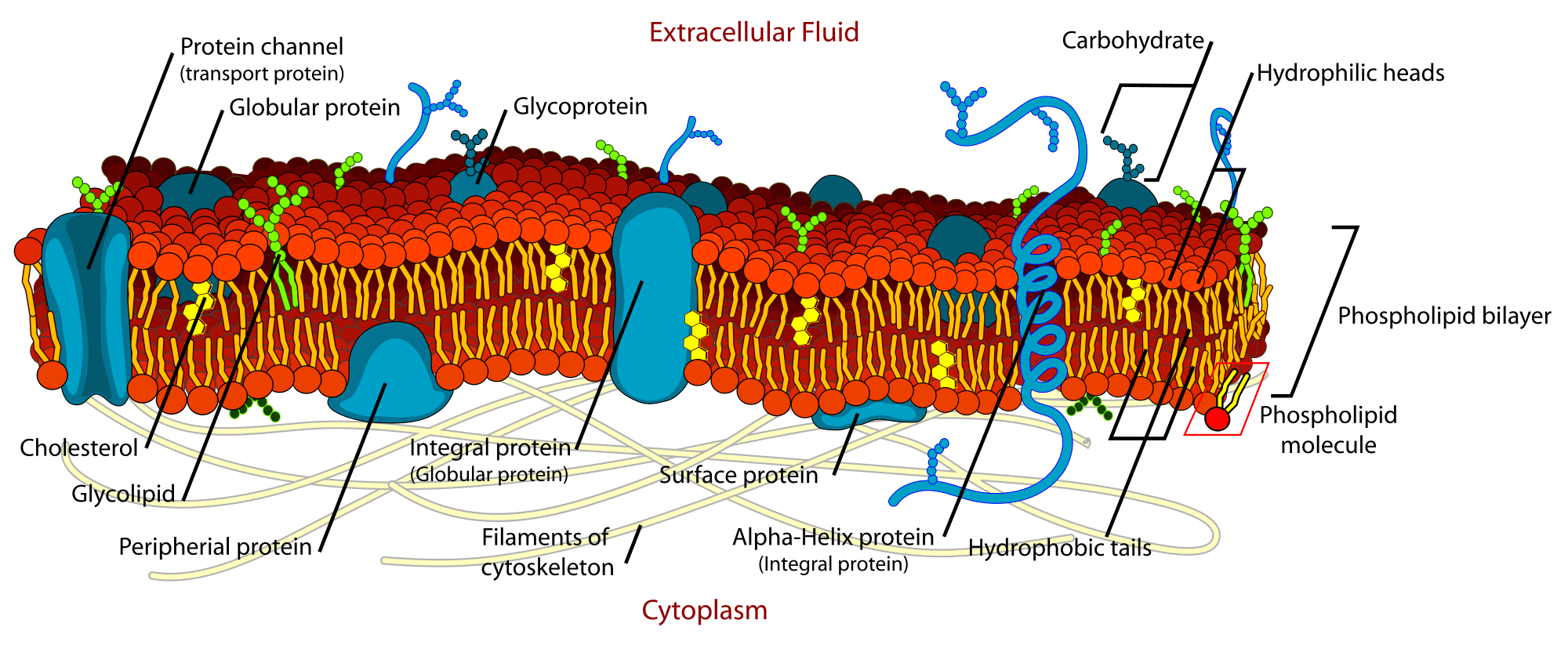

The _______________ of the phospholipids in a cell membrane face inward towards each other.
heads
tails
stems
sticks

