
 Worksheets
CPA Financial Accounting and Reporting Revision
Total questions: 101
Worksheet time: 8hrs 25mins
1.1 Which of the following are correct? I. The term 'reporting entity' may be used to describe a group of companies. II. The principal function of financial statements is to provide information to parties external to a business. III. The main purpose of financial reporting is to provide information aimed at running a business more efficiently.
1.2 Which of the following groups of users of accounts is interested primarily in the liquidity of a company?
1.3 Consider the following two statements: I. The IASB operates a rules-based system of setting accounting standards. II. The US FASB operates a principles-based system of setting accounting standards. Which of these statements are correct?
1.4 Which bodies does the IFRS Foundation oversee?
1.5. Which of the following is not a role of the IFRS Advisory Council?
1.6 Consider the following two statements: I. The Australian Accounting Standards Board (AASB) has adopted the content of IFRS with some minor changes. II. Both Australian companies' legislation and IFRS allow an entity to depart from the requirements of an IFRS in exceptional circumstances. Which of these statements are correct?
1.7 According to the Conceptual Framework for Financial Reporting, information about an entity's financial performance helps users to understand: I. the entity's needs for additional finance. II. the entity's financing and investing activities. III. the efficiency and effectiveness of management. IV. the return that the entity has produced on its economic resources.
1.8 Which of the following is not a chapter in the IASB's Conceptual Framework?
1.9 Consider the following statements: I. The IASB's Conceptual Framework underpins the preparation of financial statements; when an IFRS conflicts with the framework, the framework guidance should be followed. II. One of the purposes of the IASB's Conceptual Framework is to assist the IASB to develop IFRS that are based on consistent concepts. Which of the statements is correct?
1.10 What is shown by an entity's economic resources and the claims against it?
1.11 Why is information about a reporting entity's net cash flows helpful to users?
1.12 Which of the following statements is/are correct? I. An entity can only change an accounting policy if this is required by an accounting standard. II. A change in accounting policy is always applied prospectively, so that the effect of the change is recognised in the current period.
1.13 The underlying assumption in preparing and using general purpose financial reports is:
1.14 Consider the following statements: I. Accounting standards are not retrospective. II. Accounting standards are applied to all items in the financial statements. Which statements are correct?
1.15 The two fundamental qualitative characteristics of useful financial information are:
1.16 Which of the following qualities are required to achieve a faithful representation of economic phenomena? I. Error free II. Neutrality III. Verifiability IV. Comparability V. Completeness
1.17 Which of the following statements is/are correct? I. Departure from an IFRS is allowed only where approved by the IASB. II. In the case of a true and fair override the financial impact of the departure from IFRS should be disclosed.
1.18 Which of the following is the correct definition of equity?
1.19 Consider the following statements: I. A provision is a liability for which the amount is a reliable estimate. II. A provision should not be recognised in the financial statements. Which of the statements are correct?
1.20 Consider the following statements: I. Gains from revaluation of non-current assets are recognised in profit or loss. II. Gains from the sale of non-current assets are not recognised in profit or loss. Which of the statements are correct?
1.21 Which of the following, taken together, would make up the working capital of a business?
1.22 Which of the following would appear in the statement of financial position as a current liability?
1.23 Which of the following should be recognised as an asset in the statement of financial position according to the definition of an asset and recognition criteria provided in the Conceptual Framework?
2.1 What type of cost does the following definition describe? 'Assets are carried at the present value of cash flows from the continuing use and from its disposal at the end of its useful life of the asset.'
2.2 What is one of the main advantages of using historical cost as a measurement basis?
2.3 Which of the following does this definition describe? 'The price that would be received to sell an asset or paid to transfer a liability in an orderly transaction between market participants at the measurement date'.
2.4 Consider the following statements: I. The use of a conceptual framework and accounting standards based on that framework would be an example of positive accounting theory. II. An attempt to predict accounting behaviour by observing what actually happens and applying this to particular situations is an example of normative accounting theory. Which statements are correct?
2.5 Which type of capital maintenance concept is described by the following statement? 'Capital is looked at as the capacity to maintain a level of assets'.
2.6 Consider the following statements: I. In a time of rising prices, borrowers benefit. II. Under current purchasing power (CPP) accounting, monetary items are restated to take into account the effect of general price inflation. Are these statements correct or incorrect?
2.7 Consider the following statements: I. A management buy-in occurs when existing managers purchase the business. II. In a share option scheme, employees are given a number of share options, each of which gives the holder the right after a certain date to subscribe for shares in the company at a fixed price. Which of the statements are correct?
2.8 The preparation of the financial statements is the responsibility of:
2.9 Consider the following statements: I. The auditor's report must be disclosed in a set of financial statements. II. The auditors' report confirms that the financial statements are correct.
Which of the following statements are correct?
2.10 Which of the following is a non-mandatory disclosure in a listed company's annual report?
2.11 Which of the following is not an advantage of voluntary disclosures by companies?
2.12 Which of the following statements about the directors' report are correct? I. It includes details of the individual directors on the board. II. It includes a review of the entity's operations during the period. III. It shows the members of the board who sit on the various committees, such as audit, remuneration and nomination committees.
3.1 Where in a company's financial statements are dividends paid found?
3.2 Classify the following amounts as current or non-current: I. A bank overdraft expected to be in place for two years II. Shares bought in another company for the purpose of resale in the near future III. A receivable arising from a credit sale made to a customer with payment terms of 24 months
3.3 Which of the following must be shown in the main financial statements of a typical manufacturing company rather than in the notes to the financial statements?
3.4 Which of the following items is not required to be shown in a separate line in the statement of changes in equity?
3.5 A statement of cash flows prepared in accordance with the indirect method reconciles profit before tax to cash generated from operations. Which of the following includes only items which should be added to profit before tax in the reconciliation?
3.6 A company made a profit for the year of $12 990 after accounting for depreciation of $1300. During the year, non-current assets were purchased for $6500, receivables increased by $560, inventories decreased by $1100 and payables increased by $230. The increase in cash and bank balances during the year was
3.7 A business had non-current assets with a carrying amount of $90 000 at the start of the financial year. During the year the business sold machinery that had cost $12 000 and been depreciated to a carrying amount of $3400. The carrying amount of non-current assets at the end of the year was $91 500. How much cash has been used to purchase non-current assets?
3.8 A business' bank balance increased by $960 000 during its last financial year. In this period, it: • issued shares raising $1 400 000 • repaid a loan of $230 000 • purchased current asset investments of $800 000 • charged depreciation of $190 000 Working capital increased by $120 000 during the year. The business' profit for the year was:
3.9 Extracts from a company's statement of financial position showed balances as follows:Share Capital 20X9 = 94,000, 20X8 = 77,000. During 20X9 debentures of $70 000 were issued, a dividend of $12 000 was received and interest of $4000 was paid. What is the net cash flow from financing activities?
3.10 What type of assurance is provided by the external auditor's report on an entity's financial statements?
4.1 Which of the following conditions must be met, in order to capitalise development costs according to IAS 38? I. completion of the asset is technically feasible II. resources are available to complete the project III. there is a contract to sell or written commitment to use the item under development
4.2 Which of the following statements about intangible assets is correct?
4.3 An entity purchases a specialised machine on 1 January 20X8 for $400 000 together with production rights to manufacture a patented component, for $20 000. These production rights are worthless without the specialised machine, and the machine may not be used without the production rights. Which of the following statements is correct?
4.4 An entity purchases the brand name of a product on 1 November 20X8 for $375 000. The management feel that the brand has an indefinite useful life and have therefore not charged any amortisation in the year ended 31 October 20X9. Which of the following is correct?
4.5 The following is relevant to ABC Co. in the year ended 31 December 20X9: • $28 000 was spent investigating the properties of a new type of plastic. • $340 000 was capitalised relating to the development of a new product which went into commercial production on 1 October 20X9. Sales of the product are expected to remain constant for the first four years of its production and then halve for a further two years. What amounts should be recognised in the financial statements of ABC Co. in the year ended 31 December 20X9?
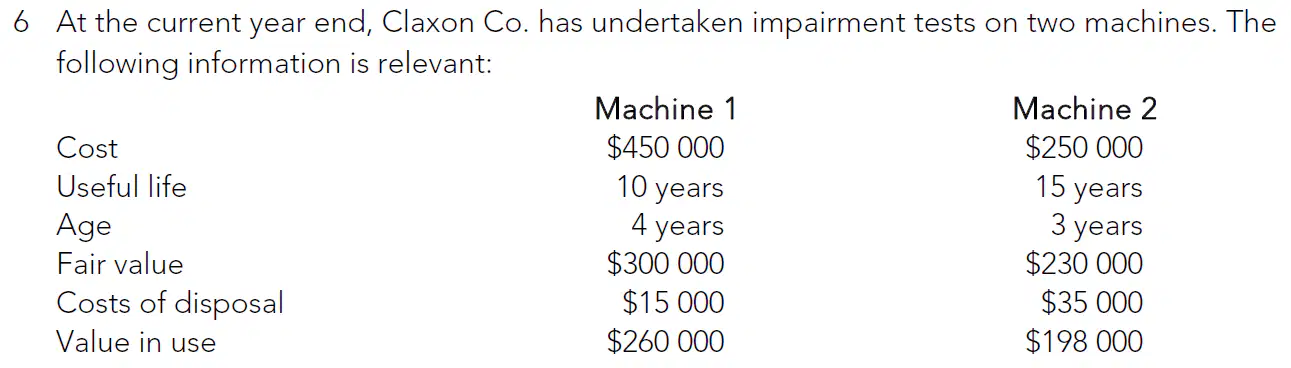
4.6 At what carrying amount should machinery be recognised in the accounts of Claxon Co?
4.7 Taunton Co. owns a property which was revalued to $900 000 at the start of the current accounting year. At that time the property had a remaining useful life of 25 years. As a result of market conditions, an impairment test is carried out at the end of the year and the property is found to have a value in use of $860 000 and a fair value of $870 000. Costs of disposal would amount to 5 per cent of fair value. What impairment loss, if any, must be recorded in the year?
4.8 Which of the following statements is/are correct? I. An impairment loss relating to goodwill cannot be reversed. II. Corporate assets must always be allocated to individual CGUs. III. An impairment loss relating to a CGU is allocated to goodwill in the first instance.

4.9 An impairment loss of $55 000 has been identified. What is the carrying amount of the machinery after this loss has been accounted for?
4.10 Rawlin Co. purchased a depreciable asset a number of years ago at a cost of $200 000. On 1 January 20X8, when it had 20 years of its useful life remaining, the asset was revalued to $600 000, with a revaluation surplus of $480 000 recognised as other comprehensive income. At 31 December 20X9, the value in use of the asset is $535 000 and its fair value less costs of disposal is $532 000. What impairment loss must be recognised and where?
4.11 Which of the following are conditions that permit revenue to be recognised over a period of time? I. The customer has paid in advance. II. The customer simultaneously receives and consumes the benefits as the performance takes place. III. The entity's performance creates or enhances an asset that the customer controls as the asset is created or enhanced.
4.12 Details of two of Lord Company's transactions in the month of May are as follows: I. It has sold goods to another customer on credit. The goods have not yet been delivered. II. It has sold an item of machinery to a customer; the machinery has been delivered and Lord Company will undertake specialist installation in two months' time. For which transactions should revenue be recognised in May?
4.13 Bubble Co. made sales on credit during May 20X7 of $450 000 for goods that were all delivered during May. Sales tax is charged at 5 per cent. They offer all customers a settlement discount of 5 per cent and on average 40 per cent of customers will take up the discount. What is Bubble Co. revenue for May 20X7?
4.14 Ray Co. reported the following amounts in its statement of financial position at 31 December 20X8: Liability for company taxes $43 800 Liability for deferred tax $79 320 The 20X8 tax liability was eventually settled at $42 120. At the 20X9 year end, there is a liability for current tax of $52 300 and the total liability for deferred tax is to decrease to $69 780. The decrease in deferred tax liability relates to items recognised within profit or loss. What is Ray Co.'s tax charge for 20X9?

4.15 Drive Co. pays corporate income tax at a rate of 20 per cent.
What is Drive Co.'s deferred tax liability at 31 October 20X9, and deferred tax charge for the year
ended 31 October 20X9?
4.16 Which of the following statements about IAS 12 is/are correct? I. Deferred tax liabilities may be classified as current liabilities. II. Tax losses are an example of a taxable temporary difference. III. Deferred tax relating to the revaluation of a property is reported as other comprehensive income.
A III only
4.17 Wiley Co. has made tax trading losses for two years, totalling $87 600. $23 000 of these were used to relieve other taxable income in accordance with tax law. At the 31 December 20X9 year end, Wiley Co. signs a large contract with a new customer which indicates that it will return to profitability. Wiley Co.'s tax rate is 20 per cent. What is the deferred tax implication of the losses?
4.18 The trial balance of Vine Co. at 31 December 20X8 shows a credit balance on the tax payable account of $450. The estimated current tax liability of $28 760 has not yet been accrued. What amounts are reported in the financial statements in respect of current tax for the year?
4.19 Radley Co. purchased raw materials on credit from a foreign supplier for 375 000 Goldings, halfway through the year ended 31 December 20X9. Half of the goods were paid for on 30 November 20X9 and the remaining half on 31 January 20Y0. Relevant exchange rates are as follows: 30 June 20X9 4.3 G: $1 30 November 20X9 4.6 G: $1 31 December 20X9 4.5 G: $1 31 January 20Y0 5 G: $1 What exchange difference is recognised in Radley Co.'s profit or loss in the year ended 31 December 20X9?

4.20 To the nearest $000 what are the translated retained earnings (including exchange differences) of Pedro Co. at 30 November 20X9?

4.21 The retained profits for the year were D115 000 and the average exchange rate was 4.2D/$. What exchange difference arises on translation of the financial statements?
4.22 Drayton Co. purchased a new non-current asset on 1 January 20X9 costing HK$ 1 450 000, agreeing 18 months' extended credit with the supplier. The exchange rate on 1 January 20X9 was 6.75HK$:$1. At 31 December 20X9, the exchange rate had moved to 7.2HK$:$1. How are the asset and payable presented in the statement of financial position at 31 December 20X9?
4.23 Which of the following statements is or are correct? I. Exchange differences are always reported in profit or loss. II. The currency that mainly influences sales prices set by an entity is likely to be the functional currency. III. A revalued 'foreign' asset is translated at the exchange rate in force on the date of the revaluation.
4.24 On 1 January 20X5 Cornwall Company entered into a three-year lease for new computer equipment. A non-refundable set-up costs of $2000 was paid on this date. The first lease payment of $8000 will be made on 1 January 20X6, in arrears with two further payments of $8000 being paid on 1 January 20X7 and 20X8 also in arrears. Cornwall Company elected to treat the lease as a low value lease. What expense will be shown in the profit or loss for the year ended 31 December 20X5?
C $8667
4.25 On 1 January 20X5 Kent Company enters into a three year lease for an asset, paying an initial deposit of $18 000. The present value of the future cash flows is $150 000. The asset they are leasing has a useful life of five years and Kent Company will not obtain ownership at the end of the lease. What is the depreciation expense for the right of use asset for the year ended 31 December 20X5?
5.1 Raleigh Co. holds the following investments: • 30 per cent of the voting shares in Well Co. The remaining 70 per cent are held by a third, unrelated, company, Slim Co., which refuses to communicate with Raleigh Co. • 18 per cent of the voting shares in Vic Co. One of Raleigh's Directors also sits on the Board of Vic Co. and takes an active part in formulating strategy. How should the investments be accounted for?
5.2 Dry Co. holds 20 per cent of the voting shares in Wet Co. and has agreed with the other shareholders that it will direct the operating activities of that company. Dry Co. also holds 40 per cent of the voting shares in Cloud Co., participating in the policy making process of that company, and 25 per cent of the voting shares in Drizzle Co. How should these investments be treated in the Dry Co. group accounts?
5.3 Which of the following conditions must be met in order for a parent to avoid presenting consolidated financial statements? I. All subsidiaries operate under severe long-term restrictions. II. Its securities are not publicly traded and it is not in the process of issuing securities in public securities markets. III. The ultimate or intermediate parent publishes consolidated financial statements that comply with International Financial Reporting Standards. IV. The parent is itself a wholly-owned subsidiary or it is a partially-owned subsidiary of another entity and its other owners do not object to the parent not presenting consolidated financial statements.
5.4 Which of the following statements about consolidated financial statements is correct?
5.5 Which of the following provides evidence of the existence of significant influence?

5.6 Included within the receivables of Car Co. is $7000 due from Train Co. Included within the payables of Train Co. is $5600 due to Car Co. The difference is due to cash in transit. What are the consolidated receivables and cash balances?
5.7 West Co. acquired 90 per cent of the 100 000 shares in East Co. on 1 January 20X7 for $480 000 when the reserves of that company amounted to $320 000. On that date the fair value of the non-controlling interest was valued at $45 000. Included in East Co.'s statement of financial position was land with a book value of $60 000. The fair value was $30 000 higher than this. West Co. group measures the non-controlling interest at fair value. What goodwill arose on the acquisition of East Co.?
5.8 North Co. acquired 80 per cent of South Co. on 1 February 20X8 for consideration totalling $560 000. At this date the fair value of a 20 per cent holding in South Co. was $130 000, and the net assets of South Co. were $620 000. In the year ended 31 January 20X9, South Co. reported profits of $75 000. North Co. group measures the non-controlling interest using the proportion of net assets method. What is the non-controlling interest to be reported in the consolidated statement of financial position at 31 January 20X9?
5.9 Axis Co. transferred an asset to its 75 per cent subsidiary Yves Co. on 31 October 20X9 for $25 000. The asset cost $32 000 on 1 November 20X7 and was depreciated monthly by Axis Co. at 20 per cent per annum on cost. Yves Co. did not amend the original useful life on the transfer and continued to depreciate the asset over its remaining life. At 31 December 20X9, extracts from the two companies' accounts were as follows: Non-current assets: Axis Co. $ 165 000 - Yves Co. $180 000. What is the consolidated figure for non-current assets?
5.10 Try Co. bought 80 per cent of the ordinary shares in Ply Co. when the retained earnings of that company were $400 000. Goodwill arising on acquisition amounted to $68 000, and 25 per cent of this amount was written off in the year ended 31 October 20X9. During the year ended 31 October 20X9, Try Co. sold $50 000 goods to Ply Co., achieving a 20 per cent mark up. At the year end, Ply Co. retained half of these in inventory. The two companies' retained earnings (prior to any adjustments during the year) at 31 October 20X9 were as follows: Try Co. $680 900 Ply Co. $532 000. What are group retained earnings at 31 October 20X9?
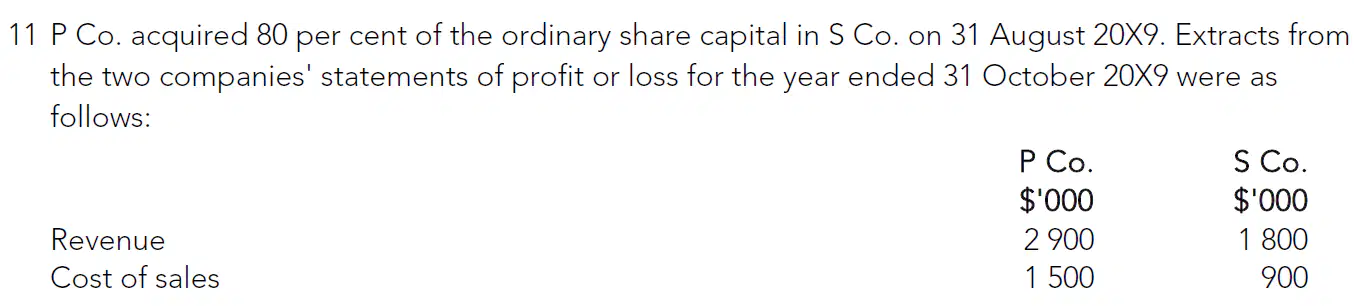
5.11 During the year, P Co. made sales of $10 000 to S Co. each month, realising a mark up of 25 per cent. At the end of the year S Co. had none of these goods in inventory. What is the group gross profit for the year ended 31 October 20X9?

5.12 Ed Co. has owned 100 per cent of the shares in Clem Co. for five years. These were bought for $450 000 when the net assets of Clem Co. were $415 000. In the year of acquisition, Clem Co. was impaired by $5000 due to a drop in profitability. Clem Co. has again suffered a loss of profits in the year ended 31 December 20X9, and accordingly goodwill is to be impaired by 20 per cent of book value. Extracts from the two companies' statements of profit or loss are as follows: What are the amounts to be reported for group cost of sales and administrative expenses?
5.13 Black Co. sold an item of machinery to Red Co., its subsidiary on 31 December 20X8 for $340 000. The machine had cost Black Co. $400 000 and had a carrying amount of $320 000 on the date of the transfer, based on annual depreciation at 10 per cent on the straight line basis. The remaining useful life of the asset remains unchanged. Companies in the Black Co. Group depreciate any asset held on the last day of the accounting period for a full year. Depreciation is charged to cost of sales. What adjustment is required to the Black Co. cost of sales in respect of this transfer in the year ended 31 December 20X9?
5.14 Green Co. sold an item of plant to Brown Co., its subsidiary on 31 October 20X9 for $200 000. The machine had cost Green Co. $300 000 and had a carrying amount of $220 000 on the date of the transfer, based on a useful life of 15 years on the straight line basis. The remaining useful life of the asset remains unchanged. Green Co. depreciates assets on a monthly basis. What adjustment is required to Green Co.'s profit in respect of this transfer in the year ended 31 December 20X9?
5.15 Which of the following statements about the consolidated statement of profit or loss are correct? I. Dividend income in the parent company's statement of profit or loss is never carried across to the consolidated statement of profit or loss. II. The non-controlling interest in profit is presented separately from group profits in the consolidated statement of profit or loss to leave profit allocated to the owners of the parent company.

5.16 Roulston Co. holds a 75 per cent investment in Hudson Co. and a 35 per cent investment in White Co. During the year ended 30 November 20X9, Roulston Co. sold goods to Hudson Co. for $400 000 and White Co. sold goods to Roulston Co. for $210 000. The companies' revenue as reported in their individual financial statements was as follows: What is the consolidated revenue figure?

5.17 Dray Co. holds a 90 per cent investment in Ray Co. and a 25 per cent investment in Lay Co. Extracts from their statements of profit or loss are as follows:
During the year Dray Co. sold $40 000 goods to Ray Co. and $10 000 to Lay Co. at a 25 per cent mark up. In each case all of these goods remained in inventory at the year end. What is the consolidated cost of sales figure?
5.18 Blue Co. has a number of subsidiaries as well as a 45 per cent investment in Pink Co. bought for $190 000 some years ago. Since acquisition, Pink Co. has made $450 000 profits and suffered no impairment. During the year ended 31 October 20X9, Pink Co. sold $30 000 goods to Blue Co. at a 20 per cent margin. Half of these goods remained in Blue Co.'s warehouse at the year end. What is the investment in associate shown in the Blue Co. Group statement of financial position at 31 October 20X9?
5.19 Which of the following statements about equity accounting and associates is correct?
5.20 Arm Co. Group bought 16 per cent of the voting shares in Leg Co. on 1 January 20X9 for $160 000, and on the same date started trading with Leg Co. such that 80 per cent of Leg Co.'s sales were made to Arm Co. In the year ended 31 December 20X9, Leg Co. made $98 000 profits, 80 per cent of these relating to sales to Arm Co. None of the goods purchased from Leg Co. remained in the inventory of Arm Co. at the year end. How is the investment in Leg Co. shown in Arm Co.'s group statement of financial position at 31 December 20X9?
6.1 Which of the following ratios provide a measure of profitability? I. Interest cover II. Dividend cover III. Return on equity IV. Gross profit margin
6.2 Booth Co. has increased its return on investment (ROI) since last year. Assuming all other factors remain the same, which of the following is the best explanation for this?
6.3 Which of the following will cause a company's gearing ratio to increase?

6.4 Assuming that Allister Co. maintained its quick ratio at the same level in 20X9, what was the receivables figure in that year?
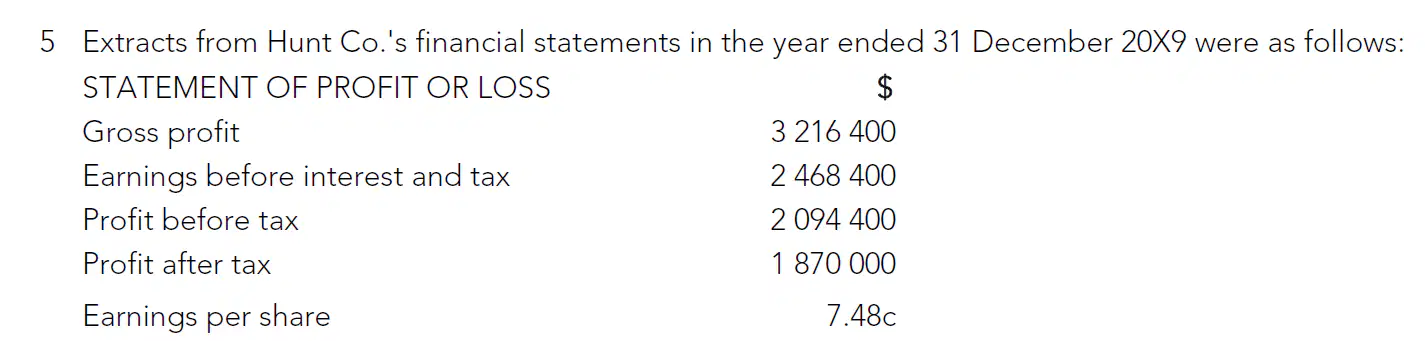
6.5 Hunt Co. made no issues of shares during the year. What was the number of Hunt Co. shares in issue throughout the year to the nearest million?
6.6 Which of the following statements is correct?
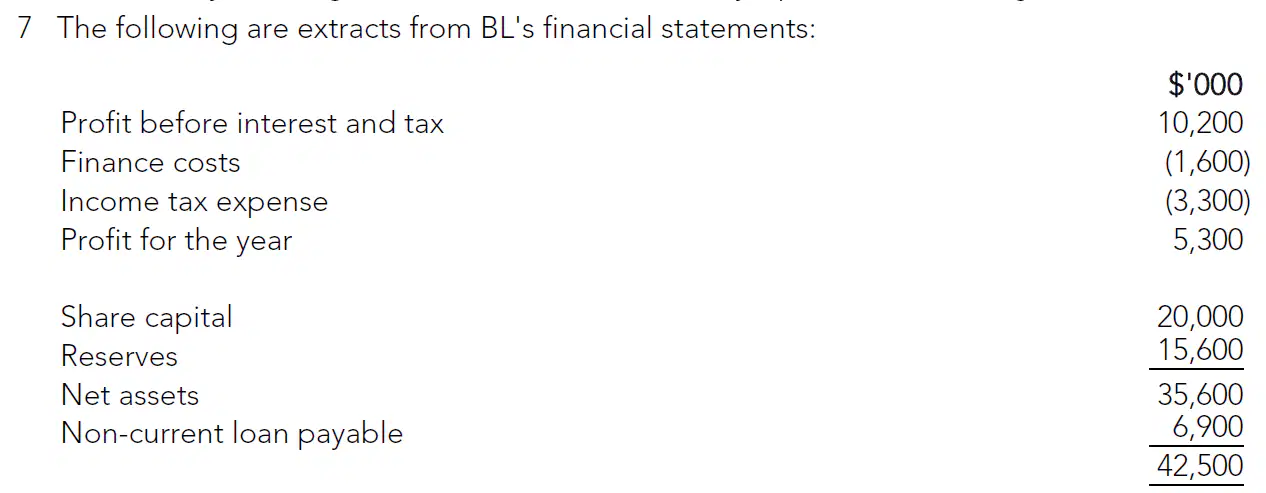
6.7 What is BL's return on investment (to the nearest %)?
6.8 What effect on ratios would an upwards revaluation of property, plant and equipment be likely to lead to?
6.9 A Bank has provided a long-term loan to NV Co. Which of the following pairs of ratios is most likely to provide the bank with relevant information?

6.10 Which of the following is the most likely explanation for the movement in the operating profit margin in the Middle East?

