
 Worksheets
Learning objectives - Project Management Approaches
Total questions: 100
Worksheet time: 55mins
Project management approaches in organisations are used to:
Improve efficiency and achieve project goals
Increase project costs
Reduce team collaboration
Delay project completion
Explain the approaches of different types of methodologies.
Waterfall, Agile, and Spiral are examples of different types of methodologies.
Methodologies do not have different approaches.
All methodologies follow the same approach.
There are no approaches in methodologies.
Types of projects that would use a project management approach include:
Routine daily tasks
Unique, temporary endeavors with specific goals
Ongoing maintenance work
Unstructured brainstorming sessions
The importance of using a suitable project management approach for different types of projects is to:
Ensure project success by matching methods to project needs
Increase project costs unnecessarily
Ignore the unique requirements of each project
Delay project completion intentionally
Not following a project management approach can lead to which of the following consequences?
Improved team communication
Increased project success rate
Missed deadlines and budget overruns
Better resource allocation
What is project management (PM)?
Project management (PM) is the process of initiating, planning and utilising all the resources required to bring a specific, one-off, time-constrained goal to a successful conclusion.
Project management (PM) is the ongoing process of managing daily business operations.
Project management (PM) is the process of hiring employees for various departments.
Project management (PM) is the method of marketing products to increase sales.
Which of the following is NOT a project management process?
Initiating project
Setting deliverables
Scoping the project
Cooking dinner
The process of ________ involves defining what needs to be achieved and the work required to deliver the project.
Scoping the project
Budgeting the project
Closing the project
Executing the project
Which project management process involves creating a plan for how the project will be carried out?
Implementation plan
Risk management
Monitoring and reporting
Managing resources
Project management is a constant activity or process with no specific start or end dates.
True
False
List any three project management processes mentioned in the text.
Initiating, Planning, Executing
Designing, Coding, Testing
Recruiting, Marketing, Selling
Budgeting, Auditing, Reporting
What is the purpose of risk management in project management?
To identify, assess, and manage potential risks that could impact the success of the project.
To increase the overall cost of the project.
To delay the project timeline intentionally.
To ignore potential problems and focus only on current tasks.
Project management gives ________ and leadership.
direction
confusion
delay
disorder
Project management ensures ________ routes.
communication
transportation
financial
security
Fill in the blank: Project management plans (a) /contingency needs.
Project management sets ________ to meet milestones.
blueprint
rules
meetings
budgets
Project management aligns team actions and ________.
deliverables
meetings
budgets
locations
Project management ensures project stays on ________.
schedule
vacation
pause
holiday
Project management reduces risk of ________ in project delivery.
failure
success
growth
expansion
Project management reports lessons learnt for ________ projects.
future
current
past
ongoing
Good project management practice is vital for businesses to get a return on their ________ in the successful implementation of a project and the benefits it can bring.
investment
location
competition
equipment
What are the four phases of project management in the project life cycle?
Initiation, Planning, Implementation, Completion
Planning, Execution, Review, Closure
Start, Develop, Finish, Evaluate
Analysis, Design, Develop, Deploy
Which phase of project management involves setting goals, scope, and risks?
Initiation
Execution
Closure
Monitoring
Which phase of project management focuses on budget, resources, and timeline?
Planning
Initiation
Execution
Closure
Which phase of project management is associated with actions, teams, and timeline?
Implementation
Initiation
Closure
Planning
Which phase of project management includes tracking, hand-over, and analysis?
Completion
Initiation
Planning
Execution
What is the purpose of the initiation phase in project management?
The purpose is to test the feasibility of a project by considering documents, plans, and the purpose of the project before making a decision to proceed.
The purpose is to execute the project plan and deliver the final product.
The purpose is to monitor and control project progress to ensure it stays on track.
The purpose is to close the project and release resources.
Which of the following is NOT a key activity in the initiation phase?
Identify the deliverables
Consider the priorities and constraints
Finalize the project deliverables
Present project proposal documents to clients
In the initiation phase, you should consider risks such as ________, budget, and time.
resources
weather
technology
location
True or False: The project manager presents the project proposal only to external clients.
True
False
List two things that should be considered when scoping what is included or not included in a project during the initiation phase.
Priorities and constraints; risks such as resources, budget, and time.
Project logo and branding; office location.
Team members' favorite colors; lunch menu.
Weather forecast; company holiday schedule.
Which of the following is the first step in the planning phase of a project?
Identify team members responsible for each task.
Create a project blueprint: high-level milestones.
Include every resource/information point needed.
Create a detailed plan of tasks for each milestone.
The planning phase begins only if and when the project proposal is _______ and has been scoped out.
approved
rejected
ignored
delayed
Which of the following should be included in the planning phase of a project?
Only the project blueprint
Only the team members
Every resource/information point needed
Only the tasks for each milestone
Planning is a one-time activity that happens only at the start of a project.
True
False
Which of the following are activities that are part of the planning phase in project management?
Defining project scope and creating a project schedule
Conducting project closure and celebrating success
Monitoring project progress and controlling changes
Delivering project outcomes and obtaining client feedback
During the implementation phase, the project team begins the actual ______ required.
work
planning
budgeting
reporting
Which of the following is a task in the implementation phase?
Set up tasks and manage team members
Write the project proposal
Close the project
Archive project documents
In the implementation phase, tasks are moved from to do/in progress/______.
done
review
testing
blocked
Which methodology is used to track progress during the implementation phase?
Preferred methodology
Random methodology
Outdated methodology
No methodology
Monitoring the critical path of a task ensures there are no ______.
bottlenecks
delays
shortcuts
errors
Communicating project progress regularly with clients is part of the implementation phase.
True
False
The project manager will be constantly ______ and changing where necessary during the implementation phase.
evaluating
complaining
delaying
ignoring
Which of the following may change during the implementation phase?
Materials availability
Team members
Objectives
All of the above
When the clients are completely satisfied, it is time to ______ the final project.
handover
delay
cancel
ignore
Which of the following is a key activity during the completion phase of a project?
Analyse performance against objectives
Start new project tasks
Ignore client feedback
Delay deliverables
During project completion, lessons ______ and what might be improved are considered.
learnt
forgotten
ignored
avoided
Which of the following is included in the handover to clients?
Procedural documents
Technical support manuals
Instructions
All of the above
Client feedback is collected for use in ______ and marketing.
reviews
invoices
shipping
inventory
Which of the following is a project management methodology mentioned in the text?
Waterfall
Agile
Kanban
Lean
Which of the following is NOT listed as a project management methodology in the text?
A) SCRUM
B) PRINCE
C) Six Sigma
D) Kanban
The four project management methodologies mentioned are Agile, SCRUM, PRINCE, and _____
Six Sigma
Waterfall
Lean
Kanban
What is the central purpose of project management according to the text?
According to the text, the central purpose of project management is to complete the project on time, with the necessary resources and within budget.
True
False
What is Agile project management?
According to the AGILE manifesto, ________ and actions are valued over processes and tools.
Individuals
Meetings
Documents
Schedules
According to the AGILE manifesto, working software is valued over ________ documentation.
comprehensive
minimal
technical
brief
According to the AGILE manifesto, customer collaboration is valued over ________ negotiation.
contract
project
team
budget
According to the AGILE manifesto, responding to change is valued over following a ________.
plan
schedule
routine
procedure
The highest priority in Agile is customer satisfaction through early and continuous delivery of _________
software/products
documentation
meetings
hardware
Fill in the blank: Change is welcome even late in development. Agile processes harness change for (a) advantage.
Fill in the blank: Deliver working software/products frequently, to test and review with (a) feedback.
Clients and developers must communicate and work together ________ throughout the project.
daily
rarely
annually
occasionally
Team members are motivated individuals and given the trust, support, resources and environments to get the ________ done.
job
food
car
house
Fill in the blank: Face-to-face conversations to convey information directly to the development team for maximum (a) .
Fill in the blank: Working software/product is the most important measure of (a) .
Agile processes promote sustainable progress. Momentum creates a constant ________ until completion.
pace
delay
pause
stop
Continuous attention to technical excellence, functionality and good design enhances ________.
agility
complexity
cost
risk
Simplicity is essential. Over complicated processes waste ________ and resources.
time
money
energy
space
Self-organising teams produce the best designs, solutions and ________.
products
meetings
rules
offices
Fill in the blank: Regular team reviews and reflection to improve effectiveness and adjust behaviours (a) .
How does Agile work in project management?
Divides project into increments
Completes the project in one go
Avoids client communication
Delivers the final product only at the end
In Agile, each increment is known as a _________?
development cycle
milestone
release plan
sprint backlog
What are development cycles called in Agile methodology?
Sprints
Iterations
Phases
Milestones
Each iteration in Agile lasts how many weeks (non-changeable)?
1–2 weeks
1–4 weeks
2–6 weeks
4–8 weeks
At the end of each iteration in Agile, results are presented to _________?
clients
developers
testers
project managers
In Agile, the final product is a collaborative result, not a 'reveal' at the end that clients may not like.
True
False
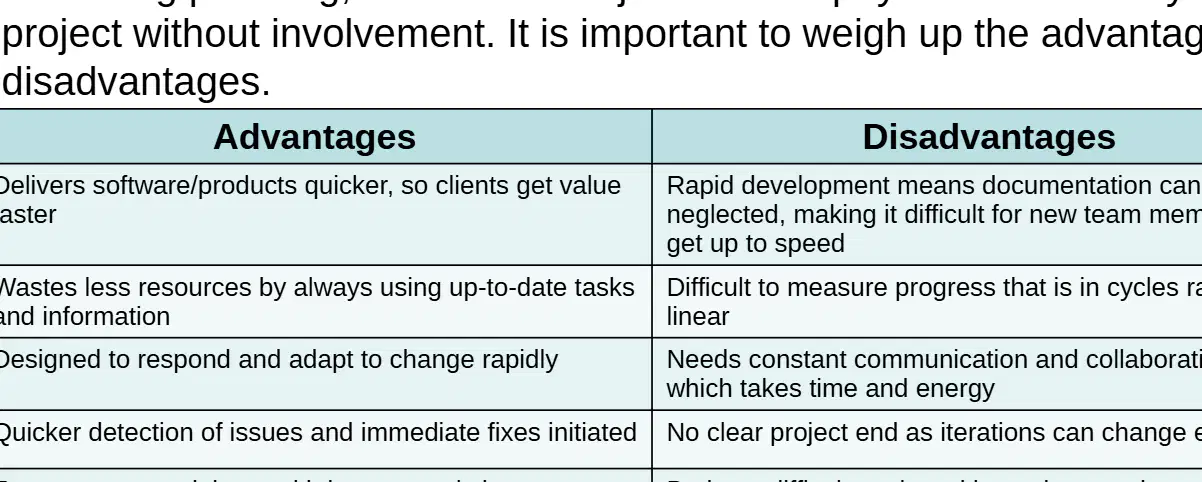
Match the following advantages of Agile with their corresponding disadvantages:
Delivers software/products quicker, so clients get value faster
Rapid development means documentation can be neglected, making it difficult for new team members to get up to speed
Wastes less resources by always using up-to-date tasks and information
Difficult to measure progress that is in cycles rather than linear
Designed to respond and adapt to change rapidly
Needs constant communication and collaboration, which takes time and energy
Quicker detection of issues and immediate fixes initiated
No clear project end as iterations can change end goals
Faster turnaround times with incremental changes
Budgets difficult to plan with continuous change processes and no end point
One advantage of Agile is that it delivers software/products quicker, so clients get value _____
faster
slower
later
eventually
Agile wastes less resources by always using up-to-date _____ and information.
tasks
meetings
budgets
deadlines
Agile is designed to respond and adapt to _____ rapidly.
change
technology
people
cost
Agile allows for quicker detection of issues and immediate _____ initiated.
fixes
delays
reviews
complaints
Agile provides faster turnaround times with _____ changes.
incremental
radical
sporadic
delayed
One disadvantage of Agile is that rapid development means documentation can be _____, making it difficult for new team members to get up to speed.
neglected
extensive
perfected
centralized
It is difficult to measure progress in Agile that is in _____ rather than linear.
cycles
steps
phases
blocks
Agile needs constant communication and _____, which takes time and energy.
collaboration
competition
isolation
neglect
In Agile, there is no clear project end as _____ can change end goals.
iterations
budgets
deadlines
resources
Fill in the blank: In Agile, budgets are difficult to plan with continuous change processes and no _____ point.
end
start
budget
goal
In SCRUM theory, knowledge comes from _________
experience
books
intuition
guesswork
In SCRUM theory, decisions are based on _________
observations
assumptions
guesses
predictions
In SCRUM theory, lean thinking reduces _________
waste
productivity
team size
velocity
In SCRUM theory, focus is on the _________
essentials
details
documentation
individuals
In SCRUM theory, it optimises _________
predictability
complexity
randomness
uncertainty
Fill in the blank: In SCRUM theory, teams with (a) and expertise do the work.
What is the event called that combines four major elements in SCRUM?
Sprint
Daily Standup
Product Backlog Refinement
Release Planning
What is the first element of SCRUM? The first element of SCRUM is _________?
Sprint planning: setting the next sprint goal.
Daily stand-up: sharing progress updates.
Sprint review: evaluating the completed work.
Retrospective: reflecting on the processckenbaum
What is the second element of SCRUM? The second element of SCRUM is _________?
Daily SCRUMs: progress updates on the last 24 hours.
Sprint Review: demonstration of completed work.
Product Backlog: list of all desired work.
Sprint Retrospective: reflection on the sprint.'
What is the third element of SCRUM? The third element of SCRUM is _________.
Sprint review meeting: demo/what got done/not done.
Daily standup meeting: team sync.
Product backlog refinement: grooming.
Sprint planning meeting: task allocation垣
What is the fourth element of SCRUM? The fourth element of SCRUM is _________.
Sprint retrospective: inspect/adapt/what worked/didn’t work.
Product backlog: list of requirements.
Daily standup: team sync meeting.
Sprint planning: define sprint goals.
How long do Sprints last for consistency? Sprints have fixed lengths of ________ weeks for consistency.
1–4
2–6
3–8
4–10

