
 Worksheets
Phy Y10Y11 Y11 C19_3 Potential Divider
Total questions: 38
Worksheet time: 52mins

Potential of A
0V
1.5V
3V
6V
Potential of B
0V
1.5V
3V
6V




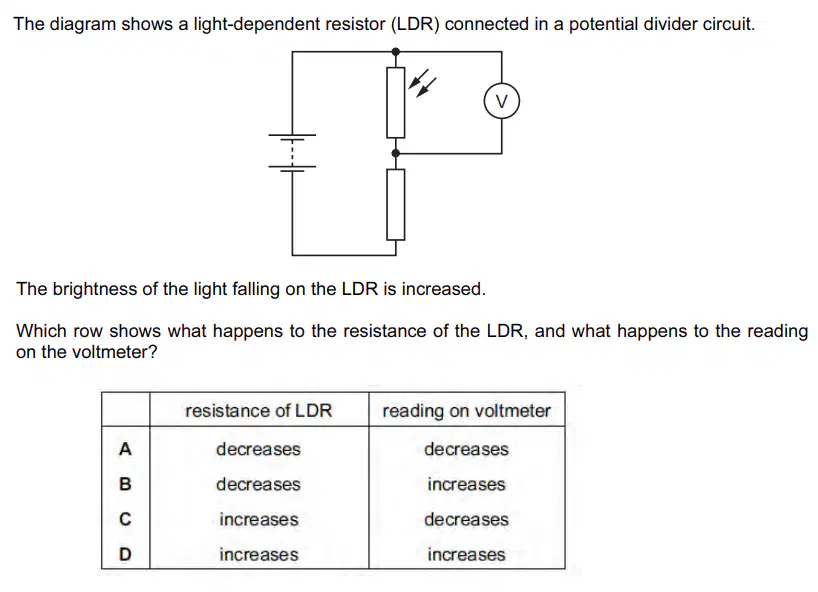
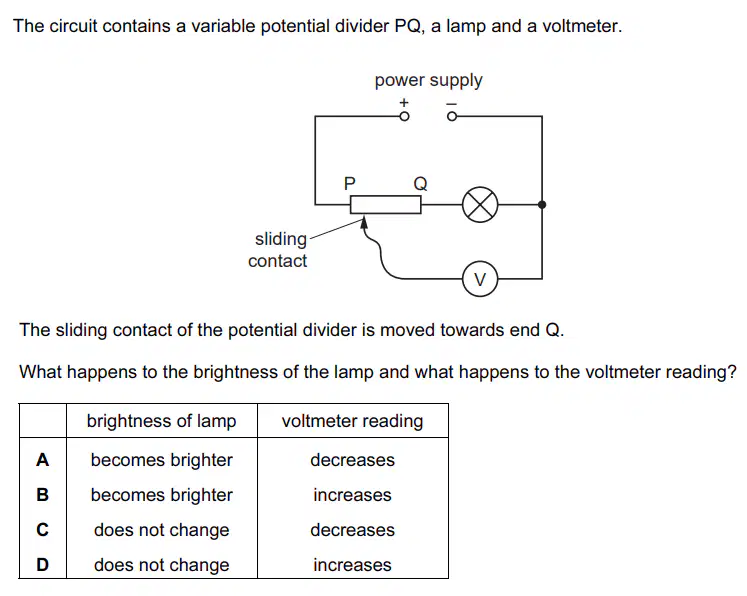
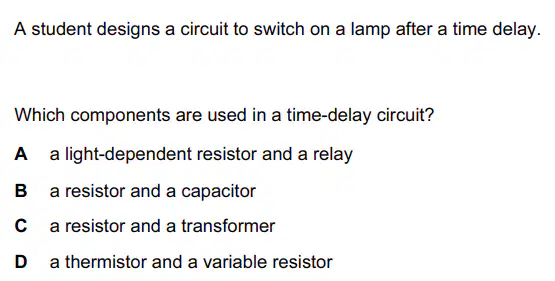
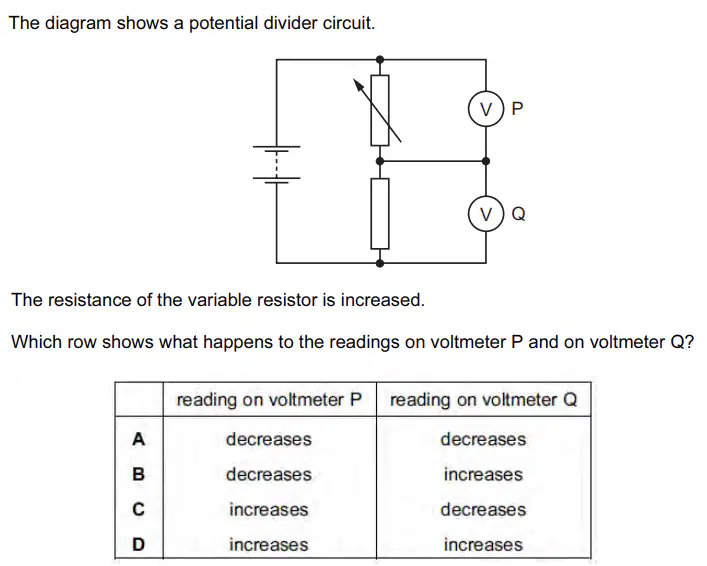

Light levels decrease. What happens to V2?
V2 decreases
V2 stays the same
V2 increases

Light levels increase. What happens to V1?
V1 increases
V1 stays the same
V1 decreases

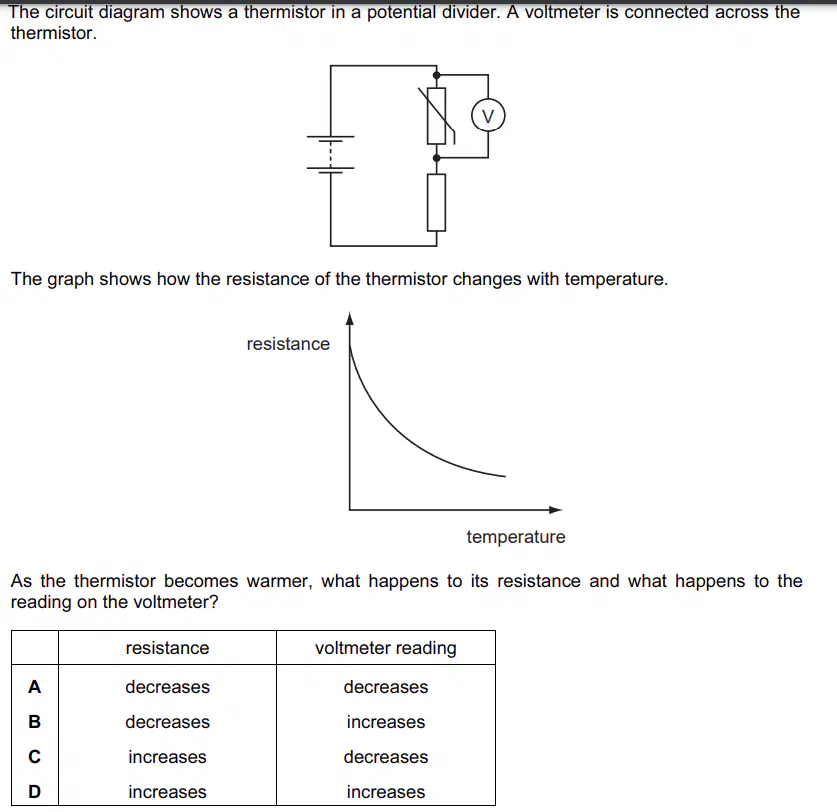
The temperature goes down. What happens to V?
V decreases
V stays the same
V increases

The temperature increases. What happens to V?
V increases
V stays the same
V decreases

At a particular temperature, the p.d across the fixed resistor is 3V. The fixed resistor is 4.7kohms. What is the resistance of the thermistor at this temperature?
14.1kohm
9.4kohm
2350ohms

V = 15V, V2 = 9.5V, RLDR = 2500ohms. What is the value of R1?
4320ohms
660ohms
1450ohms

A circuit is set up with an LDR and a fixed resistor as shown.
The voltmeter reads 4 V.
The light intensity is increased.
What is a possible voltmeter reading?
3 V
4 V
6 V
8 V

A thermistor and another component are connected to a constant voltage supply. A voltmeter is connected across one of the components. The temperature of the thermistor is then reduced but no other changes are made.
In which circuit will the voltmeter reading increase?
A
B
C
D

R1 = 50ohms, R2 = 250ohms, V = 12V, what is V1?
1V
2V
3V
4V

In the circuit shown in the diagram the cell has negligible internal resistance.
What happens to the reading of both meters when the resistance of R is decreased?
Reading of ammeter: increases
Reading of voltmeter: increases
Reading of ammeter: increases
Reading of voltmeter: decreases
Reading of ammeter: decreases
Reading of voltmeter: increases
Reading of ammeter: unchanged
Reading of voltmeter: decreases

Resistors X and Y are connected in series with a 6.0 V battery of negligible internal resistance.
X has resistance R and Y has resistance R/2.
A voltmeter of resistance R is connected across Y.
What is the reading on the voltmeter?
0.0 V
1.5 V
3.0 V
4.5 V
There are ............ types of potential divider
1
2
3
4
Fixed Potential divider is a ............................ circuit with two resistors.
parallel
series
series and parallel
For a fixed potential divider, which equation is correct?
R1 x R2 = V1 x V2
R1/V2 = R2/V1
R1/R2 = V1/V2
R1 x V1 = R2 x V2
A 3.0Ω lamp and a 6.0Ω lamp are connected in series.
What is the total resistance of the combination?
0.5 Ω
2.0 Ω
9.0 Ω
18 Ω

A lamp is to be connected in a circuit so that the p.d. across it can be varied from 0 to 6 V. Which circuit would be most suitable?
A
B
C
D
Conversion of ac into dc is called......
polarization
reflection
alternating current
rectificatio.
----------- allows current to pass in one direction.
LED
Diode
transistor
battery
A circuit is set up with an LDR and a fixed resistor as shown.
The voltmeter reads 4 V.
The light intensity is increased.
What is a possible voltmeter reading?
3 V
4 V
6 V
8 V
A thermistor and another component are connected to a constant voltage supply. A voltmeter is connected across one of the components. The temperature of the thermistor is then reduced but no other changes are made.
In which circuit will the voltmeter reading increase?
A
B
C
D
R1 = 50 ohms, R2 = 250 ohms, cell has a voltage V = 12V, Using the formula, R2R1=V2V1 , what is V2?
11V
10V
13V
14V

The figure shows a light dependent resistor (LDR) and fixed resistor R connected in series across a cell. The internal resistance of the cell is negligible.
Voltage is directly proportional to resistant (V=IR) and resistance increases with temperature due to increased vibrations of the molecules inside the conductor. Therefore ...
voltage remains same as temperature decreases.
voltage increases as temperature decreases.
voltage decreases as temperature increases.
voltage increases as temperature increases.
A circuit is set up with an LDR and a fixed resistor as shown.
t's because LDRs are made of semiconductors- unlike normal conductors, they conduct better under higher heat/light.This means the resistance is decreasing.As to why-Semiconductors' electrons will become 'excited' (yep, thats what its called) as it gains more energy from light or heat, and this frees up more electrons to carry charges across the semi conductor.The more electrons there are, the less resistance the semi conductor has.The LDR behaves like this because it uses a semiconductor which gets its electrons excited through light energy
V
V
V
V

