
 Worksheets
Unit 2 Review
Total questions: 90
Worksheet time: 45mins
"EAP" stands for what? Mark only one oval.
Emergency And Plan
Enter After Planning
Encounter Action Plan
Emergency Action Plan
Pain typically comes on suddenly and has a limited duration. It's frequently caused by damage to tissue such as bone, muscle, or organs, and the onset is often accompanied by anxiety or emotional distress. Described as sharp, stabbing, comes on suddenly, stinging. Lasts less than 6 months. Mark only one oval.
Acute Pain
Joint Pain
Chronic Pain
Referred Pain
Pain lasts longer than acute pain and is generally somewhat resistant to medical treatment. It's usually associated with a long-term illness, such as osteoarthritis. In some cases, such as with fibromyalgia, it's one of the defining characteristics of the disease. This pain can be the result of damaged tissue, but very often is attributable to nerve damage. Described as dull, throbbing, burning, aching, squeezing, stiffness. Lasts longer than 6 months. Mark only one oval.
Acute Pain
Musculoskeletal Pain
Chronic Pain
Psychogenic Pain
Pain is pain that affects the muscles, ligaments and tendons, and bones. Typically described as sharp, bright or burning. Trauma to an area (jerking movements, auto accidents, falls, fractures, sprains, dislocations, and direct blows to the muscle) also can cause musculoskeletal pain. Other causes of pain include postural strain, repetitive movements, overuse, and prolonged immobilization. Mark only one oval.
Acute Pain
Musculoskeletal Pain
Chronic Pain
Joint Pain
What is the best way to break the chain of infection? Mark only one oval.
Hand washing
Skipping hand washing to build immunity.
Sharing personal items to strengthen group resistance
Coughing into the air to release bad germs
Pain is extremely common and many different conditions can lead to painful joints, including osteoarthritis, rheumatoid arthritis, bursitis, gout, strains, sprains, and other injuries. In one national survey, about one-third of adults reported having joint pain within the past 30 days. Knee pain was the most common complaint, followed by shoulder and hip pain, but joint pain can affect any part of your body, from your ankles and feet to your shoulders and hands. Mark only one oval.
Acute Pain
Musculoskeletal Pain
Referred Pain
Joint Pain
Pain is often described as a shooting or burning, tingling or numbness pain. It can go away on its own but is often chronic. Sometimes it is unrelenting and severe, and sometimes it comes and goes. It often is the result of nerve damage or a malfunctioning nervous system. Mark only one oval.
Psychogenic Pain
Musculoskeletal Pain
Chronic Pain
Neuropathic Pain
Pain is a pain disorder associated with psychological factors. Some types of mental or emotional problems can cause, increase or prolong pain. A person with a psychogenic pain disorder may complain of pain that does not match his or her symptoms. Headaches, muscle pains, back pain, and stomach pains are some of the most common types of psychogenic pain. Mark only one oval.
Psychogenic Pain
Joint Pain
Skeletal Pain
Neuropathic Pain
Pain occurs away from the actual site of irritation. It has been called an error in perception. Each referred pain site must be considered unique to each individual. Simply stated, referred pain happens because the nerves in your body are all connected. When your body experiences a pain stimulus, your nervous system carries the signal to your brain. The brain then sends a signal to your body that you’re experiencing pain. Sometimes, because of how nerves are wired in your body, your brain will send a pain signal to a different part of your body than the area where the pain stems from. Mark only one oval.
Chronic Pain
Referred Pain
Musculoskeletal Pain
Neuropathic Pain
Select the 5 conditions required for microorganisms to grow. Check all that apply.
Time
Moisture
pH
Food
Air
What is a pathogen?
A type of bacteria
A type of virus
A type of fungus
A bacterium, virus, or other microorganism that can cause disease
What is the purpose of splinting?
To reduce swelling and inflammation
To provide pain relief
To immobilize and support an injured limb or body part
To promote healing
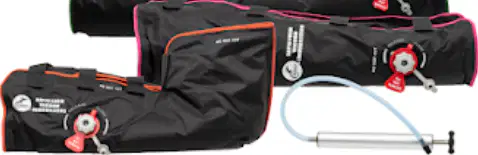
These splints are called what?
SAM Splints
C-Collar
Vacuum Splint
Air Splint
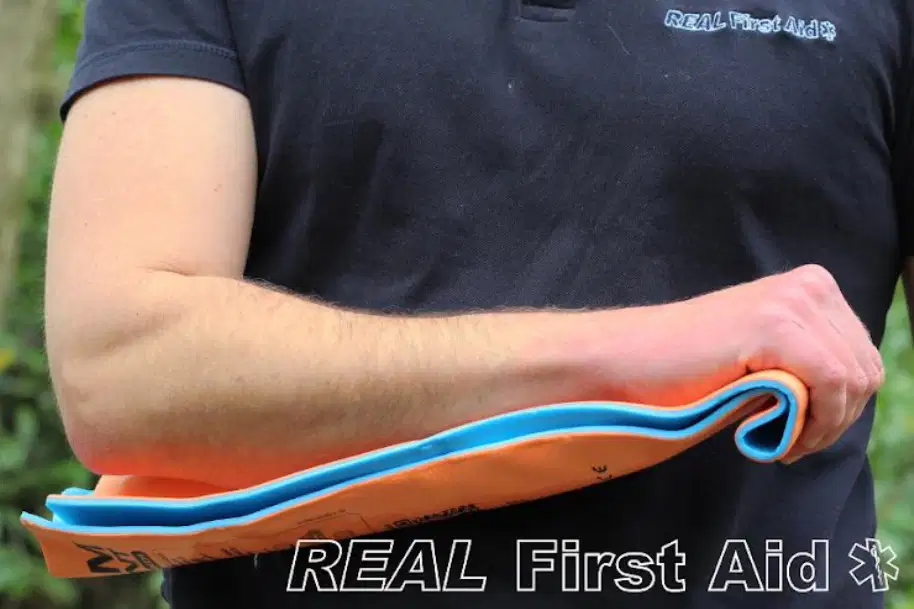
These splints are called what?
SAM Splints
C-Collar
Vacuum Splint
Air Splint
Definition of Emergency: An unexpected serious occurrence that may cause injuries requiring medical attention.
True
False
The emergency plan should be specific to the activity venue.
True
False
The EAP should be reviewed and rehearsed every 5 years.
True
False
If the ABC's are not present, you should not start CPR.
True
False
Someone experiencing hypothermia does not shiver until it becomes severe.
True
False
The higher the metabolic rate, the more heat is produced.
True
False
Someone experiencing shock, you should immediately give them something to eat and drink by mouth.
True
False
Someone experiencing shock, you should wait until symptoms worsen before calling 911.
True
False
Sweating itself causes heat loss.
True
False
You should NOT move the person with a known or suspected spinal injury if they are experiencing shock.
True
False
Heatstroke is a life-threatening emergency.
True
False
D.O.T.S. stands for all of the following except?
Temperature
Open Wounds
Swelling
Deformities
How does shivering produce heat?
Shivering activates sweat glands, which heat the body by evaporating water
Shivering makes your bones vibrate, creating heat like a microwave
Shivering pulls sunlight into the muscles to warm them up
Skeletal muscles shake in small movements creating warmth by expending energy
What is not included in "Body's Heat Production"?
Exercise
Metabolism
Shivering
Convection
When oxygen in the body is replaced by carbon monoxide, it can cause which injury?
Carbon Monoxide Poisoning
Frostbite
Hypothermia
Sunburn
"PPE" stands for what?
Personal Protective Equipment
Personal Performance Equipment
Primary Protection Essentials
Professional Practice Essentials
What is the primary purpose of sweating?
To cool the body down through evaporation of sweat on the skin
To warm the body up through evaporation of sweat on the skin
To remove toxins from the body
To provide lubrication for the skin
"RICE" stands for what?
Rest, Ice, Compress, Elevate
Rest, Ice, Conceal, Embrace
Remove, Ice, Cold, Elevate
Recover, Ice, Compress, Elongate
Which of the following is not an example of "PPE"? Mark only one oval.
Shorts
Gloves
Masks
Face shields
A person can sweat 1 quart of water per hour for how many hours? Mark only one oval.
2 hours
4 hours
6 hours
1 hour
: a life-threatening condition where the body is not getting enough blood flow. Mark only one oval.
Loss of Consciousness
Shock
Cardiac Arrest
Death
This law prevents a rescuer who voluntarily helped from being sued for wrongdoing.
Helpful Rescuer Law
Good Samaritan Law
EAP Law
Due Diligence Law
Heart Attack
Cardiac Arrhythmias
Valvular Heart Disease
Myocardial Infarction
Obstruction
Myocarditis
A condition in which the heart does not pump properly because the heart muscle is inflamed and diseased
Cardiac Arrhythmias
Valvular Heart Disease
Myocardial Infarction
Obstruction
Myocarditis
Damage to heart valves interrupts blood flow
Cardiac Arrhythmias
Valvular Heart Disease
Myocardial Infarction
Obstruction
Myocarditis
Severe irregular heart rhythms cause uncoordinated blood flow through the heart
Cardiac Arrhythmias
Valvular Heart Disease
Myocardial Infarction
Obstruction
Myocarditis
Certain conditions apply pressure or compress the heart, not allowing it to function as a pump
Cardiac Arrhythmias
Valvular Heart Disease
Myocardial Infarction
Obstruction
Myocarditis
Occurs when the heart is unable to pump blood and maintain an adequate blood supply for other vital organs
Neurogenic Shock
Hypovolemic Shock
Psychogenic Shock
Anaphylactic Shock
Cardiogenic Shock
An emergency condition in which severe blood and fluid loss makes the heart unable to pump enough blood to the body
Anaphylactic Shock
Psychogenic Shock
Neurogenic Shock
Hypovolemic Shock
Cardiogenic Shock
Severe hypersensitivity or allergic reaction.
Anaphylactic Shock
Psychogenic Shock
Neurogenic Shock
Cardiogenic Shock
Hypovolemic Shock
For hypothermia, the core temperature falls below _________ degrees.
100 degrees
104 degrees
98.6 degrees
95 degrees
For heatstroke, the most important sign is that the core temperature is _________ degrees or higher.
100 degrees
104 degrees
102 degrees
95 degrees
What is a "normal" temperature?
99.5 degrees
89.6 degrees
98.6 degrees
95.2 degrees
What is a "normal" blood pressure?
120/80
80/120
60/100
50/50
Bacteria multiplying in the blood and releasing toxins
Anaphylactic Shock
Cardiogenic Shock
Psychogenic Shock
Septic Shock
Hypovolemic Shock
Caused by spinal cord injury
Cardiogenic Shock
Psychogenic Shock
Anaphylactic Shock
Hypovolemic Shock
Neurogenic Shock
Which is not included in the "Primary Assessment"?
Assess
Ambulance
Alert
Attend
The "DOTS" in emergency care stand for what?
Discomfort, Orientation, Tingling, and Stiffness
Deformities, Open Wounds, Tenderness, and Swelling
Damage, Overuse, Trauma, and Strain
Dislocations, Obstructions, Tears, and Spasms
Heatstroke can be life-threatening and could cause death if body temperature is not lowered within ______ minutes.
10
45
60
15
More common, and is known as a ‘shock like condition’. It is produced by
Hypovolemic Shock
Cardiogenic Shock
Neurogenic Shock
Anaphylactic Shock
Psychogenic Shock
Correct heart rate for adults
60-80
80-100
Correct heart rate for children
60-80
80-100
Correct breathing rate for children
12 breaths/minute
20-25 breaths/minute
Correct breathing rate for adults
12 breaths/minute
20-25 breaths/minute
Occurs when the left ventricle contracts, thereby pumping blood.
Diastolic Pressure
Systolic Pressure
The residual pressure present in the arteries when the heart is between beats.
Diastolic Pressure
Systolic Pressure
Red, raised rash, accompanied by sensations of prickling and tingling during sweating.
Heat Rash (prickly heat)
Heat Exhaustion
Heat Syncope (heat collapse)
Heatstroke
Pale skin, dizziness, rapid pulse.
Heat Rash (prickly heat)
Heat Exhaustion
Heat Syncope (heat collapse)
Heatstroke
Dizziness, fainting, nausea.
Heat Rash (prickly heat)
Heat Exhaustion
Heat Syncope (heat collapse)
Heatstroke
Hot skin, shallow breathing, strong pulse.
Heat Rash (prickly heat)
Heat Exhaustion
Heat Syncope (heat collapse)
Heatstroke
Metabolism always causes an increase in body heat that depends on the intensity of the physical activity.
Evaporative Heat Loss
Metabolic Heat Production
Radiant Heat Exchange
Convective Heat Exchange
Conductive Heat Exchange
Physical contact with other objects can result in either a heat loss or heat gain.
Evaporative Heat Loss
Metabolic Heat Production
Radiant Heat Exchange
Convective Heat Exchange
Conductive Heat Exchange
Body heat can be lost or gained depending on the temperature of the circulating medium.
Evaporative Heat Loss
Metabolic Heat Production
Radiant Heat Exchange
Convective Heat Exchange
Conductive Heat Exchange
Radiant heat from sunshine increases body temperature.
Evaporative Heat Loss
Metabolic Heat Production
Radiant Heat Exchange
Convective Heat Exchange
Conductive Heat Exchange
Sweat evaporation results in heat loss.
Evaporative Heat Loss
Metabolic Heat Production
Radiant Heat Exchange
Convective Heat Exchange
Conductive Heat Exchange
"Who makes the phone call" should be listed under which section of the EAP? Mark only one oval.
Equipment
Communication
Emergency Care Facilities
Transportation
Someone with a suspected spinal injury goes into shock. What should you do? Mark only one oval.
Do not move them, call 911, and monitor ABC's
Encourage them to stand up and walk to improve circulation
Give them a cold drink to lower their body temperature
Gently massage their spine to alleviate pain
A responsive adult must agree to receive first aid care. This is what type of consent?
Expressed Consent
Assumed Consent
Verbal Consent
Implied Consent
Permission to perform first aid on an unresponsive victim is assumed under which type of consent?
Expressed Consent
Assumed Consent
Verbal Consent
Implied Consent
The "ABC's" in emergency care stand for what?
Airway, Breathing, Circulation
Airway, Beating, Compressions
At least, Breathing, Condone
Airway, Be, Circulating
Outermost layer of skin. Provides a waterproof barrier and creates our skin tone.
Epidermis
Dermis
Subcutaneous Tissue
Beneath the epidermis. Contains tough connective tissue, hair follicles, and sweat glands.
Epidermis
Dermis
Subcutaneous Tissue
Made of fat and connective tissue.
Epidermis
Dermis
Subcutaneous Tissue
Swelling caused by an excess buildup of fluid in the body’s tissues.
Edema
Atrophy
Vasoconstriction
Vasodilation
A decrease in size or wasting away of a body part, muscle, or tissue due to lack of use or disease.
Edema
Atrophy
Vasoconstriction
Vasodilation
The narrowing of blood vessels, which reduces blood flow.
Edema
Atrophy
Vasoconstriction
Vasodilation
The widening or enlargement of a blood vessel, opening, or passage.
Edema
Atrophy
Vasoconstriction
Vasodilation
Type of cell within the body capable of engulfing and absorbing bacteria and other small cells and particle
Phagocyte
Atrophy
Vasoconstriction
Vasodilation
A type of blood cell that is made in the bone marrow and found in the blood and lymph tissue.
Phagocyte
Atrophy
Leukocyte
Vasodilation
Strong, flexible protein fibers found in connective tissue that provide structure and support to skin, tendons, ligaments, and bones.
Phagocyte
Atrophy
Collagen Fibers
Vasodilation
1st phase of tissue response to injury is what?
Inflammatory Response
Fibroblastic Repair
Maturation Remodeling
2nd phase of tissue response to injury is what?
Inflammatory Response
Fibroblastic Repair
Maturation Remodeling
3rd phase of tissue response to injury is what?
Inflammatory Response
Fibroblastic Repair
Maturation Remodeling
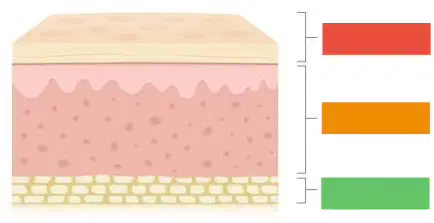
What is the name for the layer of skin highlighted in Red (top)?
Epidermis
Dermis
Subcutaneous Tissue
What is the name for the layer of skin highlighted in Orange (Middle)?
Epidermis
Dermis
Subcutaneous Tissue
What is the name for the layer of skin highlighted in Green (Bottom)?
Epidermis
Dermis
Subcutaneous Tissue

