
 Worksheets
Chemistry Quiz
Total questions: 50
Worksheet time: 50mins
What characteristics does Xenon (Xe) have?
Reacts with halogen gases to form compounds
Chemically inert and does not react
Highly reactive and reacts with metals to form salts
Radioactive
What characteristics does Sodium (Na) have?
Very stable and used for jewelry
Located in the f block
Low density and can be cut with a knife
All of the above
Which element is most similar in behavior to magnesium?
chlorine
calcium
sodium
sulfur
What do the following elements have in common? Na, Al, P, Ar
They are all metals
They are all non-metals
They are all noble gases
They are all elements in the same period
Where are the gaseous elements located?
s-block
p-block
f-block
d-block
The Phosphorus ion P³⁻ has how many electrons?
12
15
18
20
Which of the following has the correct order for ion radius size?
Mg > Mg²⁺ > Mg⁺
Mg > Mg⁺ > Mg²⁺
Mg⁺ > Mg²⁺ > Mg
Mg²⁺ > Mg⁺ > Mg

What is D labeling on the diagram to the right?
Wavelength
Orbital
Frequency
Amplitude
What energy level does (F) have?
1
2
3
4

Which of the following is the correct order of decreasing energy?
Visible light, radio waves, gamma rays, UV
Visible light, gamma rays, radio waves, UV
UV, radio waves, gamma rays, Visible light
Gamma rays, UV light, visible light, radio waves
Which visible light has the lowest energy?
Red
Yellow
Green
Blue
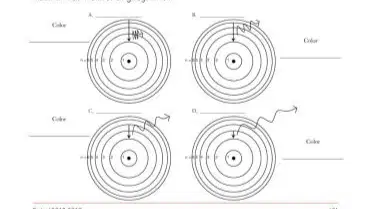
Which one of the following would be a Bohr model showing the release of violet light?
A
B
C
D
When sulfur ionizes, it gains 2 electrons. The ion's electron configuration is the same as
a) He
b) Si
c) Cl
d) Ar
Which of the following would be an impossible electron configuration?
a) 3p⁸
b) 5p⁴
c) 4f⁵
d) 2s¹
Which of the following would have the highest energy?
a) 1s
b) 2s
c) 3p
d) 4p
Why does atomic size increase as you move down a column on the periodic table?
The elements have increasing energy levels and increased distance between the valence electrons and protons
The elements are decreasing energy levels and decreased distance between the valence electrons and protons
The elements have increased effective nuclear charge
The elements have decreased effective nuclear charge
Which of the following would have the smallest atomic radius?
I
Ca
Be
S
Which of the following would have the largest atomic radius?
Ba
Na
He
Se
Which would have the highest electronegativity?
F
Cs
Cl
Xe
Which will have a stronger attractive force between their outermost electron(s) and the nucleus?
1.) Ba or Ca
2.) Cu or Cr
3.) Ar or Xe
1.) Ca
2.) Cu
3. ) Ar
1.) Ba
2.) Cu
2.) Ar
1.) Ca
2.) Cr
3.) Xe
Why is atomic radius measured as half the distance between the nuclei of two atoms of the same element?
Because the nuclei of the atoms do not move while the electrons do
Because this is a less accurate way to measure the atomic radius
Because the electrons are stationary and can be measured directly
Because the valence electron shell shields the inner core electrons
Why do atoms with higher energy level increase in size even though atomic number also increases?
Because the distance between the nuclei and the valence electrons decrease
Because of increased nuclear charge of the protons
Because the shielding effect occurs where the inner electrons block the valence electrons
Because the number of electrons is greater than the number of protons.
The atom with the largest atomic radius in Group 18 is
Ar
Kr
Xe
Rn
As atomic radius decreases, ionization energy
Increases because the electrons are pulled closer to the nucleus
Increases because the electrons are moving further from the nucleus
Decreases because the electrons are pulled closer to the nucleus
Decreases because the electrons are moving further from the nucleus
Mia is learning about chemistry and wonders why atoms with a larger atomic radius have a low electronegativity. Can you help her understand?
Because there is increased number of protons in the nucleus pulling on the electrons
Because there is decreased number of protons in the nucleus pulling on the electrons
Because the electrons are close to the nucleus and therefore have more Coulombic attraction to the nucleus
Because the electrons are far from the nucleus and therefore have less Coulombic attraction to the nucleus
Based on what you know about ions, all of the following are correct except
Li⁺
K⁺
S²+
Ca²⁺
As you move down a group, shielding
increases because there are more orbitals and therefore more electrons
decreases because the atomic radius increases
increases because there are more protons
stays constant because the number of valence electron number stays the same
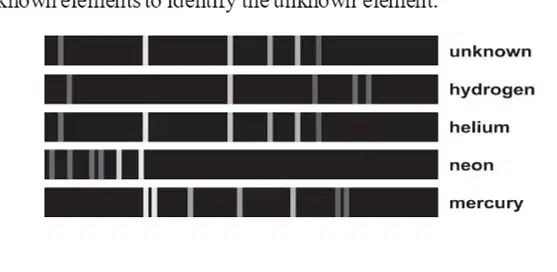
Use the emission-line spectra of the known elements to identify the unknown element.
hydrogen
helium
neon
mercury
Arrange the following elements in order of decreasing atomic radii: Li, Cs, Mg, Na, K
Li, Mg, Na, K, Cs
Cs, K, Na, Mg, Li
Mg, Li, Na, Cs, K
K, Cs, Na, Li, Mg
What is the lowest possible energy level that an electron can occupy?
Lower energy level
Ground State
Excited State
Depressive State
When atoms _____________ energy, their electrons move to higher energy levels. These electrons _____________ energy by emitting light when they return to lower energy levels.
lose, absorb
absorb, lose
lose, lose
absorb, absorb

Emission spectra emitted by an element (or compound) will produce ___ through a spectroscope.
discrete bright lines
a continuous rainbow
dark lines
white light
λ and ν are:
inversely proportional
directly proportional
they are proportional in 10 different ways
they are proportional in 20 differentways
Which principle explains that electrons fill each orbital in a subshell singly before pairing up?
Pauli exclusion principle
Hund's rule
Aufbau principle
None of the above
Who proposed that electrons are only found in specific, discrete circular orbits around the nucleus?
Albert Einstein
Erwin Schrodinger
Ernest Rutherford
Niels Bohr
Which principle explains that electrons will occupy the lowest available energy state before moving to higher states?
Pauli exclusion principle
Hund's rule
Aufbau Principle
None of the above

1s22s22p63s23p6
4s23d104p6


What element is represented in this Bohr Model?
Carbon
Hydrogen
Aluminum
Lithium


On the periodic table, Periods are
Horizontal rows
Vertical columns

How many energy levels in this element?
2
5
6
3
Who arranged the known elements into horizontal rows of increasing atomic mass leaving gaps for as yet undiscovered elements?
Mendeleev
Meyer
Newlands
Moseley
In the modern periodic table elements are arranged by:
atomic mass
atomic number
valence electrons
number of isotopes

Elements in the same group have similar ?
physical and chemical properties
atomic numbers
neutron counts
mass numbers

