
 Worksheets
Unit 2 Quiz- Propositions
Total questions: 40
Worksheet time: 25mins
Which of the following are steps of simple apprehension?
aquiring sense perceptions
forming mental images
grasping concepts
forming propositions
coming up with counter-points and arguments about the truth of the thing you've apprehended
Which of the following best describes what a term is?
A vocabulary word
An idea
A thing used to signify a concept in the mind
Used to help communicate ideas
An argument
What is wrong with this proposition:
All (potato chips) are not (healthy)
Nothing
It's obviously untrue
Misplaced qualifier
Inaccurate quantifier
What is wrong with this proposition:
Some (potato chips) are not (bite-sized), but are (still convenient)
Nothing
a contradiction inside one proposition
too many terms
Inaccurate quantifier
What is the quantifier in this proposition:
All (potato chips) are (healthy)
All
are
potato chips
healthy
Which of the following are particular propositions?
All (beet juice) is (horrifying)
Some (lightbulbs) are not (spendy)
No (beet juice) is (horrifying)
All (beet juice sold at Hy-Vee) is (over-priced)
Some (lightbulbs) are (sold at Hy-Vee next to the beet juice)
A statement using terms in which we say something is or is not something else ~or~ a statement which expresses truth or falsity
(a)
What is the qualifier in this proposition:
Some (potato chips) are not (healthy)
Some
are
potato chips
not
Which of the following are true about the third act of the mind (reasoning/inference)?
Uses sense experiences to create terms
Contains three and only three terms
When propositions are put together to draw conclusions
When we make some claim about the relationship between two terms
Which of the following are true about the second act of the mind (judgment)?
Uses sense experiences to create terms
Contains three and only three terms
When propositions are put together to draw conclusions
When we make some claim about the relationship between two terms
Which of the following best describes the type of judgment that this statement makes (NOTE: It's in everyday language and not in propositional form):
"The three dogs down the street need to get sprayed for fleas."
Particular Affirmative
Universal Affirmative
Universal negative
Particular negative
Which of the following best describes the type of judgment that this statement makes (NOTE: It's in everyday language and not in propositional form):
"Not all kinds of cheese are tasty."
Particular Affirmative
Universal Affirmative
Universal negative
Particular negative
Which of the following best describes the type of judgment that this statement makes (NOTE: It's in everyday language and not in propositional form):
"Not all rusty nails will cause you to get Tetanus disease."
Particular Affirmative
Universal Affirmative
Universal negative
Particular negative
Which of the following best describes the type of judgment that this statement makes (NOTE: It's in everyday language and not in propositional form):
"I cannot think of any reason why I should listen to country music."
Particular Affirmative
Universal Affirmative
Universal negative
Particular negative
Which of the following best represents the CONCLUSION of the argument below (from pg. 72 of the workbook):
"According to Mortimer Adler, part of knowing how to read a book requires students to assimilate knowledge they have learned (a process he calls "enlightenment"). Students who can assimilate knowledge in this way are among his best students. Therefore, at least some of the best students really know how to read a book."
Some (part of how to read a book) is (the process of student enlightenment)
All (enlightened students) are (the best students)
All (students) are (people who ought to read more books)
Some (best students) are (those who know how to read a book)
Which of the following propositions IS NOT part of the argument below (from pg. 72 of the workbook):
"According to Mortimer Adler, part of knowing how to read a book requires students to assimilate knowledge they have learned (a process he calls "enlightenment"). Students who can assimilate knowledge in this way are among his best students. Therefore, at least some of the best students really know how to read a book."
Some (part of how to read a book) is (the process of student enlightenment)
All (enlightened students) are (the best students)
All (students) are (people who ought to read more books)
Some (best students) are (those who know how to read a book)
Which of the following propositions ARE PREMISES for the following argument (from pg. 72 of the workbook):
"According to Mortimer Adler, part of knowing how to read a book requires students to assimilate knowledge they have learned (a process he calls "enlightenment"). Students who can assimilate knowledge in this way are among his best students. Therefore, at least some of the best students really know how to read a book."
Some (part of how to read a book) is (the process of student enlightenment)
All (enlightened students) are (the best students)
All (students) are (people who ought to read more books)
Some (best students) are (those who know how to read a book)
What is wrong with the following proposition:
All (patriotic Americans) ought to (eat Wisconsin Cheese curds)
No quantifer
No copula
Too many terms
it is a nonsense sentence
Which diagram correctly corresponds to the following statement:
Some fanny-pack wearers are big fans of the color lime green.
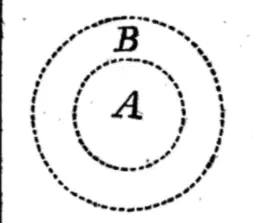
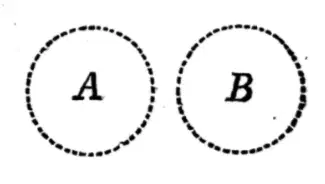
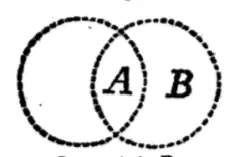
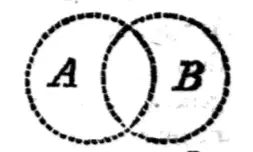
Which diagram correctly corresponds to the following statement:
Bacon is given to us as a sign of God's love.
Which diagram correctly corresponds to the following statement:
Most soap is smelly.
Which diagram correctly corresponds to the following statement:
This quiz is my favorite thing!
What does "truth-value" mean?
How convincing I think an argument is
The argument is formatted correctly
The truth that can be found in an argument or statement
It is a flavor of ice cream named in honor of Aristotle
Truth or falsity has to do with how well a judgment corresponds to (a)
Questions, commands, greetings, exclamations, self-reports (opinions) all share this in common...
They are super fun
They add a lot to conversation
They are non-propositional
They will convince people of the accuracy of an argument
The one element that not every logical proposition must have is...
Quantifier
Copula
Qualifier
Two terms
What tells us whether a proposition is negative or affirmative?
Terms
Quality of the argument
Quantity of the argument
The truth-value of the argument
Statements with singular subjects should be treated as...
Universal statements
Particular statements
Choose the proposition that best represents the judgment for the following:
"All I do is win, win, win no matter what..."
All (what I do) is (win, win, win)
All (me) is (a winner)
All (winning things) are (things that I do)
If (I do it) then (I win it)
Choose the proposition that best represents the judgment for the following:
“I think of my life as a kind of music, not always good music but still having form and melody.”—East of Eden
All (life) is (musical)
Some (lives) are (worth living)
All (my life) is (made up of form and melody)
All (form) is (melody)
Choose the proposition(s) that best represents the judgment for the following (keep an eye out for compound judgments!):
“It’s no use going back to yesterday, because I was a different person then.” - Lewis Carroll, Alice in Wonderland
All (me today) is (different than me yesterday)
All (yesterday) is (useless)
No (dwelling on yesterday) is (useful)
All (dwelling) is (best done when dealt jelly)
Choose the proposition(s) that best represents the judgment for the following (keep an eye out for compound judgments!):
“All happy families are alike; each unhappy family is unhappy in its own way.” –Anna Karenina
All (happy families) are (alike)
No (unhappy family) is (alike)
No (happy families) are (like unhappy families)
All (unique families) are (unhappy families)
Choose the proposition(s) that best represents the judgment for the following (keep an eye out for compound judgments!):
“I don't know half of you half as well as I should like; and I like less than half of you half as well as you deserve.”
― J.R.R. Tolkien, The Fellowship of the Ring
Some (you) are not (liked by me as well as you deserve)
Some (you) are not (known as well by me as you should be)
No (you) are (likeable)
No (me) is (a liker/knower of you)
Choose the proposition that best represents the judgment for the following:
“Christmas won’t be Christmas without any presents!” —Little Women
All (gift-giving) is (what makes Christmas)
No (Christmas without presents) is (real Christmas)
Some (gift-giving) is (necessary for Christmas to be Christmas)
All (gift-less Christmas) is (depressing)
Choose the proposition(s) that best represents the judgment for the following (be on the look-out for compound propositions!):
“There are few people whom I really love and still fewer of whom I think well.” —Pride and Prejudice
Some (people) are (loved by me)
Some (people) are (thought of well by me)
Some (people) are (loveable and can be thought well of)
Some (characters in this book) are (cranky and cynical)
How many terms is a proposition made up of?
1
2
3
Infinite
The (a) of a proposition are: subject, copula, predicate, quantifier/qualifier
The (a) term is the part of a proposition, the thing we are saying something about
The (a) is a form of the verb "to be" (the verb of being), it acts as a connecting term between the S and P
The four letters we use to stand for the types of propositions come from the vowels in the Latin words ________ and ________. (NOTE: Put a space between the two words)
(a)

