
 Worksheets
Electricity - AKS 10a & 10b
Total questions: 53
Worksheet time: 31mins

The picture shows an electrical circuit. This circuit is a series circuit because:
It has 3 light bulbs.
The same current flows through all three light bulbs.
It uses a single battery.
The electrical current is divided between the three light bulbs.
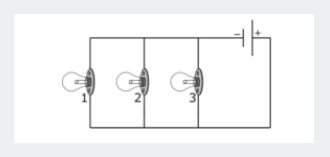
If bulb 1 burns out, what will occur?
bulbs 2 and 3 will go out
bulbs 2 and 3 receive more volts
bulbs 2 and 3 will stay lit
nothing will happen
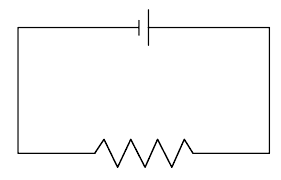
This circuit has a 24 volt battery and the resistor is 8 ohms. How many amps are running through the circuit?
3 Amps
192 Amps
2 Amps
4 Amps

If you increase the size of the resistor and keep the voltage the same, what will happen to the current?
Current will increase
Current will decrease
Current will stay the same
What does Ohm's Law state?
Voltage is the product of current and resistance.
Current is the product of voltage and resistance.
Resistance is the sum of voltage and current.
Voltage is the sum of current and resistance.
In a series circuit, how does the current behave?
The current is different at each point in the circuit.
The current is the same at every point in the circuit.
The current is zero at every point in the circuit.
The current is half at every point in the circuit.
Which of the following is a component of an electric circuit?
Battery
Water pump
Gasoline
Solar panel
What is the unit of resistance?
Ampere
Volt
Ohm
Watt
In a parallel circuit, how does the voltage across each component compare?
The voltage is different across each component.
The voltage is the same across each component.
The voltage is zero across each component.
The voltage is half across each component.
If the voltage is 12V and the resistance is 4Ω, what is the current according to Ohm's Law?
3A
48A
8A
0.33A
Which of the following is NOT a circuit component?
Resistor
Capacitor
Transformer
Thermometer
What happens to the total resistance in a series circuit when more resistors are added?
It decreases.
It remains the same.
It increases.
It becomes zero.
What is the formula for calculating voltage using Ohm's Law?
V=I×R
V=RI
V=I+R
V=I−R
In a parallel circuit, what happens to the total current when more branches are added?
It decreases.
It remains the same.
It increases.
It becomes zero.
Which of the following best describes current?
The flow of electric charge.
The opposition to the flow of electric charge.
The potential difference between two points.
The energy consumed by a circuit.
If the potential difference (voltage) across a resistor is 12V and the current through the resistor is 3A, what is the resistance?
In a circuit, if you increase the resistance of a variable resistor, what happens to the current?
The unit for electric charge is:
What happens to the total resistance if more resistors are added in series to a circuit?
A circuit has a current of 0.5A and a potential difference of 6V. What is the power being used by the circuit?
Which of the following graphs represents the current-voltage relationship for a resistor?
If a circuit has a charge flow of 20 coulombs in 40 seconds, what is the current?
Potential difference is measured in a unit called _____.
ampere
ohm
volt
coulomb
Electric current is measured in a unit called _____.
ampere
ohm
volt
coulomb

Is the symbol for _____.
Light bulb
Resistor
Battery
Switch

Is the symbol for _____.
Light bulb
Resistor
Battery
Switch
A battery is a source of alternating current.
True
False
In a series circuit, all parts of the circuit are connected in a single path.
True
False
Select the items needed to have a complete circuit.
Energy source (battery)
Wires
Energy user (lightbulb)
Voltmeter
Switch
Which of the following are examples of conductors?
Copper
Plastic
Glass
Aluminum foil
Pencil lead
Which of the following are examples of insulators?
Copper
Plastic
Glass
Aluminum foil
Pencil lead
Electricity that flows in only one direction is called _____.
Alternating current (AC)
Direct current (DC)
Electricity that changes direction as it flows is called _____.
Alternating current (AC)
Direct current (DC)

What is electricity?
flow of electrons
flow of copper atoms
light
movement of air
What is a form of energy resulting from the existence of charged particles such as electrons and protons?
Electricity
Resistance
Insulator
Gravity
What is a flow of electrons moving through a conductor or space?
Current
Conductor
Static
Electric Field
What is an object or type of material that allows the flow of electrons?
Voltage
Insulator
Conductor
Electric Potential
How do electrons react to each other in a current?
They repel each other.,
They attract each other.
They do not react to each other while in a current.
What is the slowing down of an electric current caused by the composition of the conductor?
Voltage
Amperage
Resistance
Electric Field
What are materials that present high resistance and restrict the flow of electrons?
Insulators
Conductors
Batteries
Current
What is the measurement of the number of electrons through a certain point in a wire per second?
Voltage (volts)
Amperage (amps)
Current
Electric Potential
What is the pressure (magnitude) from an electrical circuit's power source that pushes that current through a conductor
Amperage (amps)
Voltage (volts)
Resistance
Repelling
What is an invisible force field created by the attraction and repulsion of electrons?
Current
Amperage (amps)
Electric Field
Conductor
What is the buildup of an electrical charge caused by friction between 2 objects?
Voltage
Amperage
Static
Conductor
An electric current that continually reverses direction over time is known as a(n)
direct current
alternating current
simple current
An electric current that has constant magnitude and direction over time is known as a(n)
direct current
alternating current
simple current
An electric current flowing in one direction only
voltage
parallel current
direct current
electric current
current consisting of charges that move back and forth in a circuit
alternating current
direct current
parallel current
electric current
What is the difference between a series circuit and a parallel circuit?
Series circuit has 2 loops and a parallel circuit has more than 2
Series circuits are more powerful than parallel circuits
Series circuits contain one loop while parallel circuits contain 2 or more loops
They are the same
Watts are a measure of power where one watt = one ____ of energy
gram
electron
joule
meter
What does a switch do?
turn things on and off
Halts electrons
Tells electrons where to go
connect or disconnect the conducting pathway in an electrical circuit
If a light goes out in a series circuit, what happens?
The other lights go out
All other lights remain on
All the bulbs burst and explode
The lights lose their power a bit
When charge is flowing in a circuit, ____ is said to exist.
Current
Electricity
Power
Electrons

