Wayground logo

Free Printable Worksheets

Font size

S
M
L
XL
Worksheets

Exam 4 Review Questions

Total questions: 95

Worksheet time: 4hrs 4mins

Name
Class
Date
1.
Which equation describes the transformation of shifting f(x)=x2 two units right?
a)
x2 + 2
b)
x2 - 2
c)
(x + 2)2
d)
(x - 2)2
2.
Describe the transformations that maps
y = g(x) to y = - g(x + 6) - 10
a)
Reflect over y-axis
Shifted down 10 units
Shifted left 6 units
b)
Reflect over x-axis
Shifted up 10 units
Shifted left 6 units
c)
Reflect over y-axis
Shifted up 10 units
Shifted right 6 units
d)
Reflect over x-axis
Shifted down 10 units
Shifted left 6 units
3.
Given f(x) = (x-3)2 + 5.  What transformations took place from the original function f(x)?
a)
Left 3 and up 5
b)
Right 3 and down 5
c)
Left 3 and down 5
d)
Right 3 and up 5
4.
. 
If the blue is f(x)=x2, then the red must be
a)
g(x)=x2-5
b)
g(x)=x2+5
c)
g(x)=(x-5)2
d)
g(x)=(x+5)2
5.
What do we call the highest or lowest point of a quadratic?
a)
parabola
b)
vertex
c)
graph
d)
point
6.

Identify the y-intercept

a)

(0, -3)

b)

(0, 1)

c)

(0, 3)

d)

(2, 1)

7.
What is the domain of the graph?
a)
All real numbers
b)
To infinity and beyond
c)
y ≥ 0
d)
x ≥ 0
8.
What is the range of the graph?
a)
All real numbers
b)
To infinity and beyond
c)
y ≥ 0
d)
x ≥ 0
9.
What is the domain of the graph?
a)
All real numbers
b)
To infinity and beyond
c)
y ≥ -1
d)
x ≥ 0
10.
What is the range of the graph?
a)
All real numbers
b)
To infinity and beyond
c)
y ≥ -1
d)
x ≥ 0
11.

What variable represents the domain?

a)

x

b)

y

c)

d

d)

r

12.

What variable represents the range?

a)

x

b)

y

c)

d

d)

r

13.

What is the Domain of this exponential function?

a)

y=1

b)

x=0

c)

All Real Numbers

d)

x>0

14.

What is the Range of this function?

a)

y > 0

b)

x> 0

c)

All Real Numbers

d)

y > 1

15.

What is the range of the exponential function?

a)

all real numbers

b)

y > -1

c)

y < -1

d)

x > -1

16.

What is the range of the exponential function?

a)

all real numbers

b)

y > 3

c)

y < 3

d)

x > 3

17.

What is the domain of the exponential function?

a)

all real numbers

b)

y > 3

c)

y < 3

d)

x > 3

18.
If the blue graph is f(x) (the original function) and the red graph is the transformation, what is the equation of the red graph?
a)
-f(x)
b)
f(-x)
c)
f-1(x)
d)
f(2x)
19.
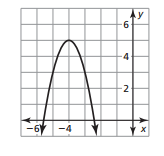
The vertex of the quadratic function f(x) in the picture is (-4, 5). If g(x) = f(x + 2) , what is the vertex of g(x)?
a)
(-2, 5)
b)
(-6, 5)
c)
(-4, 3)
d)
(-4, 7)
20.

Which of the following transformations are present (select all that apply)?

-2f(2(x - 1)) + 2

a)

reflection over horizontal axis

b)

reflection over vertical axis

c)

horizontal compression

d)

vertical shift

e)

Rotation about origin

21.

Describe the transformation

f(x)+3f\left(x\right)+3  

a)

3 Units Up

b)

3 Units Down

c)

3 Units Left

d)

3 Units Right

22.

Describe the transformation

f(x−2)f\left(x-2\right)  

a)

2 Units Up

b)

2 Units Down

c)

2 Units Left

d)

2 Units Right

23.

Describe the transformation

f(x+5)f\left(x+5\right)  

a)

5 Units Up

b)

5 Units Down

c)

5 Units Left

d)

5 Units Right

24.

Describe the transformations

−g(x)+2-g\left(x\right)+2  

a)

Reflected across the x-axis

2 Units Up

b)

Reflected across the x-axis

2 Units Down

c)

Reflected across the y-axis

2 Units Up

d)

Reflected across the y-axis

2 Units Down

25.

Describe the transformation

h(13x)h\left(\frac{1}{3}x\right)  

a)

Vertically Stretched by a factor of 13\frac{1}{3}  

b)

Vertically Compressed by a factor of 13\frac{1}{3}  

c)

Horizontally Stretched by a factor of 13\frac{1}{3}  

d)

Horizontally Stretched by a factor of 13\frac{1}{3}  

26.

Describe the transformations

g(−x)−4g\left(-x\right)-4  

a)

Reflected across the x-axis

4 Units Left

b)

Reflected across the x-axis

4 Units Down

c)

Reflected across the y-axis

4 Units Left

d)

Reflected across the y-axis

4 Units Down

27.
  The blue function is the original function f(x) = x3.  Which of the following is the correct equation for the red function, g(x)?
a)
g(x)=x3+1
b)
g(x)=x3-1
c)
g(x)=(x-1)3
d)
g(x)=(x+1)3
28.
Identify the transformation from the graph of f(x)=x2 to the graph g(x)= -(x+5)2 
a)
shifted up five units
reflection in x-axis
b)
shifted down five units
reflection in x-axis
c)
shifted left 5 units
reflection x-axis
d)
shifted right 5 units
reflection x-axis
29.
Describe the transformations that maps
y = g(x) to y = - g(x + 6) - 10
a)
Reflect over y-axis
Shifted down 10 units
Shifted left 6 units
b)
Reflect over x-axis
Shifted up 10 units
Shifted left 6 units
c)
Reflect over y-axis
Shifted up 10 units
Shifted right 6 units
d)
Reflect over x-axis
Shifted down 10 units
Shifted left 6 units
30.
If the yellow curve has equation f(x)=x2,
a)
Then the blue curve is f(x) = x2 - c
b)
Then the blue curve is f(x) = (x+c)2
c)
Then the blue curve is f(x) = (x-c)2
d)
Then the blue curve is f(x) = x2 + c
31.
If the blue function is f(x)=x2, then the red function must be
a)
g(x)=x2-5
b)
g(x)=x2+5
c)
g(x)=(x-5)2
d)
g(x)=(x+5)2
32.

g(x) = -f(x)

Describe the transformation to f(x) that results in g(x).

a)

f(x) has been reflected over the x-axis.

b)

f(x) has been reflected over the y-axis.

33.
Describe the transformation of y = f(x) for the new function
 y = f(- x)
a)
The graph of y = f(x) was flipped vertically across the x axis. 
b)
The graph of y = f(x) was flipped horizontally across the y axis.
c)
The graph of y = f(x) was shifted down.
d)
The graph of y = f(x) was shifted up
34.
Which of the following transformations are present?
-2f(x - 1) + 2
a)
Shift 1 unit down
b)
Shift 1 unit up
c)
Shift 1 unit left
d)
Shift 1 unit right
35.

What are the transformations of this functions compared to the parent function?

a)

Shifted right 5, shifted down 2, and reflected over the x-axis

b)

Reflected over the x-axis, vertical stretch, and shifted right 5

c)

Reflected over the x-axis, vertical stretch, and shifted left 5

d)

Shifted right 5, shifted down 2

36.

Which is the correct equation for this function?

a)

f(x)=3∣x−2∣−2

b)

f(x)=1/3∣x+2∣−2

c)

f(x)=3∣x+2∣−2

d)

f(x) = 1/3∣x−2∣+2

37.

y=x−2y=\sqrt{x-2}  

Which graph represents this transformed function?

a)
b)
c)
d)
38.
What are the transformations to the graph compared to the parent function?
a)
Shifted right 2, shifted up 3, and reflected over the y-axis
b)
Shifted left 2, shifted up 3, and reflected over the y-axis
c)
Shifted left 2, shifted up 3, and reflected over the x-axis
d)
Shifted right 2, shifted up 3, and reflected over the x-axis
39.
Describe the parent graph transformation
a)
stretch by 1/2, left 1, down 3
b)
stretch by 1/2, right 1, down 3
c)
compression by 1/2, left 1, down 3
d)
compression by 1/2, right 1, down 3
40.

What is the DOMAIN for the following graph?

a)

(-∞, ∞)

b)

(-∞, 0]

c)

[-12, 12]

d)

[-4, 0]

41.

What is the DOMAIN of the function?

a)

[0, ∞)

b)

(-∞, ∞)

c)

(-∞, 0]

d)

[0, 3]

42.
a)

(-∞, 0]

b)

(-∞, 0)

c)

[0, -∞)

d)

[-5, 0]

43.

What is the DOMAIN of the function?

a)

[-7, 6]

b)

(-7, 6)

c)

[-8, 2]

d)

[-7, -8]

44.

What is the RANGE for the following graph?

a)

(-∞, ∞)

b)

(-∞, 0]

c)

[-12, 12]

d)

[-4, 0]

45.
What is the domain of this graph?
a)
[-1,1]
b)
[-2,2]
c)
(-1,-2)
d)
(-∞,+∞)
46.
What is the range of this graph?
a)
(-∞,+∞)
b)
(-2,2)
c)
(-1,1)
d)
[-2,2]
47.
What is the range of this function?
a)
(-∞,+∞)
b)
(-4,2]
c)
(-∞,2]
d)
[2,-∞)
48.

If   f(x)=x2f\left(x\right)=x^2     find      f(3+h)−f(3)h\frac{f\left(3+h\right)-f\left(3\right)}{h}  .

a)

hh  

b)

6+h6+h  

c)

18+h18+h  

d)

6+3h6+3h  

49.

If  f(x)=x2−3f\left(x\right)=x^2-3    find     f(1+h)−f(1)h\frac{f\left(1+h\right)-f\left(1\right)}{h}  

a)

−1+h-1+h  

b)

hh  

c)

2+h2+h  

d)

−9+h-9+h  

50.

If   f(x)=3x2+2f\left(x\right)=3x^2+2    find     f(4+h)−f(4)h\frac{f\left(4+h\right)-f\left(4\right)}{h}  .

a)

24+3h24+3h  

b)

22+3h22+3h  

c)

2+24h+3h2h\frac{2+24h+3h^2}{h}  

d)

190+24h+3h2h\frac{190+24h+3h^2}{h}  

51.
a)

4

b)

5

c)

6

d)

7

52.
a)

4

b)

5

c)

6

d)

7

53.
a)

2a

b)

2a - h

c)

2a + h

d)

2h

54.
a)

2a

b)

2a - h

c)

2a + h

d)

2h

55.
a)

2a - 2

b)

2a - h - 2

c)

2a + h - 2

d)

2h - 2

56.
a)

2a - 3

b)

2a - h - 3

c)

2a + h - 3

d)

2h - 3

57.

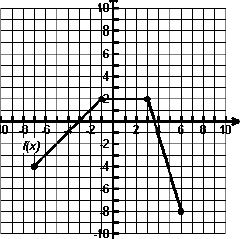
What is F(3)

a)

-6

b)

3

c)

8

d)

0

58.

What is F(-8)?

a)

2

b)

-4

c)

-2

d)

0

59.

Find x, if F(x) = 2.

a)

4

b)

-2

c)

-6

d)

8

60.

What is the range of F(x)?

a)


−10≤x≤8-10\le x\le8

b)

−7≤x≤2-7\le x\le2

c)

all real numbers

d)

−10≤y≤8-10\le y\le8

e)

−7≤y≤2-7\le y\le2

61.

What are the x-intercepts? Check all that apply.

a)

(0, 7)

b)

(-6, 0)

c)

(0, -6)

d)

(7, 0)

62.

What are the y-intercepts? Check all that apply.

a)

(0, 7)

b)

(-6, 0)

c)

(0, -6)

d)

(7, 0)

63.

Estimate the rate of change (slope) from −2≤x≤8-2\le x\le8  ?

a)

2

b)

2/5

c)

3/4

d)

-3/4

e)

5/3

64.

Select the correct intercepts for the graph. Select all that apply.

a)

x-intercept: (3, 0)

b)

x-intercept: (-2, 0)

c)

y-intercept: (0, 3)

d)

y-intercept: (0, -2)

65.

The Smith family is traveling back from vacation. Their distance from home over time is shown in the table. Select the correct meaning of the x-intercept.

a)

The x-intercept is 250. This means that after 250 hours, the family is 0 miles from home.

b)

The x-intercept is 250. This means that after 250 hours, the family is 5 miles from home.

c)

The x-intercept is 5. This means that after 5 hours, the family is 0 miles from home.

d)

The x-intercept is 5. This means that after 5 hours, the family is 250 miles from home.

66.

What is a characteristic of a linear equation?

a)

Repeating x values

b)

Graphs as a curved line

c)

Graphs as a straight line

d)

Intersects a vertical line at 2 or more points

67.

Describe the transformations of the following function: f(x) = 3(x + 9)2 - 4

a)

Right 3, Down 4

b)

Right 9, Down 4

c)

Vertical stretch of 3, Down 4, Left 9

d)

Vertical Stretch of 3, Left 9

68.

Match the correct equation to the graph shown.

a)

y = (x + 2)2 + 6

b)

y = (x + 2)2 - 6

c)

y = (x - 2)2 + 6

d)

y = x2

69.

Which equation best represents the graph?

a)

y=(x-3)2+2

b)

y=(x+3)2+2

c)

y= - (x-3)2+2

d)

y= - (x+3)2+2

70.
The Roaming Cell Phone Company charges $15.00 per month plus $0.20 per minute of airtime usage.  If Juanita uses x minutes of airtime, what is an equation that can be used to determine her monthly cell phone bill (C)?
a)
C = 0.20x + 15
b)
C =15 (0.20x)
c)
C = 15 + x + 0.20
d)
C = 0.20 + 15x
71.
Margaret is a waitress at The Seafood Bonanza.  She earns $3 an hour plus 90% of her tips.  Write an equation for her salary, S, if she works h hours and earns d dollars in tips.
a)
3h + 0.90d = S
b)
S = 90d + 3h
c)
S = 3d + 90h
d)
S = 3h + 9.0d
72.
Speedy Boat Rental charges a $15 deposit fee plus $2 for each hour of use to rent a paddle boat.  Write an equation for C, the total cost, to rent the boat for h hours.
a)
h = 2C + 15
b)
C = 15h + 2
c)
h = 15C + 2
d)
C = 2h + 15
73.

Bob has $150 in his savings account and saves $40 per month. Which function models his savings?

a)

y = 150 + 40

b)

y = 40x + 150

c)

y = 150x + 40

74.
Randy charges his tenants $400 each month to rent his houses plus $600 security deposit. In the new year, the property taxes increased on the area where he rents so as a result he must increase the rate of change by $25 to ensure his profits are not harmed. What equation best represents how much his tenants will now have to pay? 
a)
y = 425x + 600
b)
y = 425 + 600x
c)
y = 400x + 625
d)
y = 400 + 625x
75.
Find the slope given the points (-5,-3) and (2,4). 
a)
5/4
b)
1/7
c)
-1
d)
1
76.

What is the slope of the line?

a)

1/4

b)

4

c)

-1/4

d)

-4

77.
Which equation matches the table?
a)
y = x + 5
b)
y = 5x
c)
y = x - 5
d)
x = y - 5
78.

What is the slope of the line that passes through the points (4, 9) and (1, 6)?

a)

1

b)

-3

c)

3

d)

-1

79.
What is the rate of change (unit rate) for the following graph?
a)
80
b)
20
c)
40
d)
160
80.
What is the slope-intercept equation?
a)
y= - 2/3x + 3
b)
y=  2/3x - 3
c)
y= 2/4x + 3
d)
y= - 8x - 3
81.

Which of the following equations is represented by the given graph?

a)

𝑦 = 2𝑥 + 3

b)

𝑦 = 2𝑥 - 3

c)

𝑦 = 3𝑥 + 2

d)

𝑦 = 3𝑥 - 2

82.

What is the slope (𝑚) and y – intercept (𝑏) of the equation 𝑦 = 2𝑥 - 4?

a)

𝑚 = 4 𝑎𝑛𝑑 𝑏 = 2

b)

𝑚 = 2 𝑎𝑛𝑑 𝑏 = – 4

c)

𝑚 = – 4 𝑎𝑛𝑑 𝑏 = 2

d)

𝑚 = 2 𝑎𝑛𝑑 𝑏 = 4

83.

What is the equation of a line that passes through the points (0, 5) and (2, 2)?

a)

𝑦 = -2⁄3 𝑥 + 5

b)

𝑦 = 2⁄3 𝑥 + 5

c)

𝑦 = 3⁄2 𝑥 + 5

d)

𝑦 = -3⁄2 𝑥 + 5

84.

What is the slope of a line if it contains the points (-2, 3) 𝑎𝑛𝑑 (2, -3)?

a)

-3/2

b)

-2/3

c)

2/3

d)

3/2

85.
What direction is an undefined slope?
a)
horizontal
b)
vertical
86.
Find the slope of the line.
a)
Undefined
b)
0
c)
1
d)
-1
87.
Are these two lines parallel, perpendicular or neither?
y = -1/3x - 5
y = 1/3x + 2
a)
Parallel
b)
Perpendicular
c)
Neither
88.

Which of the following lines is PERPENDICULAR to the graph of y = -6x + 3 ?

a)

y=16x+2y=\frac{1}{6}x+2

b)

y=x+4y=x+4

c)

y=−16y=-\frac{1}{6}

d)

y=6x−32y=6x-32

89.

Which of the following lines is PARALLEL to the graph of 5x + 2y = 8?

a)

y=−52x+7y=-\frac{5}{2}x+7

b)

y=52x−19y=\frac{5}{2}x-19

c)

y=25xy=\frac{2}{5}x

d)

y=2x−5y=2x-5

90.

Which graph would be parallel to the graph of the equation y = - ⅔ x + 20

a)
b)
c)
d)
91.

What is the slope of the line that is perpendicular to the line in the graph?

a)

5

b)

-5

c)

⅕

d)

-⅕

92.
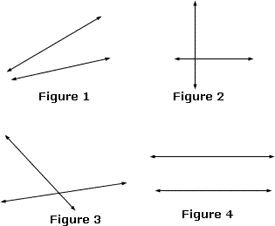
Which figure shows a set of perpendicular lines?
a)
Figure 1
b)
Figure 2
c)
Figure 3
d)
Figure 4
93.
Which figure shows a set of parallel lines?
a)
Figure 1
b)
Figure 2
c)
Figure 3
d)
Figure 4
94.

Which of the following lines goes through the point (0, 4) and is PARALLEL to y = 5x - 3?

a)

y=15x−3y=\frac{1}{5}x-3

b)

y=5x−7y=5x-7

c)

y=5x+4y=5x+4

d)

y=−5x−3y=-5x-3

95.

Write the equation of a line PERPENDICULAR to y = -1/3x + 5 and passes through the point (6,4)

a)

y=−13x+14y=-\frac{1}{3}x+14

b)

y=3x+22y=3x+22

c)

y=−13x−10y=-\frac{1}{3}x-10

d)

y=3x−14y=3x-14