
Font size
 Worksheets
West Africa Unit Test
Total questions: 35
Worksheet time: 49mins
Place the following in the correct categories.
First empire
Second empire
Third empire


Grew wealthy by TAXING traders
Led by Mansa Musa
Laws were based on Islam
Choose the 2 BEST answers for the following question.
How did natural resources and location allow for the growth of West African empires?
West Africa had many gold and salt deposits and both of those were in high demand for trade.
West Africa's location where the Sahara Desert meets the Niger River provides a place for trade.
Battles between Christians and Muslims brought new people and ideas to the region.
Traders along the Silk Road brought new minerals and resources to the area for trade.
Match the term with the definition.
existing in a land from the earliest times
indigenous
a person who was in someone's family in past times
ancestor
the belief that everything in nature has a spirit that can help or harm human needs
animism
a god or goddess, divine being
deities
a religious ceremony
ritual
A traditional African storyteller is called a (a) .
Place the empires in the correct order.
Ghana
Mali
Songhai
West Africa had three large trading empires. The first empire was the small kingdom of (a) . This empire grew wealthy through (b) .
Label the following places on the map.
Atlantic Ocean
Niger River
Sahara Desert
Gulf of Guinea

Which of the following is located at point 5?
Red Sea
Mediterranean Sea
Persian Gulf
Arabian Sea
Which of the following is located at point 6?
Red Sea
Mediterranean Sea
Persian Gulf
Arabian Sea
Place the city of TIMBUKTU in the correct location on the map.
Place the city of DJENNE in the correct location on the map.
Place the SAHARA DESERT in the correct location on the map.

According to the image, the two major trade goods in West Africa are (a)
According to the image, salt mines could be found in the city of (a)
Which West African city lies south of the Sahara Desert and at the northern point of the Niger River? (a)
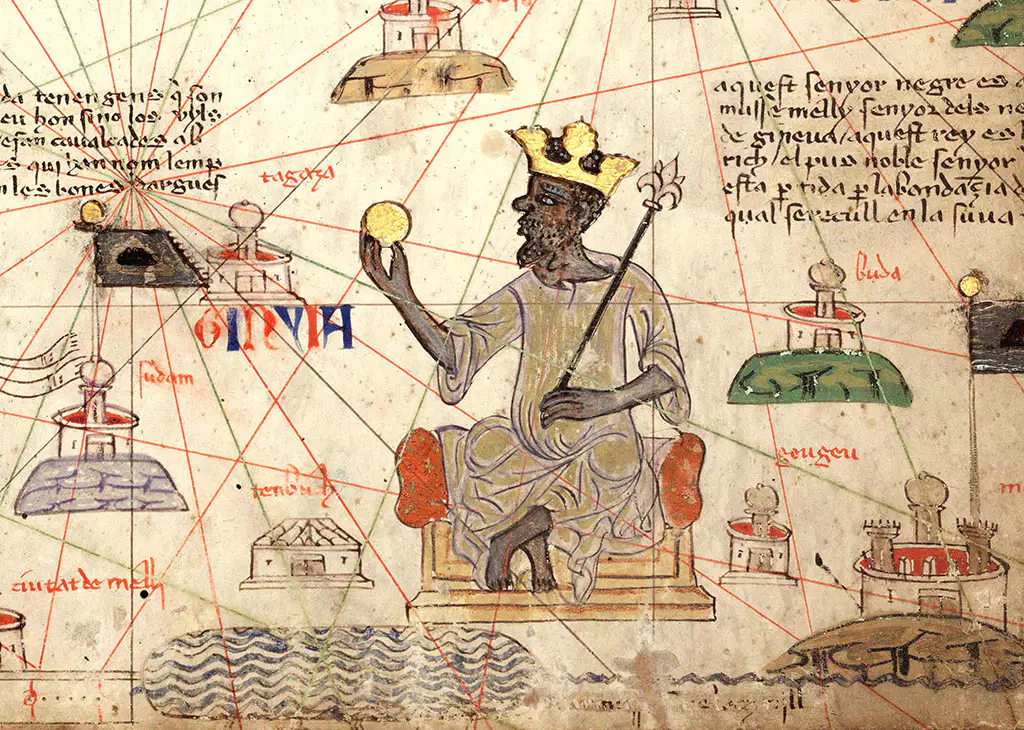
What impact did the map in the image have on the West African Empire of Mali?
What river supported trade in West Africa?
Niger
Nile
Yellow
Tigris

Which physical feature is located at point A?
Niger River
Sahara Desert
Mediterranean Sea
Red Sea

Which letter shows the location of the Gulf of Guinea?
A
B
C
D
Which letter shows the location of the Atlantic Ocean?
A
B
C
D
Why would salt be important to the people of West Africa?
It can be used to preserve meat.
When we sweat we lose salt from our bodies, which can cause dehydration.
Without enough salt in our diets, you could die.
All of these.
None of these.
What religion would be INDIGENOUS to Japan?
Shinto
Buddhism
Islam
Which trade route was the empire of Ghana in control of?
Silk Road
Mongol Route
Trans-Saharan
Gold-Silver Trade Route
Sundiata Keita of Mali
Occupation: King of Mali
Reign: 1235 to 1255
Born: 1217
Died: 1255
Best known for: Founder of the Mali Empire
Biography:
Sundiata Keita was the founder of theMali Empirein West Africa. He ruled from 1235 to 1255 CE and established the Mali Empire as the dominant power in the region.
Legend
Much of what we know about Sundiata, especially his childhood and how he came into power, comes from stories passed down orally through storytellers throughout the centuries. Although much of what we know about Sundiata is legend, he was a real king who really existed and established the Empire of Mali.
Growing Up
Sundiata was born around 1217 CE. His mother, Sogolon, was the second wife of King Maghan of Mali. Growing up, Sundiata was ridiculed as a cripple. He was weak and couldn't walk. However, King Maghan loved Sundiata and protected him. This made the king's first wife, Sassouma, jealous of Sundiata and his mother. She wanted her son, Touman, to be king someday.
When Sundiata was three, the king died. Sundiata's stepbrother, Touman, became king. Touman treated Sundiata poorly, making fun of him and picking on him constantly.
Growing Strong
When Sundiata was a child, Mali was a fairly small kingdom. While he was still a child, the Soso people captured Mali and took control. Sundiata became a captive of the Soso, living with the leader of the Soso. At the age of seven, Sundiata began to gain strength. He learned how to walk and exercised every day. In a few years, he transformed himself into a powerful warrior. He was determined to free Mali from the Soso and fled into exile.
Advertisement | Report Ad
Becoming a Leader
While in exile, Sundiata became famous as a feared warrior and hunter. After several years, he decided to return to Mali. The people of Mali were fed up with the high taxes of the Soso rulers and were ready to revolt. Sundiata gathered an army and began to fight against the Soso. He won several small victories until he finally met the king of the Soso on the battlefield. Sundiata defeated the Soso in what would later be known as the Battle of Kirina. Legend has it that Sundiata killed the Soso King, Sumanguru, with a poisoned arrow.
Emperor
After defeating the Soso at the Battle of Kirina, Sundiata marched on the Soso kingdom and took total control. He established the Mali Empire, conquering much of the Empire of Ghana as well. He took control of the gold and salt trade, helping Mali to become rich and powerful. Sundiata established the city of Niani as the capital of the empire. From Niani, he ruled for 20 years keeping peace in the region and expanding his empire.
Death
Sundiata died in 1255. There are different tales as to how he died. In one story, he died by drowning in a local river. In another, he was accidentally killed by an arrow during a celebration. His son, Mansa Wali, became king after his death.
Legacy
Sundiata's legacy lived on in the Mali Empire. The empire ruled much of Western Africa for the next several hundred years. The story of the legend of Sundiata is told throughout the world today. His story also inspired the Walt Disney film "The Lion King."
What was Sundiata Keita best known for?
Founder of the Mali Empire
King of Ghana
Leader of the Soso
Explorer of Africa
How did Sundiata Keita become a powerful warrior?
By exercising every day and learning to walk
By inheriting the throne from his father
By receiving training from the Soso
By being born into a warrior family
What significant battle did Sundiata Keita win to defeat the Soso?
Battle of Kirina
Battle of Niani
Battle of Mali
Battle of Sumanguru
Sundiata's story inspired the Walt Disney film "The (a) King."
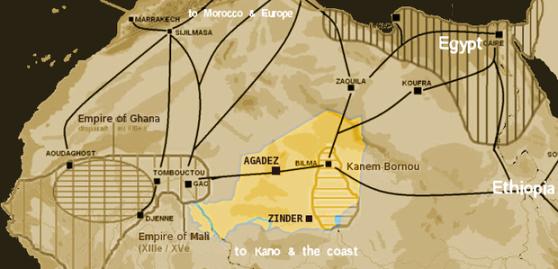
Ancient Africa
Trade Routes
The trade routes of Ancient Africa played an important role in the economy of many African Empires. Goods from Western and Central Africa were traded across trade routes to faraway places like Europe, the Middle East, and India.
What did they trade?
The main items traded were gold and salt. The gold mines of West Africa provided great wealth to West African Empires such as Ghana and Mali. Other items that were commonly traded included ivory, kola nuts, cloth, slaves, metal goods, and beads.
Major Trade Cities
As trade developed across Africa, major cities developed as centers for trade. In Western Africa the major trade centers were cities such as Timbuktu, Gao, Agadez, Sijilmasas, and Djenne. Along the coast of North Africa sea port cities developed such as Marrakesh, Tunis, and Cairo. The port city of Adulis on the Red Sea was also an important trade center.
Map of Medieval Saharan Trade by T L Miles
Routes Across the Sahara Desert
The major trade routes moved goods across the Sahara Desert between Western/Central Africa and the port trade centers along the Mediterranean Sea. One important trade route went from Timbuktu across the Sahara to Sijilmasa. Once the goods reached Sijilmasa they might be moved to many places including the port cities of Marrakesh or Tunis. Other trade routes included Gao to Tunis and Cairo to Agadez.
Advertisement | Report Ad
Caravans
Traders moved their goods across the Sahara in large groups called caravans.Camelswere the main mode of transportation and were used to carry goods and people. Sometimes slaves carried goods as well. Large caravans were important because they offered protection from bandits. A typical caravan would have around 1,000 camels with some caravans having over 10,000 camels.
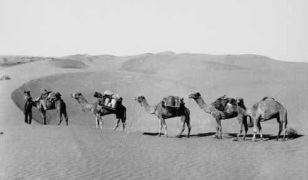
Caravan by Unknown
The Camel
The camel was the most important part of the caravan. Without the camel, trade across the Sahara would have been next to impossible. Camels are uniquely adapted to survive long periods without water. They also can survive large changes in body temperature allowing them to withstand the heat of the day and the cold of night in the desert.
History
Camels were first domesticated by the Berbers of North Africa around 300 CE. With the use of camels trade routes began to form between cities across the Sahara Desert. African trade reached its height, however, after the Arabs had conquered North Africa. Islamic traders entered the region and began to trade for gold and slaves from Western Africa. The trade routes remained an important part of the African economy throughout the Middle Ages until the 1500s.
Interesting Facts about the Trade Routes of Ancient Africa
Before a trip across the desert, camels would be fattened up to prepare for the journey.
The religion of Islam was spread throughout Western Africa through Muslim traders.
Islam helped to encourage trade because it lowered crime rates through Islamic law and also provided a common language (Arabic).
Muslim traders who lived in West Africa became known as the Dyula people and were part of the wealthy merchant caste.
Camels have a double row of eyelashes to protect their eyes from the sand and the sun. They can also close their nostrils to keep out the sand.
It took the typical caravan around 40 days to cross the Sahara Desert moving at around 3 miles per hour.
What were the main items traded in Ancient Africa?
Gold and salt
Spices and silk
Tea and porcelain
Silver and copper
Which city was a major trade center in Western Africa?
Timbuktu
Cairo
Marrakesh
Adulis
What was the primary mode of transportation for traders across the Sahara Desert?
Camels
Horses
Elephants
Donkeys
Who first domesticated camels for trade in North Africa?
Berbers
Arabs
Egyptians
Romans
How long did it typically take for a caravan to cross the Sahara Desert?
40 days
20 days
60 days
80 days
Choose the THREE best answers for the following question.
What impact did Mansa Musa's pilgrimage have on West Africa?
His journey showed off the wealth of Mali and increased trade with Europeans who wanted gold.
He brought back scholars from Arabia and turned Timbuktu into a center of education.
He gave away enough gold to decrease its value in certain parts of the world.
He conquered parts of Arabia and Northern Africa, establishing Mali as the largest empire in the world.
He was killed during his journey and his wealth was stolen.

Place the leaders with the correct empire.
None
Mansa Musa
Sundiata
Sunni Ali
Askia the Great
Match the details of Islam with the category.
Mohammed
Quran
Sunnah
monotheistic
Five Pillars
Faith
Prayer
Charity
Fasting
Pilgrimmage
(a) is the founder of Islam. It began in the city of (b) , which is located on the (c) Peninsula. Islam is a (d) religion. Their basic beliefs are the (e) , which are faith, prayer, fasting, charity and a pilgrimage to their holy city.
Match the following with their description.
The holy book of Islam
Quran
The founder of Islam
Mohammed
A follower of Islam
Muslim
The holy building of Islam
Mosque
The holy city of Islam
Mecca
Which religion spread along the Trans Saharan Trade Routes?
Buddhism
Christianity
Islam
Hinduism
Who was the leader of the Mali Empire that travelled to Mecca and was considered the richest man in history?
Julius Caesar
Mansa Musa
Lawrence of Arabia
Augustus Romulus
Why did Mansa Musa make a pilgrimage to Mecca?
For vacation
To go to a university there
Because he was Muslim
He was leading his people to war
Which empire was not located in West Africa?
Ghana
Mali
Songhai
Byzantine

