
 Worksheets
Personal Finance Quiz
Total questions: 45
Worksheet time: 23mins
Juan saved $1,000 from his summer job cleaning pools. Which of these account types would work best for him if he doesn't need access to the money for a number of years AND wants to earn the highest interest rate?
Regular savings account
Money Market account
Checking account
Certificate of Deposit
Which of the following is an effective strategy for personal saving?
Wait until the end of the month and save whatever is left in your checking account
Save a certain percentage of each paycheck and deposit it directly into a savings account
Cover all of your wants and needs and save whatever is left over
Take out a payday loan so you can save before you receive your paycheck
Joelle wants to have an emergency fund to cover 6 months of her expenses. Her monthly gross pay is $4,000 and her monthly expenses are $2,000. If she plans to save 10% of her gross pay each month, how long will it take her to build her emergency fund?
3 months
9 months
24 months
30 months
All of the following statements about bank accounts are true EXCEPT...
If the bank is FDIC-insured, your money, up to the FDIC limit, is safe even if the bank fails
Many banks pay interest on the money you deposit into your savings account
Historically, savings accounts earn higher returns than investments in the stock market
Money in a checking account is usually easy to access via ATM, debit card or check
All of the following are true about prepaid cards EXCEPT...
Prepaid cards typically include a lot of fees
Prepaid cards are a useful option for someone who is unbanked to make online purchases
Prepaid cards are a great way to build credit
Prepaid cards are usually accepted anywhere that debit and credit cards are accepted
You are developing a savings plan and using short-, medium-, and long-term goals to motivate you. Which represents possible goals from short-term to long-term? Save for...
Retirement, a house down payment, college tuition
A new cell phone, college tuition, a house down payment
A new cell phone, dinner with friends this weekend, a new bike
Retirement, college tuition, a vacation
Fill in the blanks with the correct responses. If you follow the 50-30-20 rule of budgeting, you'll be putting 50% of your monthly income toward ______________, 30% of your monthly income toward ______________, and 20% of your monthly income toward ______________.
Needs, wants, savings
Savings, needs, wants
Wants, savings, needs
Needs, savings, wants
Which represents the BEST time to start saving for your retirement?
As soon as you have your first full-time job
Right after you pay off your student loans
Once you are debt-free, including paying off all credit cards, auto loans, and your mortgage
At age 45, so you have exactly 20 years until retirement
Which of the following statements is TRUE?
The majority of Americans have an adequate emergency fund
The majority of Americans have sufficient amounts of money saved for retirement
The majority of Americans have an adequate emergency fund, but do NOT have sufficient amounts of money saved for retirement
The majority of Americans do NOT have an adequate emergency fund or sufficient amounts of money saved for retirement
Experts recommend that you accumulate enough to cover 3 to 6 _______________ of expenses in your emergency fund.
Months
Weeks
Days
Years
Which of these is a reason someone might choose to open an online savings account rather than a savings account at a traditional bank?
Online savings accounts are FDIC insured to a higher limit
Online savings accounts typically pay higher interest rates on deposits
Online savings accounts are less likely to make you the victim of identity theft
Online savings accounts are created specifically for people under age 25
Three of these statements best describe a checking account. Which statement best describes a savings account?
This account offers a convenient way to pay bills and access cash from an ATM
This account pays you interest on money you have put away for later to help your money grow
This account is automatically debited when you use a debit card
This account typically allows an unlimited number of transactions per month
You overhear your Aunt Tina tell your mom that she, her husband, and their kids are "living paycheck to paycheck." What does Aunt Tina mean by that?
Aunt Tina gets a paycheck one month, and her husband gets a paycheck the next month; they alternate pay periods
Aunt Tina and her family don't have any money saved, and their paychecks are just barely covering monthly expenses
Aunt Tina and her family have high paying jobs and don’t worry much about money
Aunt Tina only receives paper paychecks instead of direct deposit
You are at the checkout counter at the local supermarket and use your debit card to pay for your groceries. Where does the money for this purchase come from?
Your credit card company covers the cost
It is deducted directly from your checking account
Your credit card company provides you with a cash advance to cover the cost
It is deducted directly from your savings account
Fill in the blanks: If inflation is __________ your savings account interest rate then you will be __________ purchasing power.
Lower than, losing
Equal to, gaining
Higher than, losing
Higher than, gaining
Equal to, losing
Jocelyn gets a text alert from the bank that her account balance has dropped below $100 after a series of $20 ATM withdrawals. She has not used her ATM in over a week and wonders what she should do. What would you recommend?
Wait until her monthly statement arrives so she can check to see if those withdrawals are still there
Wait a week as it is fairly common for the bank to catch mistakes like this
Check her wallet to be sure her debit card has not been stolen. If she still has it, then she should not worry.
Contact her bank immediately as it appears that her account may have been hacked
Which of the following transactions will REDUCE your checking account balance immediately?
Writing your monthly rent check which you will mail tomorrow
Using your debit card to pay for groceries at the supermarket
Using your credit card to pay for your school books
Depositing a check at a local bank branch
Which of the following statements is an advantage of online banking?
Once you set up online banking, your bank will waive overdraft, ATM, and monthly fees
Using online banking allows you to earn a higher interest rate
Using online banking, you can request transfers, pay bills and automate your savings without visiting the bank branch
You can only shop online if your bank account has online banking features
FDIC Insurance is...
Optional coverage consumers can purchase so that their bank deposits remain safe
Insurance bank branches can buy to protect their business against fraud and scams
Required if you want to do online or mobile banking
Protection for bank customers’ deposits up to $250,000, guaranteeing their money is still available if the bank goes out of business
When signing up for a new checking account, you answer "Yes" to receive overdraft coverage. On this day, you have $10 in your account and go out and use your debit card to buy lunch for $12, a movie ticket for $12 and dinner for $15. What is likely to be the outcome resulting from these transactions?
Your account will be closed
You will likely be charged an overdraft fee for one or more of the transactions and also will need to repay the bank for the amount overdrawn
Since you requested overdraft coverage, the bank will not allow you to overdraw your account so your debit card will be denied
The bank will provide you five days to add funds to your account to cover the overdraft and no fees will be assessed
How often do customers typically receive a bank statement for their checking account?
Daily
Weekly
Monthly
Annually
When signing up for a new checking account you answer "No" and opt out of overdraft coverage. On this day, you have $10 in your account and go out and use your debit card to buy lunch for $12, a movie ticket for $12 and dinner for $15. What is likely to be the outcome resulting from these transactions?
Your account will be closed
You will likely be charged an overdraft fee for one or more of the transactions and also will need to repay the bank for the amount overdrawn
Since you declined overdraft coverage, the bank will not allow you to overdraw your account so your debit card will be denied
The bank will provide you five days to add funds to your account to cover the overdraft and no fees will be assessed
A person-to-person payment app could be used in each of the following scenarios EXCEPT...
Tina pays her neighbor $200 for breaking his window with a softball
Rafael writes a check to cover the entire month’s rent, and his roommates Valerie and Carlos pay Rafael for their share of the monthly rent
Ahmed’s soccer coach pays the team's registration fee for a big tournament, and each player then owes him $35 for their share of the registration fee
Mia pays Cheesy Pizza Co. for a pizza she orders on their website
Fill in the blanks: Direct deposit typically refers to your ______ sending your ______ electronically to your bank account.
employer, paycheck
friend, gift
bank, loan
customer, payment
All of the following are downsides of being unbanked EXCEPT:
Lack of access to credit
Lost time paying bills
Lack of fees associated with banks
Difficulty making cashless purchases
Provide one reason that it is important to start putting money away for retirement as early as possible.
To take advantage of compound interest
To avoid financial stress in later years
To ensure a comfortable retirement
To reduce tax liabilities
Melissa is a salaried employee who earns roughly the same amount in every paycheck. Why would it be a great idea for her to set up an automatic transfer every pay period into her savings account?
To ensure consistent savings
To avoid spending all her money
To earn interest on her savings
To meet her financial goals
Name two reasons why it is important to check your bank statements on a regular basis.
To detect unauthorized transactions
To track your spending habits
To increase your credit score
To avoid bank fees
Payroll cards are an alternative way for employers to pay employees when they don’t have a bank available for direct deposit. Which of the following is a pro of being paid by payroll cards?
Convenient access to funds without a bank account
High fees for transactions
Limited ATM access
Potential for loss or theft
Identify two fees that banks typically charge on a checking account and how you can avoid them.
Overdraft fees and monthly maintenance fees; avoid by keeping a minimum balance and opting out of overdraft protection.
ATM fees and paper statement fees; avoid by using in-network ATMs and opting for electronic statements.
Foreign transaction fees and account closure fees; avoid by using local currency and keeping the account open for a minimum period.
Wire transfer fees and check fees; avoid by using online transfers and electronic payments.
What is the 50/30/20 rule in budgeting?
50% needs, 30% wants, 20% savings
50% savings, 30% needs, 20% wants
50% wants, 30% savings, 20% needs
50% needs, 30% savings, 20% wants
What is an emergency fund?
Money set aside for unexpected expenses
Money saved for a vacation
Money invested in stocks
Money used for daily expenses
Which of the following is a good savings strategy?
Spend first, save what's left
Save a fixed percentage of your income
Save only when you have extra money
Save in a piggy bank
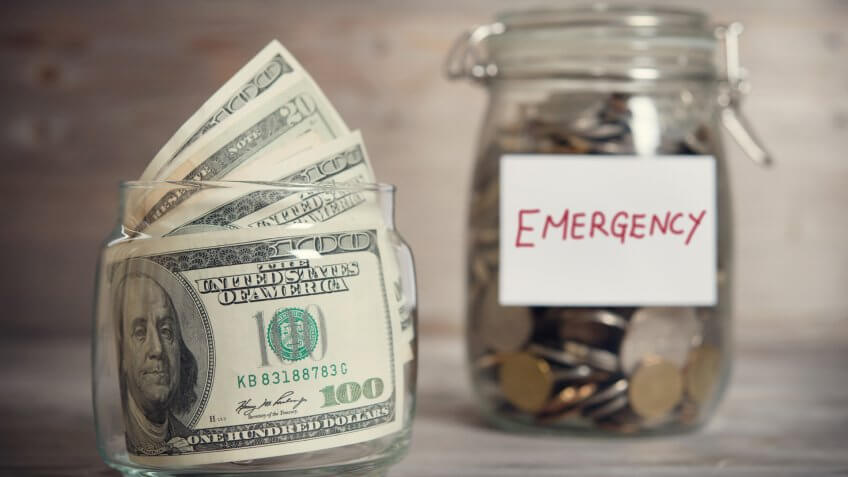
Which of the following is NOT true about emergency funds?
They are used for anything listed on the budget.
They can keep you from borrowing money from friends and family.
They help you prepare for unexpected expenses.
They help remove the worry about expenses not in the budget.
An emergency fund should NOT be used for…
fixing a blown tire on your car that you use to get to work.
repairing your laptop that you use for homework.
a last-minute school trip.
a sudden health issue that needs care.
Even though the United States is becoming a "cashless society", it is still important to have some cash at home because:
it is the best way to save for a large purchase
the money will increase in value overtime
the money can be used if ATM's become disabled during a disaster
It is a way to improve a person's credit score or net worth
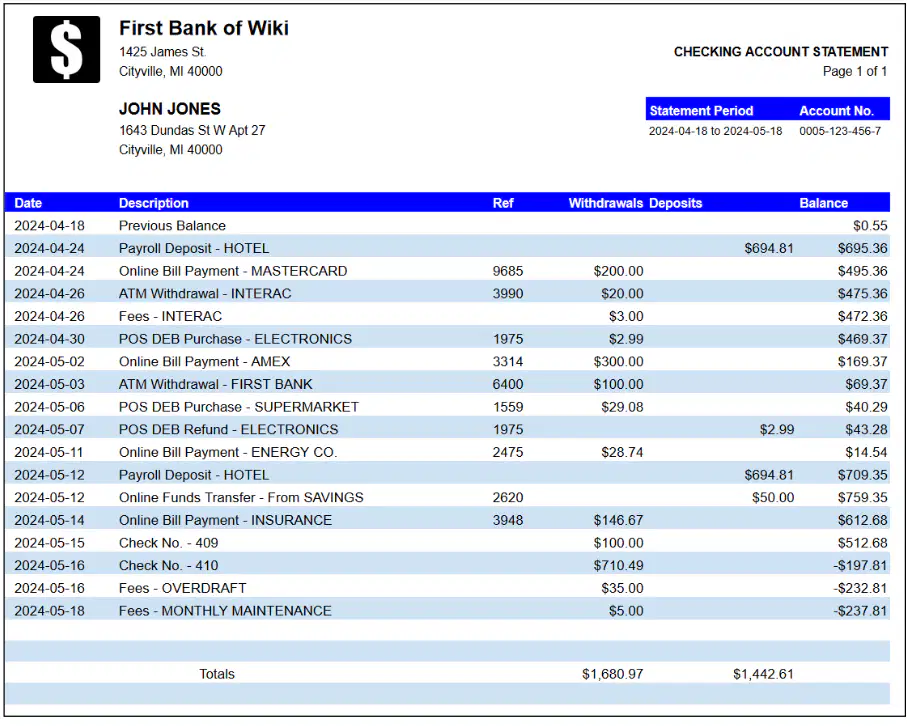
How frequently does John typically receive account statements from his bank?
Daily
Weekly
Monthly
Annually
How much did John Jones have in his account on the first day of the statement?
-$72.47
$0.55
$694.81
$1,442.62
Which transaction caused John to overdraw his account?
The Online Bill Payment for $146.67
Check No. 409 for $100
Check No. 410 for $710.49
The Overdraft Fee of $35
What was John's ending balance?
$1680.97
$1442.61
-$237.81
-$232.81
$0.00
Which savings account will earn you the least money?
One that compounds interest daily.
One that earns simple interest monthly.
One that earns simple interest daily.
One that compounds interest monthly.

