
 Worksheets
t-level year 1 unit 2.4 mechanical advantage
Total questions: 50
Worksheet time: 25mins
What is the relationship between mass and weight according to Newton's second law?
F = ma
W = ma
F = mg
W = ma²
What does the symbol 'g' represent in the equation W = mg?
Mass
Force
Gravity
Weight
On Earth, what is the approximate value of acceleration due to gravity?
9.81 m/s²
10.5 m/s²
8.9 m/s²
9.5 m/s²
In the equation F = ma, what does 'a' stand for?
Mass
Acceleration
Force
Weight
What is the formula for calculating work when force and distance are known?
work = force + distance
work = force × distance
work = force / distance
work = force - distance
Which unit is used to measure mechanical work?
Newton (N)
Joule (J)
Watt (W)
Calorie
What is the formula for work when mass, gravity, and distance are considered?
work = mass + gravity + distance
work = mass × gravity × distance
work = mass / gravity / distance
work = mass - gravity - distance
Which of the following units is used to measure electrical energy?
Calorie
BTU
Kilowatt hour (kWh)
Newton-metre (Nm)
What are the two main categories of energy?
Thermal energy and chemical energy
Kinetic energy and potential energy
Electrical energy and nuclear energy
Sound energy and light energy
What type of energy is described as the energy an object has due to its motion?
Potential energy
Thermal energy
Kinetic energy
Chemical energy
What type of energy is stored energy held by an object?
Kinetic energy
Potential energy
Electrical energy
Nuclear energy
What happens to potential energy when the input of kinetic energy ceases?
It disappears
It increases indefinitely
It tries to bring the mass back down to the ground
It transforms into thermal energy
What is the rate of doing work called?
Energy
Power
Force
Velocity
What is the unit of power?
Newton
Joule
Watt
Pascal
How is power calculated?
By multiplying work done by time
By dividing work done by time
By adding work done and time
By subtracting time from work done
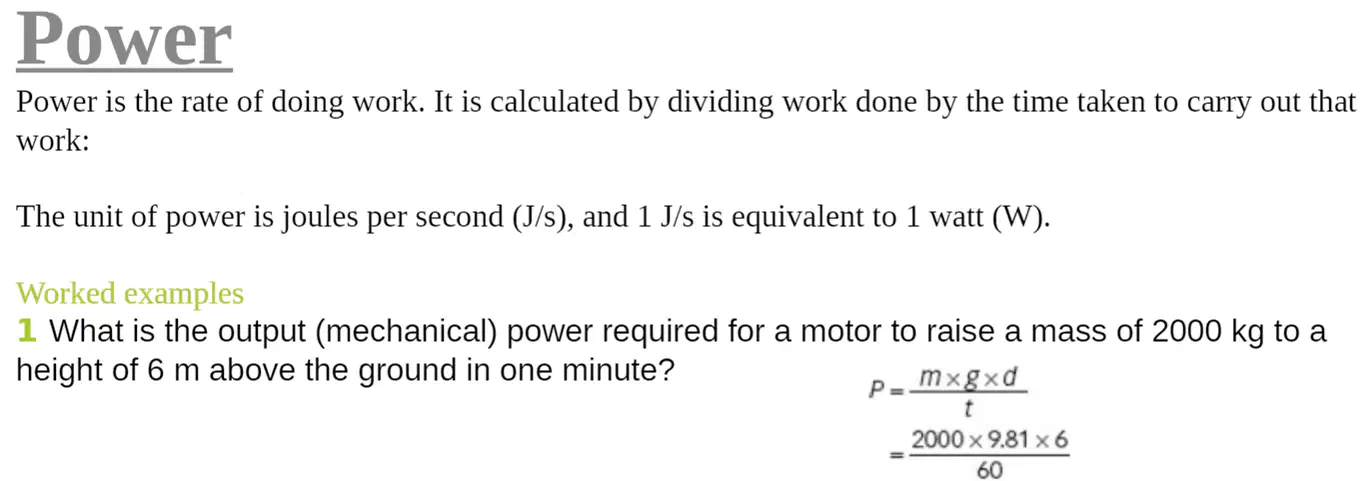
If a motor raises a mass of 2000 kg to a height of 6 m in one minute, what is the output power required?
1000 W
1500 W
1962 W
2500 W

If the same motor raises the same load in 10 seconds, what is the output power required?
5000 W
11772 W
8000 W
10000 W
What does the law of conservation of energy state?
Energy can be created and destroyed.
Energy can only be transformed from one form to another.
Energy is always lost in mechanical processes.
Energy is only used in mechanical systems.
How is the efficiency of a mechanical system calculated?
The product of input power and output power.
The ratio of useful output energy to total input energy.
The difference between total input energy and useful output energy.
The sum of useful output energy and total input energy.
What is a common form of energy loss in mechanical processes?
Light
Sound
Heat
Electricity
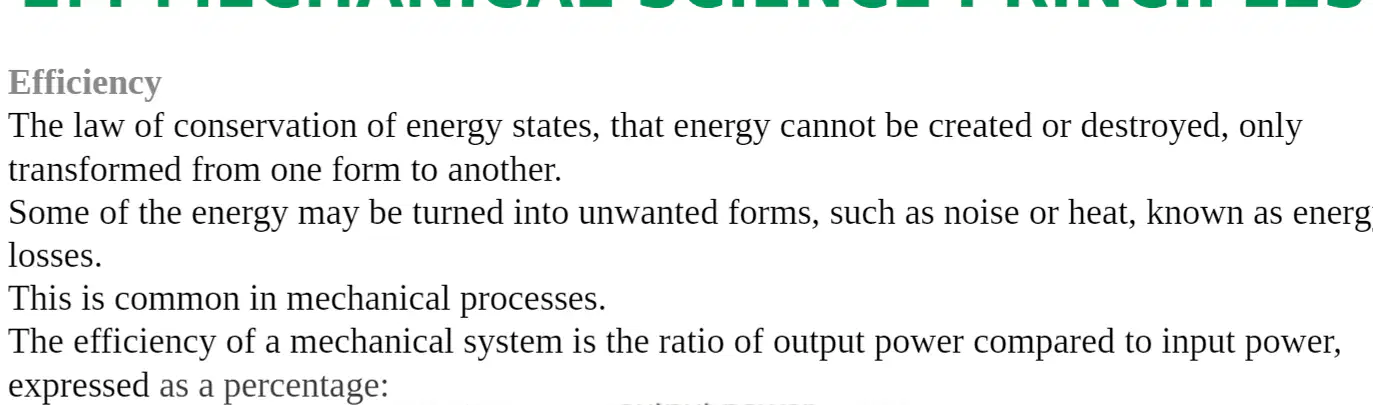
How is efficiency expressed in a mechanical system?
As a fraction
As a percentage
As a ratio
As a decimal
What is torque measured in?
Kilograms (kg)
Newton-metres (Nm)
Joules (J)
Watts (W)
What happens if there is too much torque applied to a bolt or screw?
It becomes more secure
It may break the thread or snap the object
It will not affect the object
It will make the object heavier
How is torque calculated?
M = force (F) + distance (D)
M = force (F) / distance (D)
M = force (F) × distance (D)
M = force (F) - distance (D)
According to the principle of action and reaction, what happens when your weight pushes down on the floor?
The floor moves away
The floor pushes up against you with an equal force
The floor absorbs the force
The floor does nothing
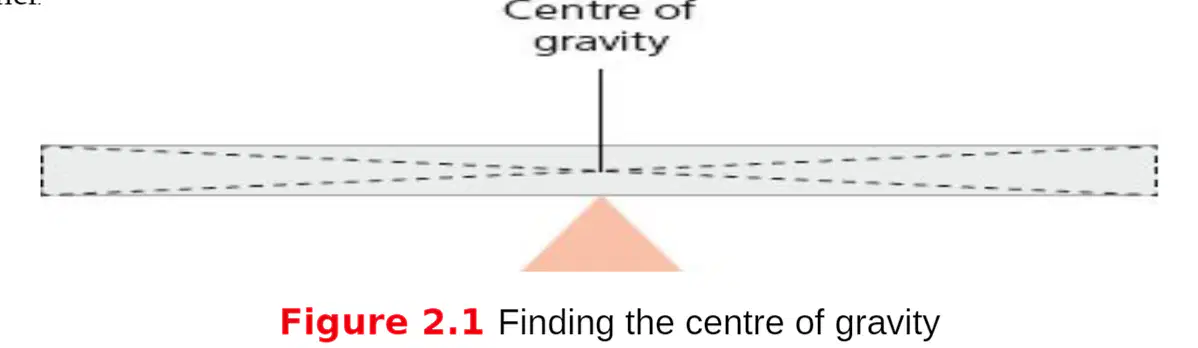
What happens to an object when a pivot is placed under its centre of gravity?
The object becomes unstable and falls.
The object remains balanced.
The object moves in a circular motion.
The object becomes heavier.
What is the centre of gravity?
The point where an object is heaviest.
The point where the weight of an object is concentrated.
The point where an object is lightest.
The point where an object is most colorful.
What is the state called when an object remains balanced with a pivot under its centre of gravity?
Instability
Equilibrium
Rotation
Acceleration
What should be done when lifting or manually handling objects to make them easier to carry?
Support them at the top.
Support them under the centre of gravity.
Support them at the sides.
Support them at the bottom.
What is velocity?
The speed of something in a given direction, measured in metres per second (m/s).
The distance traveled by an object.
The force applied to an object.
The energy used by an object.
What does the ratio express in mechanical science?
The relationship between two groups or amounts that expresses how much bigger one is than the other.
The speed of an object in a given direction.
The energy used by a lever.
The distance traveled by an object.
What is the advantage gained by a lever called?
Mechanical advantage (MA)
Torque
Velocity
Ratio
How is torque measured?
In newton-metres (Nm)
In metres per second (m/s)
In kilograms (kg)
In joules (J)
Which class of lever has the force and the load on different sides of the fulcrum?
Class 1
Class 2
Class 3
Class 4
What is an example of a Class 2 lever?
Pliers
Wheelbarrow
Fishing rod
Scissors
In a Class 3 lever, where is the force located?
Between the load and the fulcrum
On the opposite side of the fulcrum from the load
At the fulcrum
Above the load
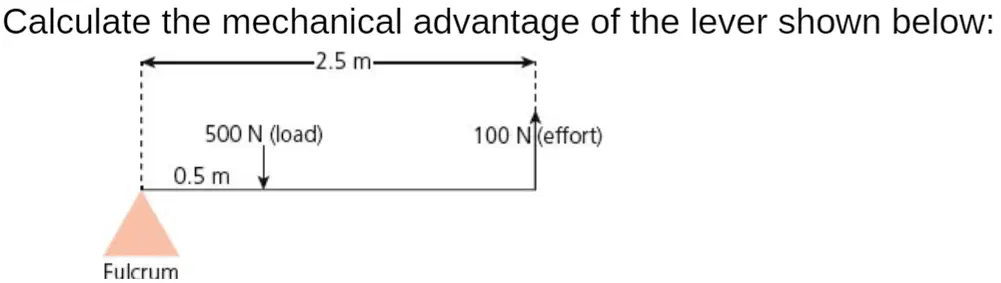
Calculate the mechanical advantage of the lever shown in the diagram.
5
2.5
0.5
10
Which class of lever has the force and the load on different sides of the fulcrum?
Class 1
Class 2
Class 3
Class 4
What is an example of a Class 2 lever?
Wheelbarrow
Pliers
Fishing rod
Scissors
In a Class 3 lever, where is the force located?
Between the load and the fulcrum
On the opposite side of the load
At the fulcrum
Above the load
Calculate the mechanical advantage of a lever with a load of 500 N and an effort of 100 N.
5
10
2
50
What is the mechanical advantage gained by using a four-pulley system?
2
3
4
5
How does a pulley provide a mechanical advantage?
By increasing the weight of the object
By reducing the force needed to lift an object
By increasing the speed of lifting
By decreasing the height of the lift
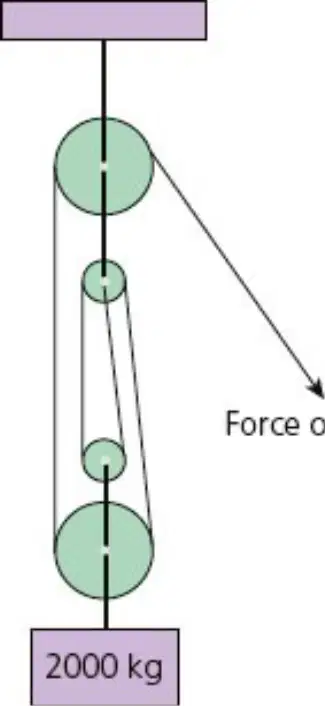
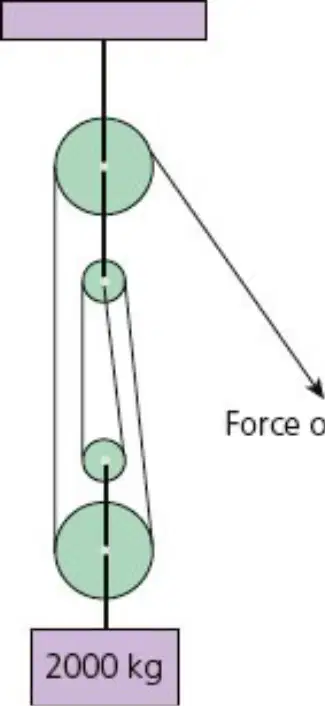
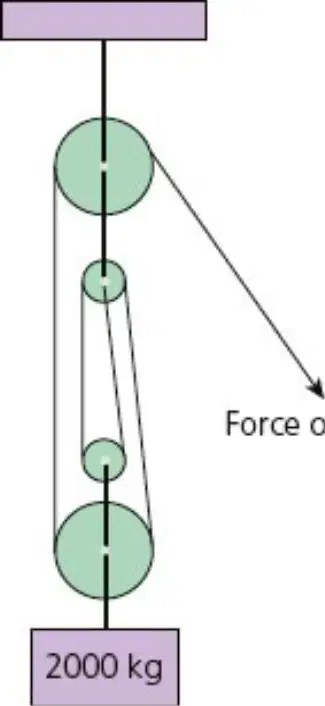
What is the force required to raise a mass of 2000 kg using the pulley system shown, given the acceleration due to gravity is 9.81 m/s²?
19,620 N
9,810 N
4,905 N
2,000 N
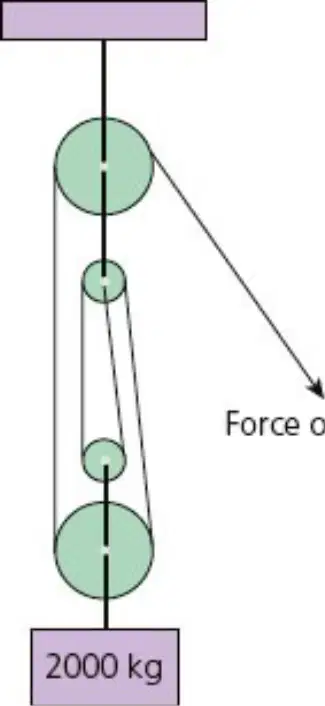
What is the mechanical advantage of the pulley system described?
4:1
2:1
3:1
5:1
How many Newtons need to be applied at the effort end of the pulley system, to lift 2000kg?
4,905 N
9,810 N
19,620 N
2,452 N
If a machine with a 250 kW output has an input power of 300 kW, what is the machine efficiency?
83.33%
75%
90%
100%
What is the primary function of a screw in mechanical systems?
To convert linear motion to rotational motion
To convert rotational motion to linear motion
To increase speed
To decrease friction
What are the helical grooves or ridges on a screw called?
Threads
Teeth
Ridges
Grooves
What is the primary function of a screw in mechanical science?
To convert linear motion to rotational motion
To convert rotational motion to linear motion
To convert electrical energy to mechanical energy
To convert thermal energy to mechanical energy

