
 Worksheets
Review Week 13 Quiz: - Bonding and Chemical Reactions
Total questions: 26
Worksheet time: 13mins
Name
Class
Date
1.
First Name
4 lines
2.
Last Name
4 lines
3.
Period
a)
1
b)
2
c)
3
d)
4
e)
5
4.
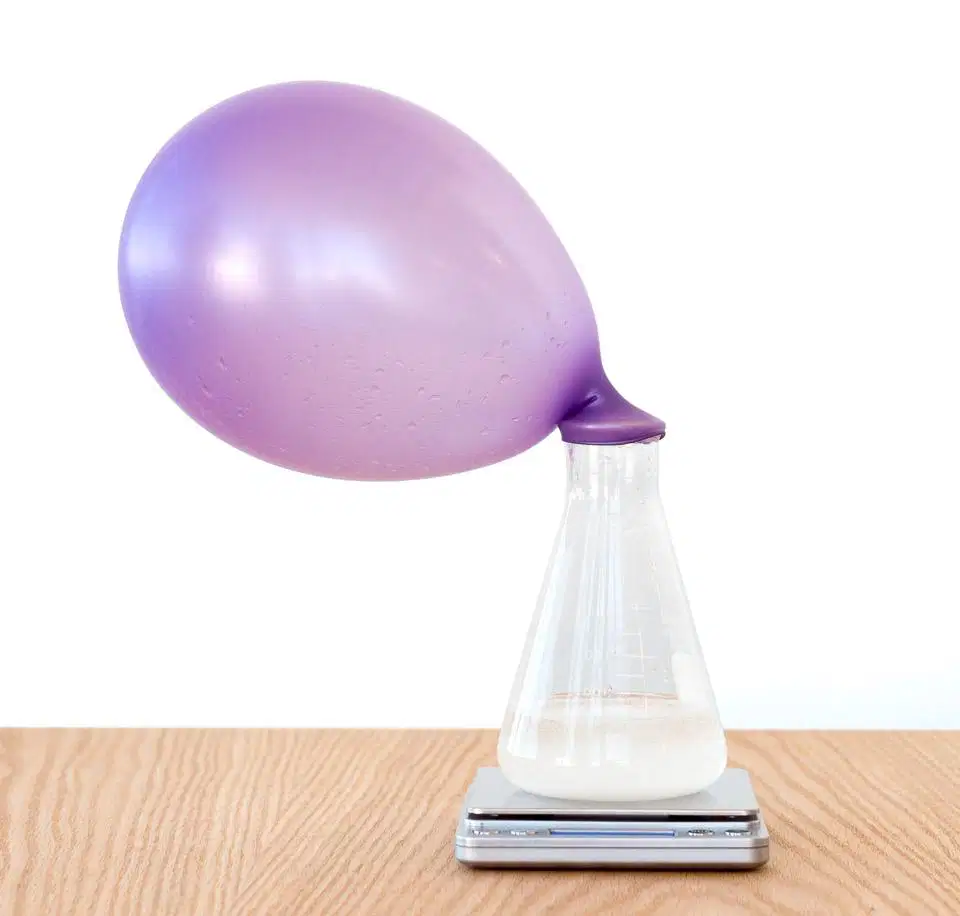
A student conducting an experiment reacted 50 grams of vinegar with 2 grams of baking soda in a flask covered by a balloon as shown. After the reaction was complete the student weighed the reaction and found it to weigh 50 grams.
Which of the following is true
a)
The reaction gained mass by forming new products
b)
The reaction maintained the law of conservation of mass
c)
The law of conservation of mass was invalid, the reaction lost mass by some of the gas escaping
5.
What is a limiting reactant?
a)
the reactant that determines how much product can be made
b)
the reactant that is in excess
c)
the amount of reactants that react with each other
d)
6.
Atoms are most stable when they have ________valence electrons in their outermost energy level
a)
6
b)
7
c)
8
d)
10
7.
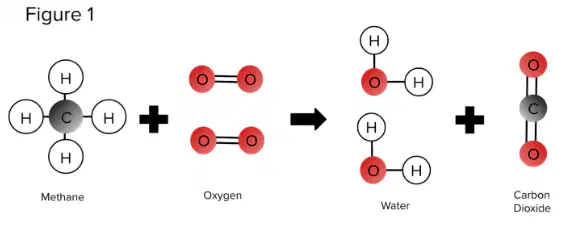
Based on the chemical reaction below, how many molecules of Oxygen (O2) react with 3 molecules of Methane (CH4)?
hint how many oxygen molecules do you need for one methane molecule?
a)
4
b)
8
c)
6
d)
2
8.
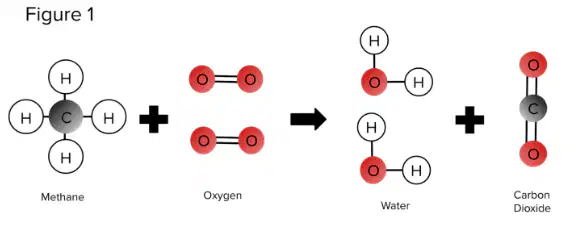
If the below reaction produces 180 grams of total products (CO2 and H2O), how many grams of O2 is reacting with 28 grams of methane (CH4).
a)
152 grams
b)
162 grams
c)
208 grams
9.

A student examined the reaction by changing the temperature of the reaction. The time it took for the reaction was recorded.
What is the relationship between temperature and the reaction rate?
a)
The reaction rate decreased as the temperature increased because particles move faster at higher temperatures.
b)
The increase in temperature of reactants caused more molecule collisions, which increased the reaction rate.
c)
The increase in temperature lowered the energy in the reaction, so the rate decreased as well.
10.

Which of the following could Oxygen bond with to have a complete octet?
a)
Carbon
b)
Magnesium
c)
Chlorine
d)
Sodium
11.

What type of reaction?
a)
Single Replacement
b)
Double Replacement
c)
Synthesis
d)
Decomposition
e)
Combustion
12.

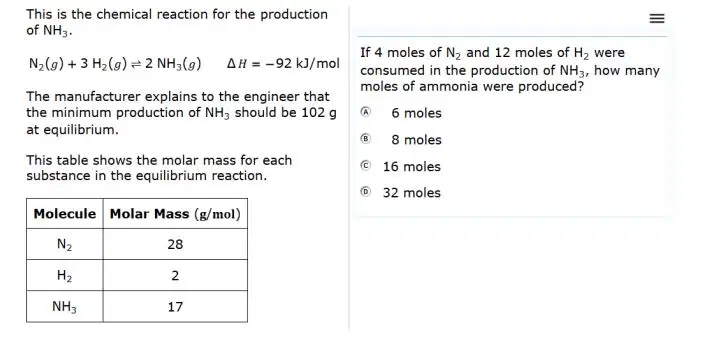
How many N2 are need to make 12 NH3?
a)
1 NH3
b)
3 NH3
c)
5 NH3
d)
6 NH3
13.
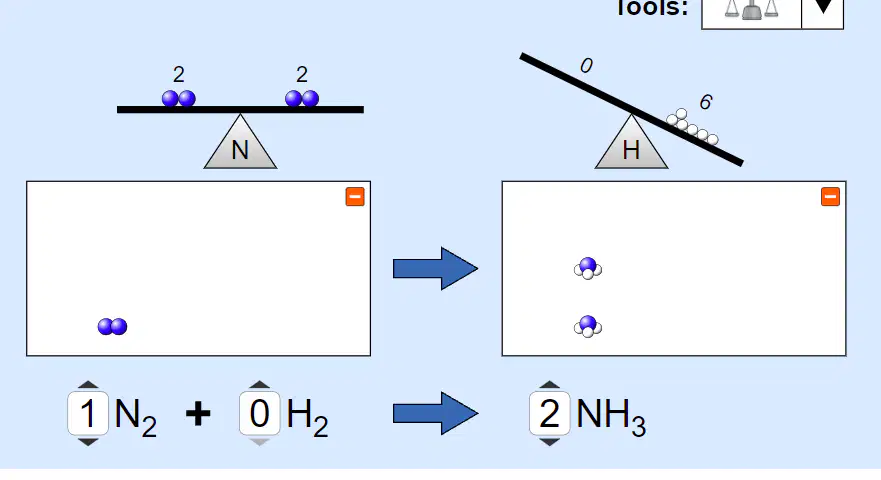
What number (coefficient) needs to go in front of the H2 to balance the equation?1
a)
1
b)
2
c)
3
d)
4
e)
5
14.
Chemical reactions are the rearrangement of atoms into new bonds
a)
True
b)
False
15.
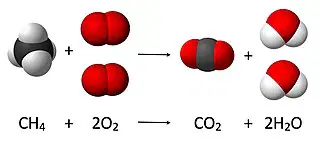
In a chemical reaction equation, the products are on the _________side of the arrow while the reactants are on the __________side
a)
Products are on the RIGHT side of the arrow and reactants the LEFT
b)
Products are on the LEFT side of the arrow and reactants the RIGHT
16.
According to the Law of Conservation of Mass, the products of a reaction can never have more mass than the reactants
a)
True
b)
False
17.
A reaction of alka seltzer produces sodium bicarbonates and carbon dioxide gas. 20.0 grams of alka seltzer reacted until no more carbon dioxide gas is given off. The remaining material has a mass of 6.0 g.
What mass of carbon dioxide gas was produced in the reaction?
a)
15.6 g
b)
4.4 g
c)
14.0 g
18.
Select all the ways you can increase the rate of a reaction (select 3)
a)
decrease temperature
b)
increase temperature
c)
increase concentration
d)
increase the surface area
e)
decrease concentration of reactants
19.
The reaction between lithium and chlorine is represented below.
2Li + F₂ --> 2LiF
Which statement best explains why this reaction can take place?
Hint ( Does this form an ionic bond or covalent bond)
a)
Lithium shares its outermost electron with Fluorine forming a positively charged compound.
b)
Fluorine can share some of its valence electrons with lithium, forming a covalent bond
c)
The valence electron of lithium are transferred to fluorine in an ionic bond, so both atoms have complete outermost energy levels
20.
Predict the products of the following reaction
MgCl₂ + NaOH --> _________
Hint(AB +CD --> AD + CB)
a)
MgNa and ClOH
b)
MgOH₂ and NaCl
c)
ClMg and OHNa
21.
What is the molar mass of one mole of N2 molecules ?
a)
14
b)
7
c)
28
22.
True or False: Water is a product of combustion
a)
True
b)
False
23.
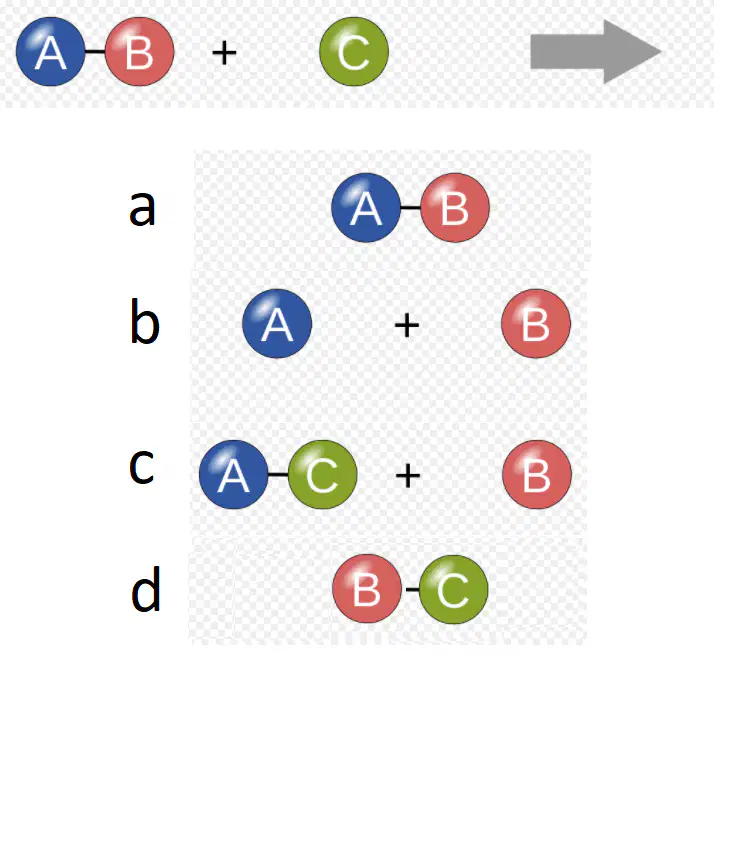
Predict the products of the following reaction
a)
a
b)
b
c)
c
d)
d
24.
Atoms form bonds to become more____________
a)
Ionic
b)
Stable
c)
Covalent
d)
reactive
25.
a)
A
b)
B
c)
C
d)
D
26.

A student studying the chemistry of the photosynthesis shown in the equation below:
What is the approximate total mass of the reactants, and how should it compare with the total mass of the products?
Approximate Masses of Atoms:
Carbon – 12 g/mol
Hydrogen – 1 g/mol
Oxygen – 16 g/mol
a)
62 g, which should be less than the total mass of the products
b)
62 g, which should equal the total mass of the products
c)
372 g, which should be less than the total mass of the products
d)
372 g, which should equal the total mass of the products
100 %

