
NEW
Font size
 Worksheets
Causes of Imperialism Study questions
Total questions: 10
Worksheet time: 5mins
Cause: Which of the following is an example of a social/cultural cause of imperialism?
The U.S. desired to build up its navy, establish naval bases around the globe, and compete with European nations for positions and power.
The U.S. wanted access to raw materials in other regions and to establish new trading markets around the world.
Many argued that the U.S. should expand across North America and eventually the globe because they believed that their race, country, language, and religion were superior and that it was their duty to “uplift” the peoples of the world.
Cause: Which of the following is an example of an economic cause of imperialism? Mark only one oval.
The U.S. desired to build up its navy, establish naval bases around the globe, and compete with European nations for positions and power.
The U.S. wanted access to raw materials in other regions and to establish new trading markets around the world.
Many argued that the U.S. should expand across North America and eventually the globe because they believed that their race, country, language, and religion were superior and that it was their duty to “uplift” the peoples of the world.
Course: ____________ is the policy of extending economic, political, or military control over weaker nations.
Expansion
Industrialization
Urbanization
Imperialism
Course: Which of the following was a major motivation for the annexation of Hawaii?
American businessmen wanted Hawaii to be annexed as part of the United States so that they would not have to pay tariffs on the sugar they produced.
Hawaii was rich in gold and rubber, which the United States wanted to export.
Hawaii had refused to allow the United States to build a naval base at Pearl Harbor.
American missionaries petitioned the U.S. government to annex Hawaii.
Course: Alaska was annexed by the United States following war with Russia in 1867, in which the U.S. supported the independence claims of the Native Alaskan inhabitants.
True
False
Effect: Which of the following was NOT an effect of the Spanish-American War? Mark only one oval.
Cuba became an independent nation.
Puerto Rico and Guam became U.S. territories.
The United States purchased and then annexed the Philippines from Spain.
The Philippines was granted its independence following the conflict.
Effect: The United States supported Panamanian revolutionaries in 1903 in their fight for independence from (blank), a country which had refused to allow the U.S. to build a canal at its narrowest point. As a result, the U.S. was granted the rights to build a canal through the newly established nation of Panama.
Columbia
Brazil
Mexico
Venezuela
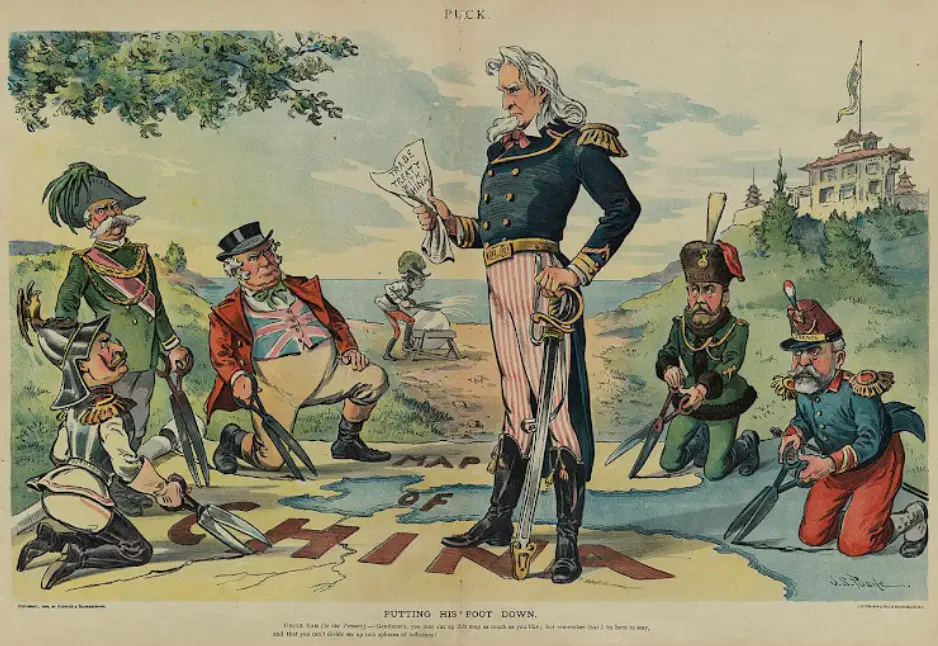
Source Analysis (Summary): What historical event is this political cartoon referencing?
The building of the Panama Canal
The Open Door Policy
The Spanish-American War
The Annexation of Hawaii
Four Worlds: Select the (W) world and (J) Justification which best matches the (E) explanation below. E = When the Hawaiian islands were formally annexed by the United States in 1898, the event marked the end of a lengthy internal struggle between native Hawaiians and non-native American businessmen for control of the Hawaiian government.
W = Political, J = Power
W = Economic, J = Trade
W = Social, J = Demographics
W = Culture, J = Respect for Authority
Source (Main idea and supporting details): Which of the following responses accurately describes the argument presented in this source? “Having therefore no foreign establishments, either colonial or military, the ships of war of the United States, in war, will be like land birds, unable to fly far from their own shores. To provide resting places for them, where they can coal and repair, would be one of the first duties of a government proposing to itself the development of the power of the nation at sea.” (Alfred T. Mahan)
The U.S. must acquire new naval bases around the world to compete with other nations on a global scale.
The U.S. must acquire new territories and colonies in order to expand its industrial economy.
The U.S. must acquire new territories and colonies in order to expand the reach of the white race, Christianity, the English language, and American culture.

