
 Worksheets
2.1 Ocean Basins Review
Total questions: 39
Worksheet time: 26mins
the deepest part of the ocean; long, narrow, steep-sided canyons are called?
Tectonic plates
Continental shelves
Trenches
What are mid-ocean ridges?
A chain of underwater waterfalls
A chain of underwater volcanos
A chain of underwater mountains
A chain of underwater rocks
The continental slope is located at the end of the...
Shoreline
Continental shelf
mid-ocean eidge
abyssal plain
Where is the shallowest part of the ocean floor?
continental slope
continental shelf
abyssal plains
What is the name of the flat land located on either side of the mid-ocean ridge?
continental slope
Continental shelf
abyssal plain
ocean basin
What is the measurement of the amount of dissolved salts in a liquid?
Density
Salinity
Volume
How are salts added to the ocean?
Precipitation
Land erosion
Evaporation
How much of earth's surface is covered by oceans?
71%
29%
53%
67%
The four main ocean basins are ________, _______, _______ and _________.
(a)
Which is the largest ocean?
Indian
Atlantic
Arctic
Pacific
Which ocean floor feature contains deposits of oil and natural gas?
The continental margin
The continental shelf
The continental slope
The continental rise
What is the longest topographic feature on Earth called?
The Andes Mountain range
The ring of fire
The mid ocean ridge
The Mariana trench
Which of the Earth's layers is broken into several large tectonic plates?
Crust
Lithosphere
Outer Core
Asthenosphere
Plates move apart at ___________ boundaries.
Convergent
Divergent
Transform
Magnetic
Convergent boundaries is when plates _____________.
slide past each other
collide
move apart from each other
Which scientist proposed the ideas that led to the development of the plate tectonics theory?
Charles Darwin
Albert Einstein
Alfred Wegener
Isaac Newton
Earth’s thick, plastic-like layer is the ___________.
asthenosphere
mid-ocean ridge
mantle
inner core

Which boundary best describes the picture?
divergent boundary
convergent ocean-ocean boundary
transform boundary

Which boundary best describes the picture?
convergent ocean-continent boundary
transform boundary
divergent boundary
Where are the youngest rocks in the ocean floor located?
volcanoes
basins
trenches
mid-ocean ridges
Where are oceanic plates pushed down into the upper mantle?
In the subduction zone
At strike-slip faults
At divergent boundaries

Which boundary best describes the picture?
divergent boundary
convergent ocean-continent boundary
transform boundary
convergent ocean-ocean boundary

The ___ is the continuous movement of water between the atmosphere and the earth's surface.
drainage basin
water cycle
continental shelf
An area where runoff drains into a river and its tributaries is a ___.
continental shelf
geyser
drainage basin
The part of a continent that extends under the ocean is a ___.
drainage basin
geyser
continental shelf
Each year the southern California area has about 10,000 earthquakes. Which of the following best describes why earthquakes are a common occurrence in California?
The two plates form a transform boundary because earthquakes are caused by plates
sliding past each other.
The two plates form a subductive boundary because earthquakes are caused by plates
sliding past each other.
The two plates form a transform boundary because earthquakes are caused by the Pacific plate subducting under the North American plate.
The two plates form a subductive boundary because earthquakes are caused by the
Pacific plate subducting under the North American plate.
A group of scientists are studying two tectonic plates. When they analyzed the data, they noticed that the two plates have been pushing against each other over the past ten years.
What option below describes what will most likely occur between the two plates?
The two plates will slowly subduct causing an earthquake.
The two plates will quickly diverge forming an ocean basin.
The plates will slowly converge causing a mountain to form.
The two plates will quickly transform causing the formation of a canyon.
The Earth's primitive atmosphere evolved from gases expelled from within the earth.
True
False
The coasts of the two continents looked like they fit together like two...
puzzle pieces
pieces of pizza
Jenga pieces
book shelves
What is the name Wegener gave to the big piece of land that held all of the continents together?
Pluto
The Continental Divide
Pangea
Mars
Did people believe Wegener's theory of Pangea at first?
Yes
No
Which word means our land slowly drifts like pieces of wood across the ocean?
Evolution
Continental Drift
Scientific Method
Floating
How many continents are there?
5
3
10
7
Was Wegener's original idea of Continental Drift correct?
Yes
No
The Great Rift Valley in Africa and the Mid-Ocean Ridge were all created by this boundary
Divergent
Convergent
Reform
Transform
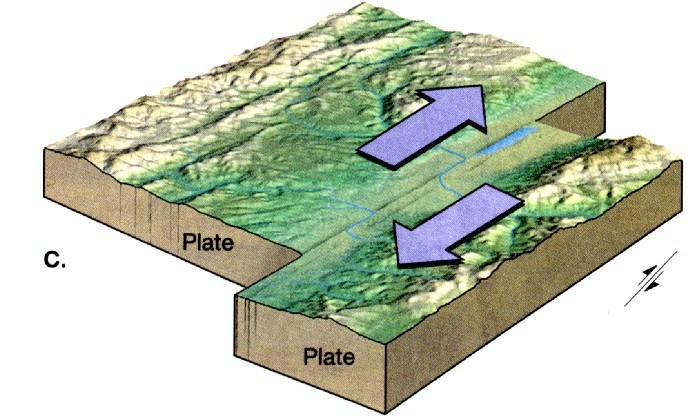
What type of plate boundary is this?
Transform
Convergent
Divergent
Plate

